Thank you for visiting SNEWPapers!
Sign up free
Literary
October 27, 1832
The Liberator
Boston, Suffolk County, Massachusetts
What is this article about?
A continued dialogue between 'Col.' and 'Anti.' debating the morality of slavery. Anti. argues against slaveholders' humanity, citing a 1721 petition by James Fosdick to reduce whipping of his slave Bristol and colonial Boston laws from 1661, 1721, 1723, and 1728 restricting slaves' rights and activities.
Clipping
OCR Quality
98%
Excellent
Full Text
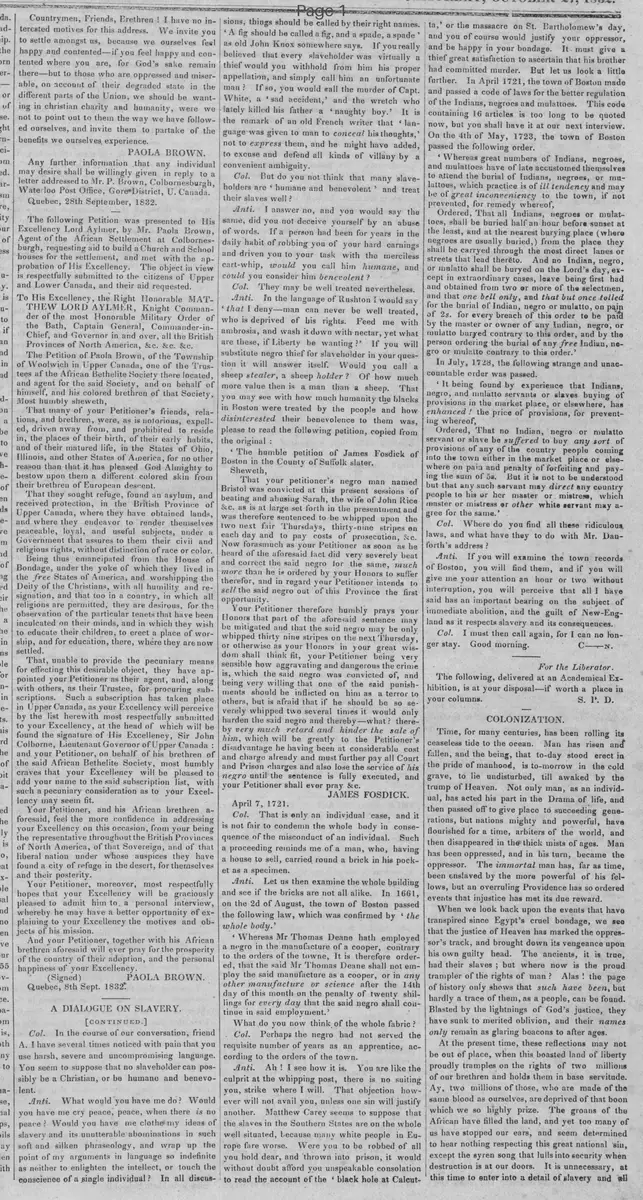
A DIALOGUE ON SLAVERY.
[CONTINUED.]
Col. In the course of our conversation, friend A. I have several times noticed with pain that you use harsh, severe and uncompromising language. You seem to suppose that no slaveholder can possibly be a Christian, or be humane and benevolent.
Anti. What would you have me do? Would you have me cry peace, peace, when there is no peace? Would you have me clothe my ideas of slavery and its unutterable abominations in such soft and silken phraseology, and wrap up the point of my arguments in language so indefinite as neither to enlighten the intellect, or touch the conscience of a single individual? In all discussions, things should be called by their right names. A fig should be called a fig, and a spade, a spade as old John Knox somewhere says. If you really believed that every slaveholder was virtually a thief would you withhold from him his proper appellation, and simply call him an unfortunate man? If so, you would call the murder of Capt. White, a 'sad accident,' and the wretch who lately killed his father a 'naughty boy.' It is the remark of an old French writer that language was given to man to conceal his thoughts, not to express them, and he might have added, to excuse and defend all kinds of villany by a convenient ambiguity.
Col. But do you not think that many slaveholders are 'humane and benevolent' and treat their slaves well?
Anti. I answer no, and you would say the same, did you not deceive yourself by an abuse of words. If a person had been for years in the daily habit of robbing you of your hard earnings and driven you to your task with the merciless cart-whip, would you call him humane, and could you consider him benevolent?
Col. They may be well treated nevertheless.
Anti. In the language of Rushton I would say 'that I deny—man can never be well treated, who is deprived of his rights. Feed me with ambrosia, and wash it down with nectar, yet what are these, if Liberty be wanting?' If you will substitute negro thief for slaveholder in your question it will answer itself. Would you call a sheep stealer, a sheep holder? Of how much more value then is a man than a sheep. That you may see with how much humanity the blacks in Boston were treated by the people and how disinterested their benevolence to them was, please to read the following petition, copied from the original:
The humble petition of James Fosdick of Boston in the County of Suffolk slater.
Sheweth,
That your petitioner's negro man named Bristol was convicted at this present sessions of beating and abusing Sarah, the wife of John Rice &c. as is at large set forth in the presentment and was therefore sentenced to be whipped upon the two next fair Thursdays, thirty-nine stripes on each day and to pay costs of prosecution, &c.
Now forasmuch as your Petitioner as soon as he heard of the aforesaid fact did very severely beat and correct the said negro for the same, much more than he is ordered by your Honors to suffer therefor, and in regard your Petitioner intends to sell the said negro out of this Province the first opportunity.
Your Petitioner therefore humbly prays your Honors that part of the aforesaid sentence may be mitigated and that the said negro may be only whipped thirty nine stripes on the next Thursday, or otherwise as your Honors in your great wisdom shall think fit, your Petitioner being very sensible how aggravating and dangerous the crime is, which the said negro was convicted of, and being very willing that one of the said punishments should be inflicted on him as a terror to others, but is afraid that if he should be so severely whipped two several times it would only harden the said negro and thereby very much retard and hinder the sale of him, which will be greatly to the Petitioner's disadvantage he having been at considerable cost and charge already and must further pay all Court and Prison charges and also lose the service of his negro until the sentence is fully executed, and your Petitioner shall ever pray &c.
JAMES FOSDICK.
April 7, 1721.
Col. That is only an individual case. and it is not fair to condemn the whole body in consequence of the misconduct of an individual. Such a proceeding reminds me of a man, who, having a house to sell, carried round a brick in his pocket as a specimen.
Anti. Let us then examine the whole building and see if the bricks are not all alike. In 1661, on the 2d of August, the town of Boston passed the following law, which was confirmed by the whole body.
Whereas Mr Thomas Deane hath employed a negro in the manufacture of a cooper, contrary to the orders of the towne, It is therefore ordered, that the said Mr Thomas Deane shall not employ the said manufacture as a cooper, or in any other manufacture or science after the 14th day of this month on the penalty of twenty shillings for every day that the said negro shall continue in said employment.'
What do you now think of the whole fabric?
Col. Perhaps the negro had not served the requisite number of years as an apprentice, according to the orders of the town.
Anti. Ah! I see how it is. You are like the culprit at the whipping post, there is no suiting you, strike where I will. That objection however will not avail you, unless one sin will justify another. Matthew Carey seems to suppose that the slaves in the Southern States are on the whole well situated, because many white people in Europe fare worse. Were you to be robbed of all you hold dear, and thrown into prison, it would without doubt afford you unspeakable consolation to read the account of the 'black hole at Calcutta,' or the massacre on St. Bartholomew's day, and you of course would justify your oppressor, and be happy in your bondage. It must give a thief great satisfaction to ascertain that his brother had committed murder. But let us look a little further. In April 1721, the town of Boston made and passed a code of laws for the better regulation of the Indians, negroes and mulattoes. This code containing 16 articles is too long to be quoted now, but you shall have it at our next interview. On the 4th of May, 1723, the town of Boston passed the following order.
'Whereas great numbers of Indians, negroes, and mulattoes have of late accustomed themselves to attend the burial of Indians, negroes, or mulattoes, which practice is of ill tendency and may be of great inconveniency to the town, if not prevented, for remedy whereof,
Ordered, That all Indians, negroes or mulattoes, shall be buried half an hour before sunset at the least, and at the nearest burying place (where negroes are usually buried,) from the place they shall be carryed through the most direct lanes or streets that lead thereto. And no Indian, negro, or mulatto shall be buryed on the Lord's day, except in extraordinary cases, leave being first had and obtained from two or more of the selectmen, and that one bell only, and that but once tolled for the burial of Indian, negro or mulatto, on pain of 2s. for every breach of this order to be paid by the master or owner of any Indian, negro, or mulatto buryed contrary to this order, and by the person ordering the burial of any free Indian, negro or mulatto contrary to this order.'
In July, 1728, the following strange and unaccountable order was passed.
'It being found by experience that Indians, negro, and mulatto servants or slaves buying of provisions in the market place, or elsewhere, has enhanced the price of provisions, for preventing whereof,
Ordered, That no Indian, negro or mulatto servant or slave be suffered to buy any sort of provisions of any of the country people coming into the town either in the market place or elsewhere on pain and penalty of forfeiting and paying the sum of 5s. But it is not to be understood but that any such servant may direct any country people to his or her master or mistress, which master or mistress or other white servant may agree for the same.'
Col. Where do you find all these ridiculous laws, and what have they to do with Mr. Danforth's address?
Anti. If you will examine the town records of Boston, you will find them, and if you will give me your attention an hour or two without interruption, you will perceive that all I have said has an important bearing on the subject of immediate abolition, and the guilt of New-England as it respects slavery and its consequences.
Col. I must then call again, for I can no longer stay. Good morning.
CONT.
[CONTINUED.]
Col. In the course of our conversation, friend A. I have several times noticed with pain that you use harsh, severe and uncompromising language. You seem to suppose that no slaveholder can possibly be a Christian, or be humane and benevolent.
Anti. What would you have me do? Would you have me cry peace, peace, when there is no peace? Would you have me clothe my ideas of slavery and its unutterable abominations in such soft and silken phraseology, and wrap up the point of my arguments in language so indefinite as neither to enlighten the intellect, or touch the conscience of a single individual? In all discussions, things should be called by their right names. A fig should be called a fig, and a spade, a spade as old John Knox somewhere says. If you really believed that every slaveholder was virtually a thief would you withhold from him his proper appellation, and simply call him an unfortunate man? If so, you would call the murder of Capt. White, a 'sad accident,' and the wretch who lately killed his father a 'naughty boy.' It is the remark of an old French writer that language was given to man to conceal his thoughts, not to express them, and he might have added, to excuse and defend all kinds of villany by a convenient ambiguity.
Col. But do you not think that many slaveholders are 'humane and benevolent' and treat their slaves well?
Anti. I answer no, and you would say the same, did you not deceive yourself by an abuse of words. If a person had been for years in the daily habit of robbing you of your hard earnings and driven you to your task with the merciless cart-whip, would you call him humane, and could you consider him benevolent?
Col. They may be well treated nevertheless.
Anti. In the language of Rushton I would say 'that I deny—man can never be well treated, who is deprived of his rights. Feed me with ambrosia, and wash it down with nectar, yet what are these, if Liberty be wanting?' If you will substitute negro thief for slaveholder in your question it will answer itself. Would you call a sheep stealer, a sheep holder? Of how much more value then is a man than a sheep. That you may see with how much humanity the blacks in Boston were treated by the people and how disinterested their benevolence to them was, please to read the following petition, copied from the original:
The humble petition of James Fosdick of Boston in the County of Suffolk slater.
Sheweth,
That your petitioner's negro man named Bristol was convicted at this present sessions of beating and abusing Sarah, the wife of John Rice &c. as is at large set forth in the presentment and was therefore sentenced to be whipped upon the two next fair Thursdays, thirty-nine stripes on each day and to pay costs of prosecution, &c.
Now forasmuch as your Petitioner as soon as he heard of the aforesaid fact did very severely beat and correct the said negro for the same, much more than he is ordered by your Honors to suffer therefor, and in regard your Petitioner intends to sell the said negro out of this Province the first opportunity.
Your Petitioner therefore humbly prays your Honors that part of the aforesaid sentence may be mitigated and that the said negro may be only whipped thirty nine stripes on the next Thursday, or otherwise as your Honors in your great wisdom shall think fit, your Petitioner being very sensible how aggravating and dangerous the crime is, which the said negro was convicted of, and being very willing that one of the said punishments should be inflicted on him as a terror to others, but is afraid that if he should be so severely whipped two several times it would only harden the said negro and thereby very much retard and hinder the sale of him, which will be greatly to the Petitioner's disadvantage he having been at considerable cost and charge already and must further pay all Court and Prison charges and also lose the service of his negro until the sentence is fully executed, and your Petitioner shall ever pray &c.
JAMES FOSDICK.
April 7, 1721.
Col. That is only an individual case. and it is not fair to condemn the whole body in consequence of the misconduct of an individual. Such a proceeding reminds me of a man, who, having a house to sell, carried round a brick in his pocket as a specimen.
Anti. Let us then examine the whole building and see if the bricks are not all alike. In 1661, on the 2d of August, the town of Boston passed the following law, which was confirmed by the whole body.
Whereas Mr Thomas Deane hath employed a negro in the manufacture of a cooper, contrary to the orders of the towne, It is therefore ordered, that the said Mr Thomas Deane shall not employ the said manufacture as a cooper, or in any other manufacture or science after the 14th day of this month on the penalty of twenty shillings for every day that the said negro shall continue in said employment.'
What do you now think of the whole fabric?
Col. Perhaps the negro had not served the requisite number of years as an apprentice, according to the orders of the town.
Anti. Ah! I see how it is. You are like the culprit at the whipping post, there is no suiting you, strike where I will. That objection however will not avail you, unless one sin will justify another. Matthew Carey seems to suppose that the slaves in the Southern States are on the whole well situated, because many white people in Europe fare worse. Were you to be robbed of all you hold dear, and thrown into prison, it would without doubt afford you unspeakable consolation to read the account of the 'black hole at Calcutta,' or the massacre on St. Bartholomew's day, and you of course would justify your oppressor, and be happy in your bondage. It must give a thief great satisfaction to ascertain that his brother had committed murder. But let us look a little further. In April 1721, the town of Boston made and passed a code of laws for the better regulation of the Indians, negroes and mulattoes. This code containing 16 articles is too long to be quoted now, but you shall have it at our next interview. On the 4th of May, 1723, the town of Boston passed the following order.
'Whereas great numbers of Indians, negroes, and mulattoes have of late accustomed themselves to attend the burial of Indians, negroes, or mulattoes, which practice is of ill tendency and may be of great inconveniency to the town, if not prevented, for remedy whereof,
Ordered, That all Indians, negroes or mulattoes, shall be buried half an hour before sunset at the least, and at the nearest burying place (where negroes are usually buried,) from the place they shall be carryed through the most direct lanes or streets that lead thereto. And no Indian, negro, or mulatto shall be buryed on the Lord's day, except in extraordinary cases, leave being first had and obtained from two or more of the selectmen, and that one bell only, and that but once tolled for the burial of Indian, negro or mulatto, on pain of 2s. for every breach of this order to be paid by the master or owner of any Indian, negro, or mulatto buryed contrary to this order, and by the person ordering the burial of any free Indian, negro or mulatto contrary to this order.'
In July, 1728, the following strange and unaccountable order was passed.
'It being found by experience that Indians, negro, and mulatto servants or slaves buying of provisions in the market place, or elsewhere, has enhanced the price of provisions, for preventing whereof,
Ordered, That no Indian, negro or mulatto servant or slave be suffered to buy any sort of provisions of any of the country people coming into the town either in the market place or elsewhere on pain and penalty of forfeiting and paying the sum of 5s. But it is not to be understood but that any such servant may direct any country people to his or her master or mistress, which master or mistress or other white servant may agree for the same.'
Col. Where do you find all these ridiculous laws, and what have they to do with Mr. Danforth's address?
Anti. If you will examine the town records of Boston, you will find them, and if you will give me your attention an hour or two without interruption, you will perceive that all I have said has an important bearing on the subject of immediate abolition, and the guilt of New-England as it respects slavery and its consequences.
Col. I must then call again, for I can no longer stay. Good morning.
CONT.
What sub-type of article is it?
Dialogue
Essay
What themes does it cover?
Slavery Abolition
Political
Moral Virtue
What keywords are associated?
Slavery Dialogue
Abolition Argument
Colonial Boston Laws
Slave Treatment
Humanity Critique
Historical Petition
Negro Rights
Literary Details
Title
A Dialogue On Slavery.
Key Lines
What Would You Have Me Do? Would You Have Me Cry Peace, Peace, When There Is No Peace?
In All Discussions, Things Should Be Called By Their Right Names. A Fig Should Be Called A Fig, And A Spade, A Spade As Old John Knox Somewhere Says.
Man Can Never Be Well Treated, Who Is Deprived Of His Rights. Feed Me With Ambrosia, And Wash It Down With Nectar, Yet What Are These, If Liberty Be Wanting?
Your Petitioner Therefore Humbly Prays Your Honors That Part Of The Aforesaid Sentence May Be Mitigated... But Is Afraid That If He Should Be So Severely Whipped Two Several Times It Would Only Harden The Said Negro And Thereby Very Much Retard And Hinder The Sale Of Him...
All I Have Said Has An Important Bearing On The Subject Of Immediate Abolition, And The Guilt Of New England As It Respects Slavery And Its Consequences.