Thank you for visiting SNEWPapers!
Sign up free
Gazette Of The United States
New York, New York County, New York
What is this article about?
Alexander Hamilton's Jan. 9, 1790, report to the House proposes duty collection on spirits, wines, teas, coffee; funding public debt via these revenues, post-office, and borrowing; sinking fund; state debt assumption by 1791. Emphasizes credit establishment.
Clipping
OCR Quality
Full Text
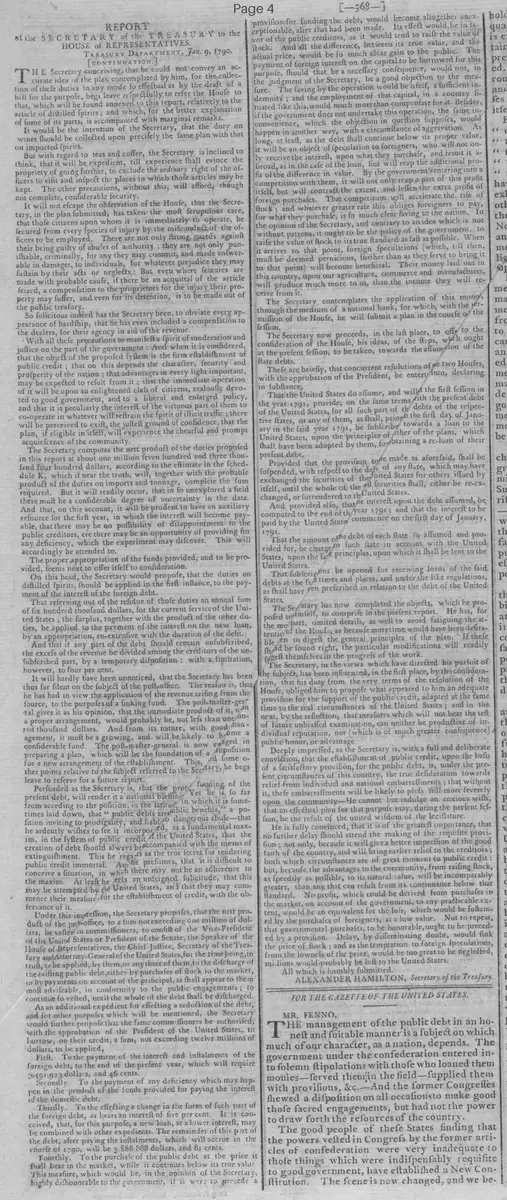
of the SECRETARY of the TREASURY to the
HOUSE of REPRESENTATIVES.
Treasury Department, Jan. 9, 1790.
THE Secretary conceiving, that he could not convey an accurate idea of the plan contemplated by him, for the collection of the duties on distilled spirits; and which, for the better explanation of some of its parts, is accompanied with marginal remarks.
It would be the intention of the Secretary, that the duty on wines should be collected upon precisely the same plan with that on imported spirits.
But with regard to teas and coffee, the Secretary is inclined to think, that it will be expedient, till experience shall evince the propriety of going further, to exclude the ordinary right of the officers to visit and inspect the places in which those articles may be kept. The other precautions, without this, will afford, though not complete, considerable security.
It will not escape the observation of the House, that the Secretary, in the plan submitted, has taken the most scrupulous care, that those citizens upon whom it is immediately to operate, be secured from every species of injury by the misconduct of the officers to be employed. There are not only strong guards against their being guilty of abuses of authority; they are not only punishable, criminally, for any they may commit, and made answerable in damages, to individuals, for whatever prejudice they may sustain by their acts or neglects: But even where seizures are made with probable cause, if there be an acquittal of the article seized, a compensation to the proprietors for the injury their property may suffer, and even for its detention, is to be made out of the public treasury.
So solicitous indeed has the Secretary been, to obviate every appearance of hardship, that he has even included a compensation to the dealers, for their agency in aid of the revenue.
With all these precautions to manifest a spirit of moderation and justice on the part of the government: And when it is considered, that the object of the proposed system is the firm establishment of public credit; that on this depends the character, security and prosperity of the nation; that advantages in every light important, may be expected to result from it; that the immediate operation of it will be upon an enlightened class of citizens, zealously devoted to good government, and to a liberal and enlarged policy, and that it is peculiarly the interest of the virtuous part of them to co-operate in whatever will restrain the spirit of illicit traffic; there will be perceived to exist, the justest ground of confidence, that the plan, if eligible in itself, will experience the cheerful and prompt acquiescence of the community.
The Secretary computes the net product of the duties proposed in this report at about one million seven hundred and three thousand four hundred dollars, according to the estimate in the schedule K, which if near the truth, will, together with the probable product of the duties on imports and tonnage, complete the sum required. But it will readily occur, that in so unexplored a field there must be a considerable degree of uncertainty in the data. And that, on this account, it will be prudent to have an auxiliary resource for the first year, in which the interest will become payable, that there may be no possibility of disappointment to the public creditors, ere there may be an opportunity of providing for any deficiency, which the experiment may discover. This will accordingly be attended to.
The proper appropriation of the funds provided, and to be provided, seems next to offer itself to consideration.
On this head, the Secretary would propose, that the duties on distilled spirits, should be applied in the first instance, to the payment of the interest of the foreign debt.
That reserving out of the residue of those duties an annual sum of six hundred thousand dollars, for the current service of the United States; the surplus, together with the product of the other duties, be applied to the payment of the interest on the new loan, by an appropriation, co-extensive with the duration of the debt.
And that if any part of the debt should remain unsubscribed, the excess of the revenue be divided among the creditors of the unsubscribed part, by a temporary disposition: with a limitation, however, to four per cent.
It will hardly have been unnoticed, that the Secretary has been thus far silent on the subject of the post-office. The reason is, that he has had in view the application of the revenue arising from that source, to the purposes of a sinking fund. The post-master-general gives it as his opinion, that the immediate product of it, upon a proper arrangement, would probably be, not less than one hundred thousand dollars. And from its nature, with good management, will likely become a considerable fund. The post-master-general is now engaged in preparing a plan, which will be the foundation of a disposition of this revenue to the purposes mentioned.
This arrangement the establishment.
On other points relative to the subject referred to the Secretary, he begs leave to reserve for a future report.
Persuaded as the Secretary is, that the proper funding of the present debt, will render it a national blessing.
Yet he is so far from acceding to the position, in the latitude in which it is sometimes laid down, that "public debts are public benefits," a position inviting to prodigality, and liable to dangerous abuse—that, in the system of public credit of the United States, that he ardently wishes to see incorporated as a fundamental maxim, that the creation of debt should always be accompanied with the means of extinguishment. This he regards as the true secret of rendering public credit immortal. And he presumes, that it is difficult to conceive a situation, in which there may not be an adherence to the maxim. At least he feels an unfeigned solicitude, that this may be attempted by the United States, and that they may commence their measures for the establishment of credit, with the observance of it.
Under this impression, the Secretary proposes, that the net proceeds of the post-office, to a sum not exceeding one million of dollars, be vested in commissioners, to consist of the Vice-President of the United States or President of the Senate, the Speaker of the House of Representatives, the Chief Justice, Secretary of the Treasury and Attorney-General of the United States, for the time being, in trust, to be applied, by them, or any three of them, to the discharge of the existing public debt, either by purchases of stock in the market, or by payments on account of the principal, as shall appear to them most advisable, in conformity to the public engagements; to continue so vested, until the whole of the debt shall be discharged.
As an additional expedient of effecting a reduction of the debt, and for other purposes which will be mentioned, the Secretary would further propose that the same commissioners be authorized, with the approbation of the President of the United States, to borrow, on their credit, a sum, not exceeding twelve millions of dollars, to be applied,
First. To the payment of the interest and installments of the foreign debt, to the end of the present year, which will require 3,491,923 dollars, and 46 cents.
Secondly. To the payment of any deficiency which may happen in the product of the funds provided for paying the interest of the domestic debt.
Thirdly. To the effecting a change in the form of such part of the foreign debt, as bears an interest of five per cent. It is conceived, that, for this purpose, a new loan, at a lower interest, may be combined with other expedients. The remainder of this part of the debt, after paying the installments, which will accrue in the course of 1790, will be 3,888,888 dollars, and 81 cents.
Fourthly. To the purchase of the public debt at the price it shall bear in the market, while it continues below its true value.
This measure, which would be, in the opinion of the Secretary, highly dishonorable to the government, if it were to precede a provision for funding the debt, would become altogether unexceptionable, after that had been made. Its effect would be in favor of the public creditors, as it would tend to raise the value of stock. And all the difference, between its true value, and the actual price, would be so much clear gain to the public. The payment of foreign interest on the capital to be borrowed for this purpose, should that be a necessary consequence, would not, in the judgment of the Secretary, be a good objection to the measure. The saving by the operation would be itself, a sufficient indemnity; and the employment of that capital, in a country situated like this, would much more than compensate for it. Besides, if the government does not undertake this operation, the same inconvenience, which the objection in question supposes, would happen in another way, with a circumstance of aggravation. As long, at least, as the debt shall continue below its proper value, it will be an object of speculation to foreigners, who will not only receive the interest, upon what they purchase, and remit it abroad, but will reap the additional profit of the difference in value. By the government's entering into a competition with them, it will not only reap a part of this profit itself, but will contract the extent, and lessen the extra profit of foreign purchases. That competition will accelerate the rise of stock; and whatever greater rate this obliges foreigners to pay, for what they purchase, is so much clear saving to the nation. In the opinion of the Secretary, and contrary to an idea which is not without patrons, it ought to be the policy of the government, to raise the value of stock to its true standard as fast as possible. When without patrons, it ought to be the policy of the government, to raise the value of stock to its true standard as fast as possible. When it arrives to that point, foreign speculations (which, till then, must be deemed pernicious, further than as they serve to bring it to that point) will become beneficial. Their money laid out in this country, upon our agriculture, commerce and manufactures, will produce much more to us, than the income they will receive from it.
The Secretary contemplates the application of this money, through the medium of a national bank, for which, with the permission of the House, he will submit a plan in the course of the session.
The Secretary now proceeds, in the last place, to offer to the consideration of the House, his ideas, of the steps, which ought at the present session, to be taken, towards the assumption of the state debts,
These are briefly, that concurrent resolutions of the two Houses, with the approbation of the President, be entered into, declaring in substance,
That the United States do assume, and will at the first session in the year 1791, provide, on the same terms with the present debt of the United States, for all such part of the debts of the respective states, or any of them, as shall, prior to the first day of January in the said year 1791, be subscribed towards a loan to the United States, upon the principles of either of the plans, which shall have been adopted by them, for obtaining a re-loan of their present debt.
Provided that the provision to be made as aforesaid, shall be suspended, with respect to the debt, of any state, which may have exchanged the securities of the United States for others issued by itself, until the whole of the said securities shall, either be re-exchanged, or surrendered to the United States.
And provided also, that no interest upon the debt assumed, be paid by the United States, computed to the end of the year 1791; and that the interest to be paid, commence on the first day of January, 1791.
That the amount of the debt of each state so assumed and provided for, be charged such state in account with the United States, upon the same principles, upon which it shall be lent to the United States.
That subscriptions be opened for receiving loans of the said state debts at the same times and places, and under the like regulations, as shall have been prescribed in relation to the debt of the United States.
The Secretary has now completed the objects, which he proposed to himself, to comprise in the present report. He has, for the most part, omitted details, as well to avoid fatiguing the attention of the House, as because more time would have been desirable to digest the general principles of the plan. If these shall be found right, the particular modifications will readily suggest themselves in the progress of the work.
The Secretary, in the views which have directed his pursuit of the subject, has been influenced, in the first place, by the consideration, that his duty from the very terms of the resolution of the House, obliged him to propose what appeared to him an adequate provision for the support of the public credit, adapted at the same time to the real circumstances of the United States; and in the next, by the reflection, that measures which will not bear the test of future unbiased examination, can neither be productive of individual reputation, nor (which is of much greater consequence) public honor, or advantage.
Deeply impressed, as the Secretary is, with a full and deliberate conviction, that the establishment of public credit, upon the basis of a satisfactory provision, for the public debt, is, under the present circumstances of this country, the true desideratum towards relief from individual and national embarrassments; that without it, these embarrassments will be likely to press still more severely upon the community—He cannot but indulge an anxious wish, that an effectual plan for that purpose may, during the present session, be the result of the united wisdom of the legislature.
He is fully convinced, that it is of the greatest importance, that no further delay should attend the making of the requisite provision; not only, because it will give a better impression of the good faith of the country, and will bring earlier relief to the creditors; both which circumstances are of great moment to public credit: but, because the advantages to the community, from raising stock, as speedily as possible, to its natural value, will be incomparably greater, than any that can result from its continuance below that standard. No profit, which could be derived from purchases in the market, on account of the government, to any practicable extent, would be an equivalent for the loss, which would be sustained by the purchases of foreigners, at a low value. Not to repeat, that governmental purchases, to be honorable, ought to be preceded by a provision. Delay, by disseminating doubt, would sink the price of stock; and as the temptation to foreign speculations, from the lowness of the price, would be too great to be neglected, millions would probably be lost to the United States.
All which is humbly submitted.
ALEXANDER HAMILTON,
Secretary of the Treasury.
What sub-type of article is it?
What keywords are associated?
What entities or persons were involved?
Where did it happen?
Domestic News Details
Primary Location
United States
Event Date
1790 01 09
Key Persons
Outcome
proposes funding public debt through duties on distilled spirits, wines, teas, coffee; applies post-office revenue to sinking fund; authorizes borrowing up to 12 million dollars for debt payments and purchases; suggests assumption of state debts by 1791.
Event Details
Secretary of the Treasury Alexander Hamilton submits a report to the House of Representatives outlining a plan for collecting duties on distilled spirits, wines, teas, and coffee with precautions against officer misconduct and compensation for dealers. Proposes allocating duties to pay foreign debt interest, domestic debt, and current services. Suggests using post-office revenue for a sinking fund managed by commissioners. Recommends borrowing via national bank for debt management and purchasing stock below value. Advocates assuming state debts subscribed by January 1791 on same terms as federal debt.