Thank you for visiting SNEWPapers!
Sign up free
The Wilmingtonian, And Delaware Advertiser
Wilmington, New Castle County, Delaware
What is this article about?
A collection of anecdotes from George Washington's presidency, drawn from Custis Recollections, detailing his public levees, private habits, interactions with Revolutionary War veterans, frugality, avoidance of pomp, and emotional reaction to St. Clair's defeat by Indians in 1791.
Merged-components note: Continuation of biographical narrative about General Washington across pages 1 and 2.
Clippings
1 of 2
OCR Quality
Full Text
His Life, Habits and Manners—Anecdotes.
From the Custis Recollections and Private Memoirs of Washington.
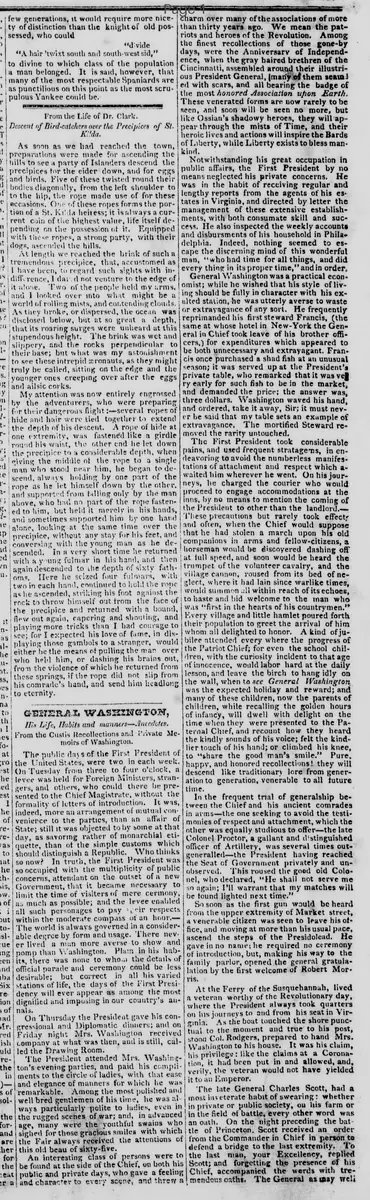
The public days of the First President of the United States, were two in each week. On Tuesday from three to four o'clock, a levee was held for Foreign Ministers, strangers, and others, who could there be presented to the Chief Magistrate, without the formality of letters of introduction. It was, indeed, more an arrangement of mutual convenience to the parties, than an affair of State; still it was objected to by some at that day, as savoring rather of monarchical etiquette, than of the simple customs which should distinguish a Republic. Who thinks so now? In truth, the First President was so occupied with the multiplicity of public concerns, attendant on the outset of a new Government, that it became necessary to limit the time of visitors of mere ceremony, as much as possible; and the levee enabled all such personages to pay their respects within the moderate compass of an hour.—The world is always governed in a considerable degree by form and usage. There never lived a man more averse to show and pomp than Washington. Plain in his habits, there was none to whom the details of official parade and ceremony could be less desirable; but correct in all his varied stations of life, the days of the First Presidency will ever appear as among the most dignified and imposing in our country's annals.
On Thursday the President gave his congressional and Diplomatic dinners; and on Friday night Mrs. Washington received company at what was then, and is still, called the Drawing Room. The President attended Mrs. Washington's evening parties, and paid his compliments to the circle of ladies, with that ease and elegance of manners for which he was remarkable. Among the most polished and well bred gentlemen of his time, he was always particularly polite to ladies, even in the rugged scenes of war; and, in advanced age, many were the youthful swains who sighed for those gracious smiles with which the Fair always received the attentions of this old beau of sixty-five.
An interesting class of persons were to be found at the side of the Chief, on both his public and private days, who gave a feeling and character to every scene, and threw a charm over many of the associations of more than thirty years ago. We mean the patriots and heroes of the Revolution. Among the finest recollections of those gone-by days, were the Anniversary of Independence, when the gray haired brethren of the Cincinnati, assembled around their illustrious President General, many of them seamed with scars, and all bearing the badge of the most honored Association upon Earth. These venerated forms are now rarely to be seen, and soon will be seen no more, but like Ossian's shadowy heroes, they will appear through the mists of Time, and their heroic lives and actions will inspire the Bards of Liberty, while Liberty exists to bless mankind.
Notwithstanding his great occupation in public affairs, the First President by no means neglected his private concerns. He was in the habit of receiving regular and lengthy reports from the agents of his estates in Virginia, and directed by letter the management of these extensive establishments, with both consummate skill and success. He also inspected the weekly accounts and disbursements of his household in Philadelphia. Indeed, nothing seemed to escape the discerning mind of this wonderful man, "who had time for all things, and did every thing in its proper time," and in order.
General Washington was a practical economist; while he wished that his style of living should be fully in character with his exalted station, he was utterly averse to waste or extravagance of any sort. He frequently reprimanded his first steward Francis, (the same at whose hotel in New-York the General in Chief took leave of his brother officers,) for expenditures which appeared to be both unnecessary and extravagant. Francis once purchased a shad fish at an unusual season; it was served up at the President's private table, who remarked that it was very early for such fish to be in the market, and demanded the price; the answer was, three dollars. Washington waved his hand, and ordered, take it away, Sir; it must never be said that my table sets an example of extravagance. The mortified Steward removed the rarity untouched.
The First President took considerable pains, and used frequent stratagems, in endeavoring to avoid the numberless manifestations of attachment and respect which awaited him wherever he went. On his journeys, he charged the courier who would proceed to engage accommodations at the inns, by no means to mention the coming of the President to other than the landlord.—These precautions but rarely took effect: and often, when the Chief would suppose that he had stolen a march upon his old companions in arms and fellow-citizens, a horseman would be discovered dashing off at full speed, and soon would be heard the trumpet of the volunteer cavalry, and the village cannon, roused from its bed of neglect, where it had lain since warlike times, would summon all within reach of its echoes, to haste and bid welcome to the man who was "first in the hearts of his countrymen."
Every village and little hamlet poured forth their population to greet the arrival of him whom all delighted to honor. A kind of jubilee attended everywhere the progress of the Patriot Chief; for even the school children, with the curiosity incident to that age of innocence, would labor hard at the daily lesson, and leave the birch to hang idly on the wall, when to see General Washington was the expected holiday and reward; and many of these children, now the parents of children, while recalling the golden hours of infancy, will dwell with delight on the time when they were presented to the Paternal Chief, and recount how they heard the kindly sounds of his voice; felt the kinder touch of his hand; or climbed his knee, to "share the good man's smile." Pure, happy, and honored recollections! they will descend like traditionary lore from generation to generation, venerable to all future time.
In the frequent trial of generalship between the Chief and his ancient comrades in arms—the one seeking to avoid the testimonies of respect and attachment, which the other was equally studious to offer—the late Colonel Proctor, a gallant and distinguished officer of Artillery, was several times out-generalled—the President having reached the Seat of Government privately and unobserved. This roused the good old Colonel, who declared, "He shall not serve me so again; I'll warrant that my matches will be found lighted next time."
So soon as the first gun would be heard from the upper extremity of Market street, a venerable citizen was seen to leave his office, and moving at more than his usual pace, ascend the steps of the President's lead. He gave in no name; he required no ceremony of introduction, but, making his way to the family parlor, opened the general gratulation by the first welcome of Robert Morris.
At the Ferry of the Susquehannah, lived a veteran worthy of the Revolutionary day, where the President always took quarters on his journeys to and from his seat in Virginia. As the boat touched the shore punctual to the moment and true to his post, stood Col. Rodgers, prepared to hand Mrs. Washington to his house. It was his claim, his privilege: like the claims at a Coronation, it had been put in and allowed, and, verily, the veteran would not have yielded it to an Emperor.
The late General Charles Scott, had a most inveterate habit of swearing: whether in private or public society, on his farm or in the field of battle, every other word was an oath. On the night preceding the battle of Princeton, Scott received an order from the Commander in Chief in person to defend a bridge to the last extremity. "To the last man, your Excellency," replied Scott; and forgetting the presence of his Chief, accompanied the words with tremendous oaths. The General was well...
be supposed, had but little time, on that eventful evening to notice or chide this want of decorum in his brave and well-tried soldier. After the war, a friend of the gallant's General's anxious to reform his evil habit, asked him, whether it was possible that the man so much beloved, the admired Washington, ever swore? Scott reflected for a moment, and then exclaimed, "Yes. once. It was at Monmouth, on a day that would have made any man swear. Yes, sir, he swore on that day, till the leaves shook on the trees: charming, delightful. Never have I enjoyed such swearing before, or since. Sir, on that ever memorable day he swore like an Angel from Heaven." The reformer abandoned the General in despair.
In the First Presidency, the door of the President's gathered but little rust on its hinges, while often was its latch lifted by the "broken soldier." Scarce a day passed that some veteran of the heroic time did not present himself at Head Quarters. The most tattered of these types of the days of privation and trial was "kindly bid to stay." was offered refreshment, and a glass of something to their old General's health, and then dismissed with lighter hearts and heavier pouches. So passed the many, but not so with one of Erin's sons. It was about the hour of the Tuesday levee, when German John, the porter, opened to an hearty rap; expecting to admit at least a dignitary of the land or foreign ambassador, when who should march into the hall but an old fellow, whose weather countenanced, and well worn apparel, shewed him to be "no carpet knight." His introduction was short but to the purpose. He had come to Head Quarters, to see his honor's excellency, God bless him. He was an old soldier.
In vain the porter assured him that it would be impossible to see the President at that time; a great company was momentarily expected—the hall was not a fitting place—would he go the steward's apartment and get something to drink? To all which Pat replied that he was in no hurry; that he would wait his honor's leisure; and taking a chair composed himself comfortably. And now passed Ministers of State, and foreign Ministers, Senators, Judges; the great and gay; meanwhile, poor Pat stoutly maintained his post, gazing on the crowd, till the levee having ended, and the President about to retire to his library, he was informed that an obstinate Irishman had taken possession of the hall, and would be satisfied with nothing short of an interview with the President himself. The Chief good-naturedly turned into the hall. So soon as the veteran saw his old commander, he roared out: "Long life to your honor's excellency," at the same time hurling his hat to the ground and erecting himself with military precision.
"Your honor will not remember me; though many is the day that I have marched under your orders, and many's the hard knocks I've had, too. I belonged to Wayne's brigade—Mad Antony, the British called him, and by the powers, he was always mad enough for them. I was wounded in the battle of Germantown. Hurra for America—and it does my heart good to see your honor; and how is the dear lady and all the little ones?" Here the usually grave temperament of Washington gave way, and with a smile he replied, that he was well, as was Mrs. Washington, but they were unfortunate in having no children; then pressing a token into the soldier's hand, he ascended the stair case to his library. The Irishman followed with his eyes the retiring General, then looking again and again upon the token which he had received from his honor's own hand, pocketed it, recovered his hat, which he placed with military exactness a little on one side, then took up his line of march, and as he passed the porter, called out, "there now you Hessian fellow! see that his honor's excellence has not forgotten an old soldier."
These anecdotes, though simple in themselves, possess no common character. They are Tales of the Days of Washington, and Tales of the Heart. We proceed to something of a graver sort.
The President was dining, when an officer arrived from the Western Army with despatches, his orders requiring that he should deliver them only to the Commander in Chief. The President retired but soon reappeared, bearing in his hand an opened letter. No change was perceptible in his countenance, as addressing the company he observed that the army of St. Clair had been surprised by the Indians, and was cut to pieces. The company soon after retired. The President repaired to his private parlor, attended by Mr. Lear, his principal Secretary, and a scene ensued of which our pen can give but a feeble description.
The Chief paced the room in hurried strides. In his agony, he struck his clenched hands with fearful force against his forehead, and in a paroxysm of anguish exclaimed: "That brave army, so officered—Butler, Ferguson, Kirkwood—such officers are not to be replaced in a day—that brave army cut to pieces, O God!" Then turning to the Secretary, who stood amazed at a spectacle so unique, as Washington in all his terrors, he continued: "It was here, sir, in this very room, that I conversed with St. Clair on the very eve of his departure for the West. I remarked, I shall not interfere, General, with the orders of General Knox and the War Department; they are sufficiently comprehensive and judicious; but as an old soldier, as one whose early life was particularly engaged in Indian warfare, I feel myself competent to counsel: General St. Clair, in three words, beware of surprise; trust not the Indian; leave not your arms for a moment; and, when you halt for the night, be sure to fortify your camp; again and again, General, beware of surprise. And yet, that brave army surprised, and cut to pieces, with Butler, and a host of others slain, Oh, God!" Here the struggle ended, as with mighty efforts the hero chained down the rebellious giant of passion, and Washington became "himself again." In a subdued tone of voice he proceeded: "But he shall have justice; yes, long, faithful, and meritorious services have their claim—I repeat it they shall have justice."
Thus concluded a scene as remarkable as rare. It served to display this great man as nature had made him, with passions fierce and impetuous, which like the tornado of the tropics, would burst for a while in awful grandeur, and then show, in higher relief, a serene and brilliant sky.
The first interview of the President with St. Clair, after the fatal 4th of November, was nobly impressive. The unfortunate general, worn down by age, disease, and the hardships of a frontier campaign, assailed by the press, and with the current of popular opinion setting hard against him, repaired to his Chief, as to a shelter from the fury of so many elements. Washington extended his hand to one who appeared in no new character: for during the whole of a long life, misfortune seemed "to have marked him for her own." Poor old St. Clair hobbled up to his Chief, seized the offered hand in both of his, and gave vent to his feelings in an audible manner. He was subsequently tried by a commission of Government and proved to have been unfortunate.
The means by which the Commander in Chief obtained secret intelligence from the enemy during the War of the Revolution, and more especially from New-York, the focus of Royal dominion, was a matter of deep speculation to many even of the General Staff. It would have probably continued to be an affair of surmise only but for an accident. Soon after the termination of hostilities, Gen. Washington, attended by two or three favorite officers, repaired to the store of ---, in New-York, for the avowed purpose of looking at some books. On entering the store, the General asked if the books which he had bespoken were ready. "Will your excellency be pleased to walk into this room," replied the ---, leading the way, "everything is ready." The door was but imperfectly closed, and the officers distinctly heard in succession the chinking of two heavy purses of gold, as they were placed on a table. The General soon returned, --- assuring him that he should be most happy (as heretofore) at all times, to execute his orders. The officers became convinced that it was --- the King's official, who had been in the secret service of the Commander in Chief of the American Army during nearly the whole of the war of the Revolution.
What sub-type of article is it?
What themes does it cover?
What keywords are associated?
What entities or persons were involved?
Where did it happen?
Story Details
Key Persons
Location
Philadelphia, Virginia, New York
Event Date
First Presidency (1789 1797), With References To Revolutionary War (1775 1783) And St. Clair's Defeat On November 4, 1791
Story Details
A series of anecdotes from Washington's presidency illustrating his dignified public routines like levees and dinners, frugality in rejecting an expensive fish, kindness to Revolutionary veterans including an Irish soldier and interactions with figures like Scott and Rodgers, efforts to avoid public adulation, emotional anguish over St. Clair's army defeat by Indians despite prior warnings, commitment to justice for St. Clair, and revelation of a secret intelligence source in New York during the Revolution.