Thank you for visiting SNEWPapers!
Sign up free
The Intelligencer, & Petersburg Commercial Advertiser
Petersburg, Virginia
What is this article about?
Outline of U.S. claims against France for seizures of American ships and cargo under Napoleonic decrees (Berlin, Milan, Bayonne, Rambouillet) from 1806-1810, violating conventions and international law, leading to uncondemned sequestrations and condemned properties.
Clipping
OCR Quality
Full Text
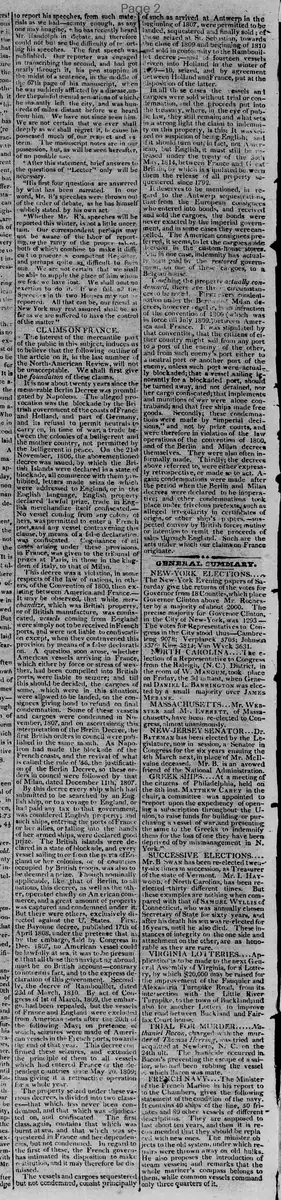
The interest of the mercantile part of the public in this subject, induces us to believe that the following outline of the article on it, in the last number of the North-American Review, will not be unacceptable. We shall first give the foundation of these claims. It is now about twenty years since the memorable Berlin Decree was promulgated by Napoleon. The alleged provocation was the blockade by the British government of the coasts of France and Holland, and part of Germany, and its refusal to permit neutrals to carry on, in time of war, a trade between the colonies of a belligerent and the mother country, not permitted by the belligerent in peace. On the 21st November, 1806, the abovementioned decree was issued, by which the British Islands were declared in a state of blockade, all commerce with them prohibited. Letters made seizure of which were addressed to England, or in the English language, English property declared lawful prize, trade in English merchandize itself confiscated. No vessel coming from any colony of hers, was permitted to enter a French port, and any vessel contravening this clause, by means of a false declaration, was confiscated. —Cognizance of all cases arising under these provisions, in France, was given to the tribunal of prizes at Paris, in those in the kingdom of Italy, to that of Milan. This decree was a violation, in some respects of the law of nations, in others, of the Convention of 1800, then existing between America and France. It may be observed, that while merchandize, which was British property, or of British manufacture, was confiscated, vessels coming from England were simply not to be received in French ports, and were not liable to confiscation except, when they contravened this provision by means of a false declaration. A question soon arose, whether American vessels arriving in France, which either by force or stress of weather, had been compelled into British ports, were liable to seizure: and till this should be decided, the cargoes of some, which were in this situation, were allowed to be landed, on the consignees giving bond to refund on final condemnation. Some of these vessels and cargoes were condemned in November, 1807, and on ascertaining this interpretation of the Berlin Decree, the first British orders in council were published in the same month. As Napoleon had made the blockade of the French coasts, and the revival of what is called the rule of 1756, the justification of the Berlin Decree, so these orders in council were followed by that of Milan, dated December 17th, 1807. By this decree every ship which had submitted to be searched by an English ship, or to a voyage to England, or had paid any tax to that government, was considered English property; and such ships, entering the ports of France or her allies, or falling into the hands of her armed ships, were declared good prize. The British islands were declared in a state of blockade, and every vessel sailing to or from the ports of England or her colonies, or of countries occupied by British troops, was also to be deemed a prize. Though nominally applicable, like that of Berlin, to all nations, this decree, as well as the other, operated chiefly on American commerce, and a great amount of property was captured and condemned under it. But there were others, exclusively directed against the U. States. First, the Bayonne decree, published 17th of April 1808, under the pretence that as, by the embargo, laid by Congress in Dec. 1807, no American vessel could be lawfully at sea, it was to be presumed that all those then navigating abroad, must be on British account—contrary to notorious fact, and to the express declaration of this government. Secondly, the decree of Rambouillet, dated 23d of March, 1810. By act of Congress of 1st of March, 1809, the embargo, had been repealed, but the vessels of France and England were excluded from American ports after the 20th of the following May; on pretence of which, seizures were made of American vessels in the French ports, towards the end of that year. This decree confirmed these seizures, and extended the principle of them to all vessels which had entered France or the dependent countries since May 20. 1809; thus giving it a retroactive operation for a whole year. The property seized under these various decrees, is divided into two classes—that which has never been condemned, and that which was adjudicated on, and confiscated. The first class, again, contains that which was burnt at sea, and that which was sequestered in France and her dependencies, but not condemned. In regard to the first of these, the French government has intimated its disposition to make restitution, and it may therefore be dismissed. The vessels and cargoes sequestered but not condemned, consist principally of such as arrived at Antwerp in the beginning of 1807, were permitted to be landed, sequestered and finally sold; of those seized at St. Sebastian, towards the close of 1809 and beginning of 1810 and sold in conformity to the Rambouillet decree;—and of fourteen vessels driven into Holland in the winter of 1809 -10, seized, and by agreement between Holland and France, put at the disposition of the latter. In all these cases the vessels and cargoes were sold without trial or condemnation, and the proceeds put into the treasury, where, in the eye of public law, they still remain; and what sets in a strong light the claim to indemnity on this property, is this: It was seized on suspicion of being English: and if it should turn out, in fact, not American, but English, it must still be released under the treaty of the 30th May, 1814, between France and Great Britain, by which is stipulated between them the release of all property sequestered since 1792. It deserves to be mentioned, in regard to the Antwerp sequestrations, that from the European consignees who entered into bonds," and received and sold the cargoes, the bonds were never exacted by the imperial government, and in some cases they were cancelled. The American consignees preferred, it seems, to let the cargoes abide decision in the custom-house stores. In one case, indemnity has actually been paid by the restored government, on one of these cargoes, to a Belgian-house. Touching the property actually condemned, there are three circumstances to be noted. First: every condemnation under the Berlin and Milan decrees, however regular, is an infraction of the convention of 1800 (which was in force till July 1809,) between America and France. It was stipulated by that convention, that the citizens of either country might sail from any port to a port of the enemy of the other, and from such enemy's port either to a neutral port or another port of the enemy, unless such port were actually blockaded; that a vessel sailing ignorantly for a blockaded port, should be turned away, and not detained, nor her cargo confiscated that implements and munitions of war were alone contraband; and that free ships made free goods. Secondly; these condemnations were made by "imperial decisions," and not by prize courts, and were therefore in violation of the law of nations, of the operations of the convention of 1800, and of the Berlin and Milan decrees themselves. They were also often informally made. Thirdly; the decrees above referred to, were either expressly retrospective, or made so to act. Again; condemnations were made after the period when the Berlin and Milan decrees were declared to be inoperative; and other, condemnations took place under frivolous pretexts, such as alleged irregularity in certificates of origin, or other ship's papers, —suspected convoy by British force; mutiny or intention to remit the proceeds of sales through England. Such are the acts under which our claims on France originate.
What sub-type of article is it?
What keywords are associated?
What entities or persons were involved?
Where did it happen?
Foreign News Details
Primary Location
France
Event Date
1806 1810
Key Persons
Outcome
seizure, sequestration, and condemnation of numerous american vessels and cargoes; sales without trial; proceeds held in treasury; violations leading to claims for indemnity.
Event Details
The article outlines U.S. claims against France stemming from Napoleonic decrees (Berlin 1806, Milan 1807, Bayonne 1808, Rambouillet 1810) that blockaded British trade, seized American ships suspected of British ties, violated the 1800 U.S.-France convention and international law, resulting in uncondemned sequestrations at ports like Antwerp, St. Sebastian, and Holland, and condemned properties via imperial decisions.