Thank you for visiting SNEWPapers!
Sign up free
Editorial
April 1, 1817
Daily National Intelligencer
Washington, District Of Columbia
What is this article about?
An anonymous editorial critiques the inhumane conditions in American jails, including exposure to weather, lack of warmth and clothing, leading to disease and death. It urges magistrates, judges, and legislators to reform prison construction, provide necessities, and ensure humane treatment, especially for slaves, to promote reformation over punishment.
Clipping
OCR Quality
95%
Excellent
Full Text
FROM THE ENQUIRER
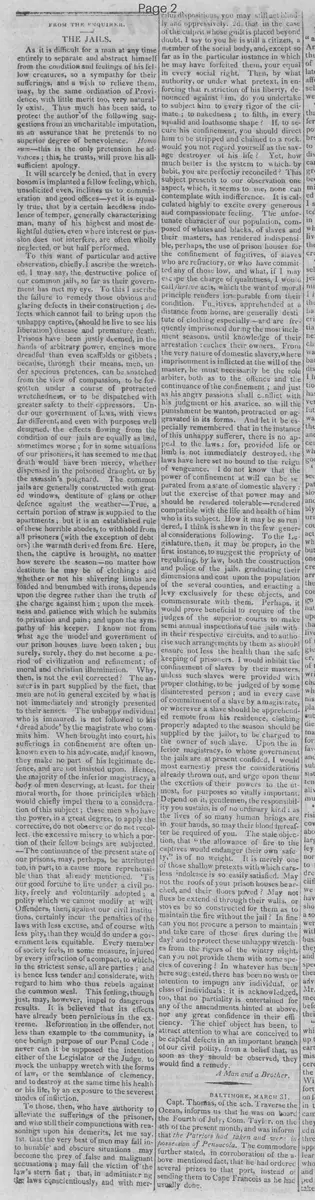
THE JAILS.
As it is difficult for a man at any time entirely to separate and abstract himself from the condition and feelings of his fellow creatures, so a sympathy for their sufferings, and a wish to relieve them, may, by the same ordination of Providence, with little merit too, very naturally exist. Thus much has been said, to protect the author of the following suggestions from an uncharitable imputation, as an assurance that he pretends to no superior degree of benevolence. Homo sum--this is the only pretension he advances; this, he trusts, will prove his all-sufficient apology.
It will scarcely be denied, that in every bosom is implanted a fellow feeling, which unsolicited even, inclines us to commiseration and good offices--yet it is equally true, that by a certain heedless indolence of temper, generally characterizing man, many of his highest and most delightful duties, even where interest or passion does not interfere, are often wholly neglected, or but half performed. To this want of particular and active observation, chiefly, I ascribe the wretched--I may say, the destructive police of our common jails, so far as their government has met my eye. To this I ascribe the failure to remedy those obvious and glaring defects in their construction; defects which cannot fail to bring upon the unhappy captive, (should he live to see his liberation) disease and premature death.
Prisons have been justly deemed, in the hands of arbitrary power, engines more dreadful than even scaffolds or gibbets; because, through their means, men, under specious pretences, can be snatched from the view of compassion, to be forgotten under a course of protracted wretchedness, or to be dispatched with greater safety to their oppressors. Under our government of laws, with views far different, and even with purposes well designed, the effects flowing from the condition of our jails are equally as bad, sometimes worse; for in some situations of our prisoners, it has seemed to me that death would have been mercy, whether dispensed in the poisoned draught, or by the assassin's poignard. The common jails are generally constructed with grated windows, destitute of glass or other defence against the weather--True, a certain portion of straw is supplied to the apartments; but it is an established rule of these horrible abodes, to withhold from all prisoners (with the exception of debtors) the warmth derived from fire. Here, then, the captive is brought, no matter how severe the season--no matter how destitute he may be of clothing: and whether or not his shivering limbs are loaded and benumbed with irons, depends upon the degree rather than the truth of the charge against him; upon the meekness and patience with which he submits to privation and pain; and upon the sympathy of his keeper. I know not from what age the model and government of our prison houses have been taken; but surely, surely, they do not become a period of civilization and refinement; of moral and christian illumination. Why, then, is not the evil corrected? The answer is in part supplied by the fact, that men are not in general excited by what is not immediately and strongly presented to their senses. The unhappy individual who is immured, is not followed to his 'dread abode' by the magistrate who commits him. When brought into court, his sufferings in confinement are often unknown even to his advocate, and, if known, they make no part of his legitimate defence, and are not insisted upon. Hence, the majority of the inferior magistracy, a body of men deserving, at least, for their moral worth, for those principles which would chiefly impel them to a consideration of this subject; these men who have the power, in a great degree, to apply the corrective, do not observe or do not recollect the excessive misery to which a portion of their fellow beings are subjected.--The continuance of the present state of our prisons, may, perhaps, be attributed too, in part, to a cause more reprehensible than that already mentioned. 'Tis our good fortune to live under a civil polity, freely and voluntarily adopted; a polity which we cannot modify at will. Offenders, then, against our civil institutions, certainly incur the penalties of the laws with less excuse, and of course with less pity, than they would do under a government less equitable. Every member of society feels, in some measure, injured by every infraction of a compact, to which, in the strictest sense, all are parties; and is hence less tender and considerate, with regard to him who thus rebels against the common weal. This feeling, though just, may, however, impel to dangerous results. It is believed that its effects have already been pernicious in the extreme. Reformation in the offender, not less than example to the community, is one benign purpose of our Penal Code: never can it be supposed the intention either of the Legislator or the Judge, to mock the unhappy wretch with the forms of law, or the semblance of clemency, and to destroy at the same time his health or his life, by an exposure to the severest modes of infliction.
To those, then, who have authority to alleviate the sufferings of the prisoner, and who still their compunctions with reasonings upon his demerits, let me say, 1st. that the very best of men may fall into humble and obscure situations may become the prey of false and malignant accusations; may fall the victim of the law's stern fiat; that, in administering the laws conscientiously, and with merciful dispositions, you may still act blindly and oppressively. 2d. that in the case of the culprit whose guilt is placed beyond doubt, I say to you he is still a citizen, a member of the social body, and, except so far as in the particular instance in which he may have forfeited them, your equal in every social right. Then, by what authority, or under what pretext, in enforcing that restriction of his liberty, denounced against him, do you undertake to subject him to every rigor of the climate; to nakedness; to filth, in every squalid and loathsome shape? If, to secure his confinement, you should direct him to be stripped and chained to a rock, would you not regard yourself as the savage destroyer of his life? Yet, how much better is the system to which, by habit, you are perfectly reconciled? This subject presents to our observation one aspect, which, it seems to me, none can contemplate with indifference. It is calculated highly to excite every generous and compassionate feeling. The unfortunate character of our population, composed of whites and blacks, of slaves and their masters, has rendered indispensable, perhaps, the use of prison houses for the confinement of fugitives, of slaves who are refractory, or who have committed any of those low, and what, if I may escape the charge of quaintness, I would call furtive acts, which the want of moral principle renders inseparable from their condition. Fugitives, apprehended at a distance from home, are generally destitute of clothing especially--and are frequently imprisoned during the most inclement seasons, until knowledge of their arrestation reaches their owners. From the very nature of domestic slavery, where imprisonment is inflicted at the will of the master, he must necessarily be the sole arbiter, both as to the offence and the continuance of the confinement; and just as his angry passions shall conflict with his judgment or his avarice, so will the punishment be wanton, protracted or aggravated in its forms. And let it be especially remembered that in the instance of this unhappy sufferer, there is no appeal to the laws: for, provided life or limb is not immediately destroyed, the laws have here set no bound to the reign of vengeance. I do not know that the power of confinement at will can be separated from a state of domestic slavery: but the exercise of that power may and should be rendered tolerable--rendered compatible with the life and health of him who is its subject. How it may be so rendered, I think is shewn in the few general considerations following. To the Legislature, then, it may be proper, in the first instance, to suggest the propriety of regulating, by law, both the construction and police of the jails, graduating their dimensions and cost upon the population of the several counties, and enacting a levy exclusively for these objects, and commensurate with them. Perhaps, it would prove beneficial to require of the judges of the superior courts to make semiannual inspections of the jails within their respective circuits, and to authorize such arrangements by them as should ensure not less the health than the safe keeping of prisoners. I would inhibit the confinement of slaves by their masters, unless such slaves were provided with proper clothing, to be judged of by some disinterested person; and in every case of commitment of a slave by a magistrate, or wherever a slave should be apprehended remote from his residence, clothing properly adapted to the season should be supplied by the jailor, to be charged to the owner of such slave. Upon the inferior magistracy, to whose government the jails are at present confided, I would most earnestly press the considerations already thrown out, and urge upon them the exertion of their powers to the utmost, for purposes so vitally important. Depend on it, gentlemen, the responsibility you sustain, is of no ordinary kind: as the lives of so many human beings are in your hands, so may their blood hereafter be required of you. The stale objection, that "the allowance of fire to the captives would endanger their own safety," is of no weight. It is merely one of those shallow pretexts with which careless indolence is so easily satisfied. May not the roofs of your prison houses be pitched, and their floors paved? May not flues be extended through their walls, or stoves be so constructed for them as to maintain the fire without the jail? In fine, can you not procure a person to maintain and take care of those fires during the day? and to protect these unhappy wretches from the rigors of the wintry night, can you not provide them with some species of covering? In whatever has been here suggested, there has been no wish or intention to impugn any individual, or class of individuals; it is acknowledged, too, that no partiality is entertained for any of the amendments hinted at above, nor any great confidence in their efficiency. The chief object has been, to attract attention to what are conceived to be capital defects in an important branch of our civil polity, from a belief that, as soon as they should be observed, they would find a remedy.
THE JAILS.
As it is difficult for a man at any time entirely to separate and abstract himself from the condition and feelings of his fellow creatures, so a sympathy for their sufferings, and a wish to relieve them, may, by the same ordination of Providence, with little merit too, very naturally exist. Thus much has been said, to protect the author of the following suggestions from an uncharitable imputation, as an assurance that he pretends to no superior degree of benevolence. Homo sum--this is the only pretension he advances; this, he trusts, will prove his all-sufficient apology.
It will scarcely be denied, that in every bosom is implanted a fellow feeling, which unsolicited even, inclines us to commiseration and good offices--yet it is equally true, that by a certain heedless indolence of temper, generally characterizing man, many of his highest and most delightful duties, even where interest or passion does not interfere, are often wholly neglected, or but half performed. To this want of particular and active observation, chiefly, I ascribe the wretched--I may say, the destructive police of our common jails, so far as their government has met my eye. To this I ascribe the failure to remedy those obvious and glaring defects in their construction; defects which cannot fail to bring upon the unhappy captive, (should he live to see his liberation) disease and premature death.
Prisons have been justly deemed, in the hands of arbitrary power, engines more dreadful than even scaffolds or gibbets; because, through their means, men, under specious pretences, can be snatched from the view of compassion, to be forgotten under a course of protracted wretchedness, or to be dispatched with greater safety to their oppressors. Under our government of laws, with views far different, and even with purposes well designed, the effects flowing from the condition of our jails are equally as bad, sometimes worse; for in some situations of our prisoners, it has seemed to me that death would have been mercy, whether dispensed in the poisoned draught, or by the assassin's poignard. The common jails are generally constructed with grated windows, destitute of glass or other defence against the weather--True, a certain portion of straw is supplied to the apartments; but it is an established rule of these horrible abodes, to withhold from all prisoners (with the exception of debtors) the warmth derived from fire. Here, then, the captive is brought, no matter how severe the season--no matter how destitute he may be of clothing: and whether or not his shivering limbs are loaded and benumbed with irons, depends upon the degree rather than the truth of the charge against him; upon the meekness and patience with which he submits to privation and pain; and upon the sympathy of his keeper. I know not from what age the model and government of our prison houses have been taken; but surely, surely, they do not become a period of civilization and refinement; of moral and christian illumination. Why, then, is not the evil corrected? The answer is in part supplied by the fact, that men are not in general excited by what is not immediately and strongly presented to their senses. The unhappy individual who is immured, is not followed to his 'dread abode' by the magistrate who commits him. When brought into court, his sufferings in confinement are often unknown even to his advocate, and, if known, they make no part of his legitimate defence, and are not insisted upon. Hence, the majority of the inferior magistracy, a body of men deserving, at least, for their moral worth, for those principles which would chiefly impel them to a consideration of this subject; these men who have the power, in a great degree, to apply the corrective, do not observe or do not recollect the excessive misery to which a portion of their fellow beings are subjected.--The continuance of the present state of our prisons, may, perhaps, be attributed too, in part, to a cause more reprehensible than that already mentioned. 'Tis our good fortune to live under a civil polity, freely and voluntarily adopted; a polity which we cannot modify at will. Offenders, then, against our civil institutions, certainly incur the penalties of the laws with less excuse, and of course with less pity, than they would do under a government less equitable. Every member of society feels, in some measure, injured by every infraction of a compact, to which, in the strictest sense, all are parties; and is hence less tender and considerate, with regard to him who thus rebels against the common weal. This feeling, though just, may, however, impel to dangerous results. It is believed that its effects have already been pernicious in the extreme. Reformation in the offender, not less than example to the community, is one benign purpose of our Penal Code: never can it be supposed the intention either of the Legislator or the Judge, to mock the unhappy wretch with the forms of law, or the semblance of clemency, and to destroy at the same time his health or his life, by an exposure to the severest modes of infliction.
To those, then, who have authority to alleviate the sufferings of the prisoner, and who still their compunctions with reasonings upon his demerits, let me say, 1st. that the very best of men may fall into humble and obscure situations may become the prey of false and malignant accusations; may fall the victim of the law's stern fiat; that, in administering the laws conscientiously, and with merciful dispositions, you may still act blindly and oppressively. 2d. that in the case of the culprit whose guilt is placed beyond doubt, I say to you he is still a citizen, a member of the social body, and, except so far as in the particular instance in which he may have forfeited them, your equal in every social right. Then, by what authority, or under what pretext, in enforcing that restriction of his liberty, denounced against him, do you undertake to subject him to every rigor of the climate; to nakedness; to filth, in every squalid and loathsome shape? If, to secure his confinement, you should direct him to be stripped and chained to a rock, would you not regard yourself as the savage destroyer of his life? Yet, how much better is the system to which, by habit, you are perfectly reconciled? This subject presents to our observation one aspect, which, it seems to me, none can contemplate with indifference. It is calculated highly to excite every generous and compassionate feeling. The unfortunate character of our population, composed of whites and blacks, of slaves and their masters, has rendered indispensable, perhaps, the use of prison houses for the confinement of fugitives, of slaves who are refractory, or who have committed any of those low, and what, if I may escape the charge of quaintness, I would call furtive acts, which the want of moral principle renders inseparable from their condition. Fugitives, apprehended at a distance from home, are generally destitute of clothing especially--and are frequently imprisoned during the most inclement seasons, until knowledge of their arrestation reaches their owners. From the very nature of domestic slavery, where imprisonment is inflicted at the will of the master, he must necessarily be the sole arbiter, both as to the offence and the continuance of the confinement; and just as his angry passions shall conflict with his judgment or his avarice, so will the punishment be wanton, protracted or aggravated in its forms. And let it be especially remembered that in the instance of this unhappy sufferer, there is no appeal to the laws: for, provided life or limb is not immediately destroyed, the laws have here set no bound to the reign of vengeance. I do not know that the power of confinement at will can be separated from a state of domestic slavery: but the exercise of that power may and should be rendered tolerable--rendered compatible with the life and health of him who is its subject. How it may be so rendered, I think is shewn in the few general considerations following. To the Legislature, then, it may be proper, in the first instance, to suggest the propriety of regulating, by law, both the construction and police of the jails, graduating their dimensions and cost upon the population of the several counties, and enacting a levy exclusively for these objects, and commensurate with them. Perhaps, it would prove beneficial to require of the judges of the superior courts to make semiannual inspections of the jails within their respective circuits, and to authorize such arrangements by them as should ensure not less the health than the safe keeping of prisoners. I would inhibit the confinement of slaves by their masters, unless such slaves were provided with proper clothing, to be judged of by some disinterested person; and in every case of commitment of a slave by a magistrate, or wherever a slave should be apprehended remote from his residence, clothing properly adapted to the season should be supplied by the jailor, to be charged to the owner of such slave. Upon the inferior magistracy, to whose government the jails are at present confided, I would most earnestly press the considerations already thrown out, and urge upon them the exertion of their powers to the utmost, for purposes so vitally important. Depend on it, gentlemen, the responsibility you sustain, is of no ordinary kind: as the lives of so many human beings are in your hands, so may their blood hereafter be required of you. The stale objection, that "the allowance of fire to the captives would endanger their own safety," is of no weight. It is merely one of those shallow pretexts with which careless indolence is so easily satisfied. May not the roofs of your prison houses be pitched, and their floors paved? May not flues be extended through their walls, or stoves be so constructed for them as to maintain the fire without the jail? In fine, can you not procure a person to maintain and take care of those fires during the day? and to protect these unhappy wretches from the rigors of the wintry night, can you not provide them with some species of covering? In whatever has been here suggested, there has been no wish or intention to impugn any individual, or class of individuals; it is acknowledged, too, that no partiality is entertained for any of the amendments hinted at above, nor any great confidence in their efficiency. The chief object has been, to attract attention to what are conceived to be capital defects in an important branch of our civil polity, from a belief that, as soon as they should be observed, they would find a remedy.
What sub-type of article is it?
Crime Or Punishment
Social Reform
Legal Reform
What keywords are associated?
Prison Reform
Jail Conditions
Prisoner Treatment
Penal Code
Slave Confinement
Humane Punishment
Judicial Inspections
What entities or persons were involved?
Magistrates
Legislature
Judges
Jailors
Prisoners
Slaves
Masters
Editorial Details
Primary Topic
Reform Of Jail Conditions And Humane Treatment Of Prisoners
Stance / Tone
Sympathetic Advocacy For Prison Reforms
Key Figures
Magistrates
Legislature
Judges
Jailors
Prisoners
Slaves
Masters
Key Arguments
Jail Conditions Cause Disease And Premature Death Due To Exposure And Lack Of Warmth
Prisons Should Promote Reformation, Not Destroy Health Or Life
Provide Fire, Clothing, And Better Construction To Prisoners Regardless Of Guilt
Regulate Jail Construction And Police By Law, With Funding And Inspections
Ensure Humane Treatment For Confined Slaves, Including Seasonal Clothing