Thank you for visiting SNEWPapers!
Sign up free
Editorial
July 25, 1924
Union Labor Bulletin
Little Rock, Pulaski County, Arkansas
What is this article about?
William H. Holly critiques U.S. taxation as unsystematic and burdensome on business, advocating a 'sane' system via the Keller bill's 1% tax on land value over $10,000, exempting improvements, to shift burden from producers to speculators without harming commerce. Presented at 1923 National Tax Relief Convention in Chicago.
Clipping
OCR Quality
98%
Excellent
Full Text
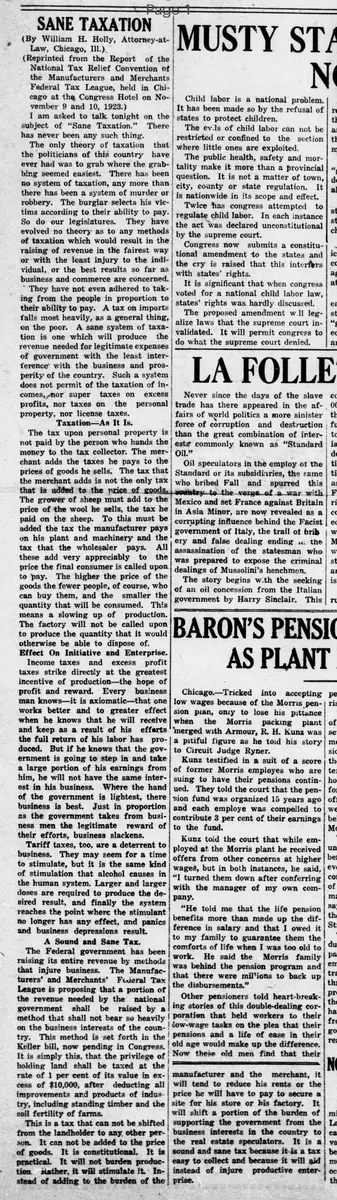
SANE TAXATION
(By William H. Holly, Attorney-at-Law, Chicago, Ill.)
(Reprinted from the Report of the National Tax Relief Convention of the Manufacturers and Merchants Federal Tax League, held in Chicago at the Congress Hotel on November 9 and 10, 1923.)
I am asked to talk tonight on the subject of "Sane Taxation." There has never been any such thing. The only theory of taxation that the politicians of this country have ever had was to grab where the grabbing seemed easiest. There has been no system of taxation, any more than there has been a system of murder or robbery. The burglar selects his victims according to their ability to pay. So do our legislatures. They have evolved no theory as to any methods of taxation which would result in the raising of revenue in the fairest way or with the least injury to the individual, or the best results so far as business and commerce are concerned. They have not even adhered to taking from the people in proportion to their ability to pay. A tax on imports falls most heavily, as a general thing, on the poor. A sane system of taxation is one which will produce the revenue needed for legitimate expenses of government with the least interference with the business and prosperity of the country. Such a system does not permit of the taxation of incomes, nor super taxes on excess profits, nor taxes on the personal property, nor license taxes.
Taxation-As It Is.
The tax upon personal property is not paid by the person who hands the money to the tax collector. The merchant adds the taxes he pays to the prices of goods he sells. The tax that the merchant adds is not the only tax that is added to the price of goods. The grower of sheep must add to the price of the wool he sells, the tax he paid on the sheep. To this must be added the tax the manufacturer pays on his plant and machinery and the tax that the wholesaler pays. All these add very appreciably to the price the final consumer is called upon to pay. The higher the price of the goods the fewer people, of course, who can buy them, and the smaller the quantity that will be consumed. This means a slowing up of production. The factory will not be called upon to produce the quantity that it would otherwise be able to dispose of.
Effect On Initiative and Enterprise
Income taxes and excess profit taxes strike directly at the greatest incentive of production-the hope of profit and reward. Every business man knows--it is axiomatic-that one works better and to greater effect when he knows that he will receive and keep as a result of his efforts the full return of his labor has produced. But if he knows that the government is going to step in and take a large portion of his earnings from him, he will not have the same interest in his business. Where the hand of the government is lightest, there business is best. Just in proportion as the government takes from business men the legitimate reward of their efforts, business slackens. Tariff taxes, too, are a deterrent to business. They may seem for a time to stimulate, but it is the same kind of stimulation that alcohol causes in the human system. Larger and larger doses are required to produce the desired result, and finally the system reaches the point where the stimulant no longer has any effect, and panics and business depressions result.
A Sound and Sane Tax.
The Federal government has been raising its entire revenue by methods that injure business. The Manufacturers' and Merchants' Federal Tax League is proposing that a portion of the revenue needed by the national government shall be raised by a method that shall not bear so heavily on the business interests of the country. This method is set forth in the Keller bill, now pending in Congress. It is simply this, that the privilege of holding land shall be taxed at the rate of 1 per cent of its value in excess of $10,000, after deducting all improvements and products of industry, including standing timber and the soil fertility of farms. This is a tax that can not be shifted from the landholder to any other person. It can not be added to the price of goods. It is constitutional. It is practical. It will not burden production. Rather, it will stimulate it. Instead of adding to the burden of the manufacturer and the merchant, it will tend to reduce his rents or the price he will have to pay to secure a site for his store or his factory. It will shift a portion of the burden of supporting the government from the business interests in the country to the real estate speculators. It is a sound and sane tax because it is a tax easy to collect and because it will aid instead of injure productive enterprise.
(By William H. Holly, Attorney-at-Law, Chicago, Ill.)
(Reprinted from the Report of the National Tax Relief Convention of the Manufacturers and Merchants Federal Tax League, held in Chicago at the Congress Hotel on November 9 and 10, 1923.)
I am asked to talk tonight on the subject of "Sane Taxation." There has never been any such thing. The only theory of taxation that the politicians of this country have ever had was to grab where the grabbing seemed easiest. There has been no system of taxation, any more than there has been a system of murder or robbery. The burglar selects his victims according to their ability to pay. So do our legislatures. They have evolved no theory as to any methods of taxation which would result in the raising of revenue in the fairest way or with the least injury to the individual, or the best results so far as business and commerce are concerned. They have not even adhered to taking from the people in proportion to their ability to pay. A tax on imports falls most heavily, as a general thing, on the poor. A sane system of taxation is one which will produce the revenue needed for legitimate expenses of government with the least interference with the business and prosperity of the country. Such a system does not permit of the taxation of incomes, nor super taxes on excess profits, nor taxes on the personal property, nor license taxes.
Taxation-As It Is.
The tax upon personal property is not paid by the person who hands the money to the tax collector. The merchant adds the taxes he pays to the prices of goods he sells. The tax that the merchant adds is not the only tax that is added to the price of goods. The grower of sheep must add to the price of the wool he sells, the tax he paid on the sheep. To this must be added the tax the manufacturer pays on his plant and machinery and the tax that the wholesaler pays. All these add very appreciably to the price the final consumer is called upon to pay. The higher the price of the goods the fewer people, of course, who can buy them, and the smaller the quantity that will be consumed. This means a slowing up of production. The factory will not be called upon to produce the quantity that it would otherwise be able to dispose of.
Effect On Initiative and Enterprise
Income taxes and excess profit taxes strike directly at the greatest incentive of production-the hope of profit and reward. Every business man knows--it is axiomatic-that one works better and to greater effect when he knows that he will receive and keep as a result of his efforts the full return of his labor has produced. But if he knows that the government is going to step in and take a large portion of his earnings from him, he will not have the same interest in his business. Where the hand of the government is lightest, there business is best. Just in proportion as the government takes from business men the legitimate reward of their efforts, business slackens. Tariff taxes, too, are a deterrent to business. They may seem for a time to stimulate, but it is the same kind of stimulation that alcohol causes in the human system. Larger and larger doses are required to produce the desired result, and finally the system reaches the point where the stimulant no longer has any effect, and panics and business depressions result.
A Sound and Sane Tax.
The Federal government has been raising its entire revenue by methods that injure business. The Manufacturers' and Merchants' Federal Tax League is proposing that a portion of the revenue needed by the national government shall be raised by a method that shall not bear so heavily on the business interests of the country. This method is set forth in the Keller bill, now pending in Congress. It is simply this, that the privilege of holding land shall be taxed at the rate of 1 per cent of its value in excess of $10,000, after deducting all improvements and products of industry, including standing timber and the soil fertility of farms. This is a tax that can not be shifted from the landholder to any other person. It can not be added to the price of goods. It is constitutional. It is practical. It will not burden production. Rather, it will stimulate it. Instead of adding to the burden of the manufacturer and the merchant, it will tend to reduce his rents or the price he will have to pay to secure a site for his store or his factory. It will shift a portion of the burden of supporting the government from the business interests in the country to the real estate speculators. It is a sound and sane tax because it is a tax easy to collect and because it will aid instead of injure productive enterprise.
What sub-type of article is it?
Taxation
Economic Policy
What keywords are associated?
Sane Taxation
Land Value Tax
Income Tax Criticism
Keller Bill
Business Burden
Federal Revenue
Tax Relief
What entities or persons were involved?
William H. Holly
Manufacturers And Merchants Federal Tax League
Keller Bill
Congress
Editorial Details
Primary Topic
Advocacy For Land Value Taxation Via Keller Bill
Stance / Tone
Critical Of Current Taxes And Supportive Of Business Friendly Land Tax
Key Figures
William H. Holly
Manufacturers And Merchants Federal Tax League
Keller Bill
Congress
Key Arguments
No Systematic Taxation Exists; Politicians Grab Easiest Targets.
Current Taxes Like Personal Property And Imports Burden The Poor And Slow Production.
Income And Excess Profit Taxes Reduce Business Incentive And Enterprise.
Tariff Taxes Cause Eventual Economic Depressions.
Keller Bill Proposes 1% Tax On Land Value Over $10,000, Exempting Improvements, Unshiftable To Consumers.
Land Tax Stimulates Production, Reduces Rents, Shifts Burden To Speculators.