Thank you for visiting SNEWPapers!
Sign up free
Springfield Weekly Republican
Springfield, Hampden County, Massachusetts
What is this article about?
Proposed U.S. congressional apportionment bill would give Massachusetts an 11th representative based on 1880 census population, with district rearrangements suggested around Boston to balance urban and rural areas and political parties.
Clipping
OCR Quality
Full Text
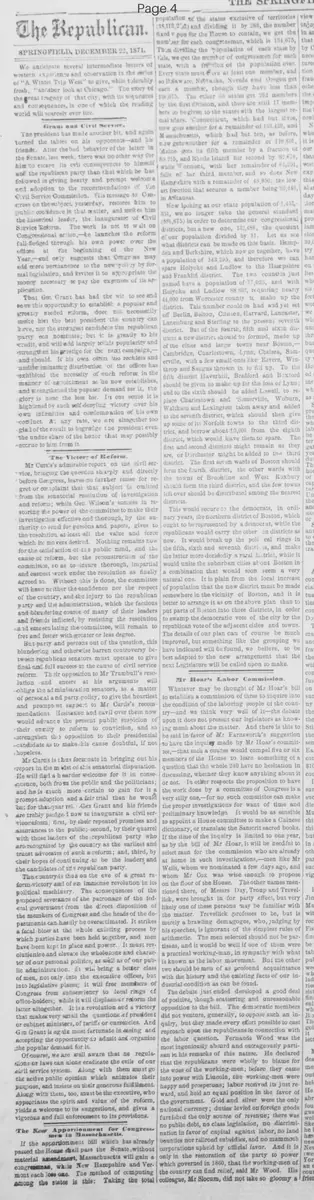
If the apportionment bill which has already passed the House shall pass the Senate without material amendment, Massachusetts will gain a congressman, while New Hampshire and Vermont each lose one. The method of computing among the states is this: Taking the total population of the states exclusive of territories (39,118,791) and dividing it by 283, the number fixed upon for the House to contain, we get the number for each congressman, which is 138,467. Then dividing the population of each state by this, we get the number of congressmen for each state, with a fraction of the population over. Every state must have at least one member, and so Delaware, Nebraska, Nevada and Oregon get each a member, though they have less than 138,467. The other states get 266 members by the first division, and there are still 17 members to be given to the states with the largest remainders. Connecticut, which had but five, now gets another for a remainder of 133,429, and Massachusetts, which had but ten, as before, now gets another for a remainder of 116,401. Maine gets its fifth member by a fraction of 82,210, and Rhode Island her second by 81,675, while Vermont, with her remainder of 61,001, falls of her third member, and so does New Hampshire with a remainder of 48,350; the lowest fraction that secures a member being 64,446 in Arkansas.
Now looking at our state population of 1,457,351, we no longer take the general standard (138,467) in order to determine our congressional districts, but a new one, 132,486, the quotient of our population divided by 11. Let us see what districts can be made on this basis. Hampden and Berkshire, which now go together, have a population of 143,205, and therefore we can spare Holyoke and Ludlow to the Hampshire and Franklin district. The two counties just named have a population of 87,028, and with Holyoke and Ludlow, 95,000, requiring nearly 41,000 from Worcester county to make up the district. This number could be had and yet set off Berlin, Bolton, Clinton, Harvard, Lancaster, Lunenburg and Sterling to the present seventh district. But of the fourth, fifth and sixth districts a new district should be formed, made up of the cities and large towns near Boston,—Cambridge, Charlestown, Lynn, Chelsea, Somerville, with a few small ones like Revere, Winthrop and Saugus thrown in to fill up. To the fifth district Haverhill, Bradford and Boxford should be given to make up for the loss of Lynn, and to the sixth should be added Lowell, to replace Charlestown and Somerville, Woburn, Waltham and Lexington taken away and added to the seventh district, which should then give up some of its Norfolk towns to the third district, and borrow about 10,000 from the eighth district, which would have them to spare. The first and second districts might remain as they are, or Dorchester might be added to the third district. The first seven wards of Boston should form the fourth district, the other wards with the towns of Brookline and West Roxbury should form the third district, and the few towns left over should be distributed among the nearest districts.
This would secure the Democrats, in ordinary years, the northern district of Boston, which ought to be represented by a Democrat, while the Republicans would carry the other ten districts as now. It would break up the political rings in the fifth, sixth and seventh districts, and make the latter more decidedly a rural district, while it would unite the suburban cities about Boston in a combination that would soon seem a very natural one. It is plain from the local increase of population that the new district must be made somewhere in the vicinity of Boston, and it is better to arrange it as on the above plan than to put parts of Boston into three districts, in order to swamp the Democratic vote of the city by the Republican vote of the adjacent cities and towns. The details of our plan can of course be much improved, but something like the grouping we have indicated will be found, we believe, to be best adapted to the new arrangement that the next Legislature will be called upon to make.
What sub-type of article is it?
What keywords are associated?
Where did it happen?
Domestic News Details
Primary Location
Massachusetts
Outcome
massachusetts gains one congressman (from 10 to 11); new hampshire and vermont each lose one; connecticut gains one (to 6); maine gains one (to 5); rhode island gains one (to 2); proposed district rearrangements around boston to balance political representation.
Event Details
The apportionment bill, passed by the House, proposes dividing the U.S. population (39,118,791) by 283 representatives to get 138,467 per congressman. States get members based on population quotients and largest remainders, with minimum one per state. Massachusetts population 1,457,351 divided by 11 gives new district standard of 132,486. Suggested redistricting: Adjust Hampden, Berkshire, Hampshire, Franklin, Worcester; Form new district with Cambridge, Charlestown, Lynn, Chelsea, Somerville, etc.; Adjustments to fifth, sixth, seventh districts including Haverhill, Lowell, Woburn; Boston wards divided into third and fourth districts. Aims to secure Democratic representation in northern Boston district and break political rings.