Thank you for visiting SNEWPapers!
Sign up free
Editorial
September 22, 1797
Gazette Of The United States, & Philadelphia Daily Advertiser
Philadelphia, Philadelphia County, Pennsylvania
What is this article about?
An editorial defends John Fenno against charges of royalism by the Aurora's editor (Bache) and Jacobins, highlighting Fenno's Revolutionary War service and Federalist patriotism while condemning French-aligned factions for undermining U.S. neutrality and government.
Clipping
OCR Quality
95%
Excellent
Full Text
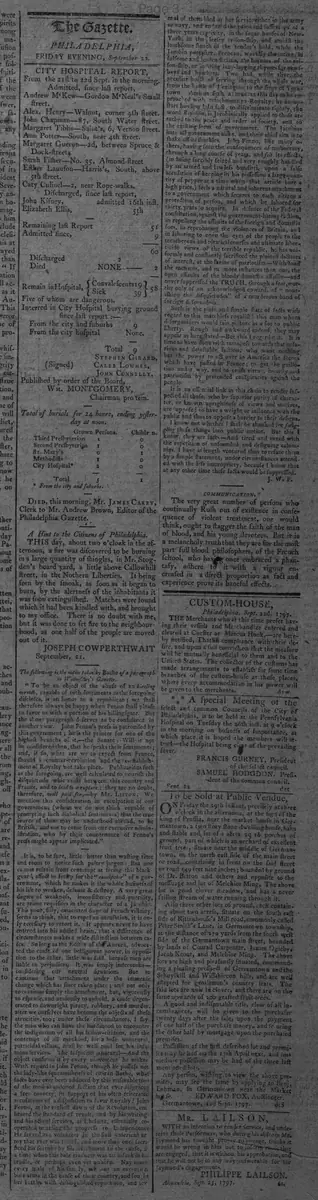
It is, to be sure, little better than wasting time and room to notice such paltry jargon: But one cannot refrain from contempt at seeing this black guard, affect to set up for the "exculpator" of a government, which he makes it the whole business of his life to weaken, defame & destroy. A very great degree of weakness, inconsistency and puerility are prime requisites in the character of a Jacobin. This poor, silly, emaciated dupe of French villainy seems to think, that to repel an accusation, it is only necessary to retort it. It appears never to have entered into his addled brain, that a difference of circumstances makes a wide distinction between cases. So long as the Editor of the Aurora, advocated the cause of one belligerent power, in opposition to the other, little was said, because men are liable to prejudices, It was simply indecorous—considering our neutral situation. But to continue that attachment under the immense change which has since taken place; and not only to continue simply the attachment, but, vigorously to excuse, and zealously to uphold, a cause degenerated to downright piracy, robbery, and murder. after we ourselves have become the objects of these atrocities, too; under these circumstances, I say. the man who can have the hardihood to encounter the indignation of all his fellow-citizens, and the contempt of all mankind, for a base, unnatural, patricidal villain, must be well paid for his infamous services. The suspicion is natural—And the object confirms it by every movement he makes
With regard to John Fenno, though he possesses not the lady-like squeamishness of citizen Bache, what facts have ever been adduced by this miserable tool of the most abandoned faction that ever disgraced a free country, in support of his often-reiterated accusations of a disposition to favor Royalty? John Fenno, at the earliest dawn of the Revolution, embraced the standard of revolt, and by his writings and his actual services, as I believe, essentially co-operated in aiding the progress to Independence He served as a volunteer in the first American army that ever was raised, and more than once sacrificed his fortune by his attachment to the cause, at a time when this base traducer was an infant in his cradle, or perhaps even yet unborn. Nay more every male of his family, without exception bore arms in the cause of their country, and fought her battles with distinguished reputation, and few of them bled in her service—either in the army or navy, and endured the pains and sufferings of a three years captivity, in the sugar houses of New-York, in the Jersey prison-ship, and amidst the loathsome stench of the tender's hold, while the Jacobin poetaster, Freneau, was idly chanting, in fulsome and leaden strains, the horrors of the prison-ship, or inditing lazy-lagging rhymes for newspapers and hawkers. Two had, while alive; the peculiar boast of serving through the whole war, from the battle of Lexington to the siege of York-town Another such as made at this day to be reproached with attachment to Royalty, by an upstart hireling? In fact, to discriminate rightly, the word Royalty, is Jacobinically applied to those attached to the peace and order of society, and to the existing form of government. The Jacobins hate all government alike, and their chief aim is to shake off its shackles. John Fenno, like many others, having seen the consequences of mobocracy, through a long course of years, and felt its effects, (in being forcibly seized and very roughly handled by an armed and lawless banditti, upon a false accusation of keeping in his possession a large quantity of pepper at a time when that article bore a high price,) feels a natural and inherent attachment to a government which secures to each citizen a protection of person, and which he labored for thirty years to acquire. In defence of the Federal constitution, against the government-hating faction, in repelling the assaults of the foreign and domestic foes, in reprobating the violences of Britain, and in laboring to open the eyes of the people to the treacherous and piratical courses and ultimate liberticide views of the terrible republic, he has uniformly and constantly sacrificed the plainest dictates of interest, at the shrine of patriotism—Withstood the menaces, and in more instances than one, the open assaults of the bloody domestic assassin—and never suppressed the TRUTH, through a fear, worthy only of an acknowledged coward, of "nourishing the disquietudes" of a murderous band of foreign desperadoes.
Such is the plain and simple state of facts with regard to this matchless royalist! this man whom disorganizers would fain picture as a foe to public liberty. Rough and awkward indeed, they may appear as here stated—But this I regard not. It is time to have done with rameses towards that nefarious and detestable faction, who want nothing but the power to act over in America the scenes which have passed in France; to get the guillotines under way, and to crush virtue, honesty and patriotism by pretended conspiracies against the people.
It is an essential link in this chain to render suspected all those, who by superior purity of character, or known uprightness of views and motives, are supposed to have a weight or influence with the public and thus to oppose a barrier to their designs. I know not whether I shall be thanked for mingling these things into public notice. But this I know, they are facts—And tired and vexed with the repetition of unfounded and designing calumnies, I have at length ventured thus to refute them by a simple statement, under circumstances attended with the less impropriety, because I know that at any other time these facts would be suppressed.
J. W. F.
With regard to John Fenno, though he possesses not the lady-like squeamishness of citizen Bache, what facts have ever been adduced by this miserable tool of the most abandoned faction that ever disgraced a free country, in support of his often-reiterated accusations of a disposition to favor Royalty? John Fenno, at the earliest dawn of the Revolution, embraced the standard of revolt, and by his writings and his actual services, as I believe, essentially co-operated in aiding the progress to Independence He served as a volunteer in the first American army that ever was raised, and more than once sacrificed his fortune by his attachment to the cause, at a time when this base traducer was an infant in his cradle, or perhaps even yet unborn. Nay more every male of his family, without exception bore arms in the cause of their country, and fought her battles with distinguished reputation, and few of them bled in her service—either in the army or navy, and endured the pains and sufferings of a three years captivity, in the sugar houses of New-York, in the Jersey prison-ship, and amidst the loathsome stench of the tender's hold, while the Jacobin poetaster, Freneau, was idly chanting, in fulsome and leaden strains, the horrors of the prison-ship, or inditing lazy-lagging rhymes for newspapers and hawkers. Two had, while alive; the peculiar boast of serving through the whole war, from the battle of Lexington to the siege of York-town Another such as made at this day to be reproached with attachment to Royalty, by an upstart hireling? In fact, to discriminate rightly, the word Royalty, is Jacobinically applied to those attached to the peace and order of society, and to the existing form of government. The Jacobins hate all government alike, and their chief aim is to shake off its shackles. John Fenno, like many others, having seen the consequences of mobocracy, through a long course of years, and felt its effects, (in being forcibly seized and very roughly handled by an armed and lawless banditti, upon a false accusation of keeping in his possession a large quantity of pepper at a time when that article bore a high price,) feels a natural and inherent attachment to a government which secures to each citizen a protection of person, and which he labored for thirty years to acquire. In defence of the Federal constitution, against the government-hating faction, in repelling the assaults of the foreign and domestic foes, in reprobating the violences of Britain, and in laboring to open the eyes of the people to the treacherous and piratical courses and ultimate liberticide views of the terrible republic, he has uniformly and constantly sacrificed the plainest dictates of interest, at the shrine of patriotism—Withstood the menaces, and in more instances than one, the open assaults of the bloody domestic assassin—and never suppressed the TRUTH, through a fear, worthy only of an acknowledged coward, of "nourishing the disquietudes" of a murderous band of foreign desperadoes.
Such is the plain and simple state of facts with regard to this matchless royalist! this man whom disorganizers would fain picture as a foe to public liberty. Rough and awkward indeed, they may appear as here stated—But this I regard not. It is time to have done with rameses towards that nefarious and detestable faction, who want nothing but the power to act over in America the scenes which have passed in France; to get the guillotines under way, and to crush virtue, honesty and patriotism by pretended conspiracies against the people.
It is an essential link in this chain to render suspected all those, who by superior purity of character, or known uprightness of views and motives, are supposed to have a weight or influence with the public and thus to oppose a barrier to their designs. I know not whether I shall be thanked for mingling these things into public notice. But this I know, they are facts—And tired and vexed with the repetition of unfounded and designing calumnies, I have at length ventured thus to refute them by a simple statement, under circumstances attended with the less impropriety, because I know that at any other time these facts would be suppressed.
J. W. F.
What sub-type of article is it?
Partisan Politics
Foreign Affairs
What keywords are associated?
John Fenno
Jacobins
Aurora Editor
Federalist Defense
Revolutionary Service
French Influence
Political Accusations
What entities or persons were involved?
John Fenno
Editor Of The Aurora
Bache
Freneau
Jacobins
Editorial Details
Primary Topic
Defense Of John Fenno Against Jacobin Accusations Of Royalism
Stance / Tone
Strongly Pro Federalist And Anti Jacobin
Key Figures
John Fenno
Editor Of The Aurora
Bache
Freneau
Jacobins
Key Arguments
John Fenno Served In The Revolution And Sacrificed For Independence
Fenno's Family Fought In The War While Critics Were Absent
Accusations Of Royalism Are Jacobin Tactics To Undermine Government Supporters
Continued Support For France After U.S. Neutrality Is Broken Is Treacherous
Fenno Has Consistently Defended The Federal Constitution Against Factions