Thank you for visiting SNEWPapers!
Sign up free
The Irish Standard
Minneapolis, Saint Paul, Hennepin County, Ramsey County, Minnesota
What is this article about?
Irish envoys Messrs. Dillon and O'Brien received a grand welcome at New York's Metropolitan Opera House upon arriving in America. In an interview, O'Brien addressed the famine fund controversy using a Dublin Daily Express cutting from October 7, 1890, and described their escape from Ireland via yacht St. Patrick amid British pursuit.
Clipping
OCR Quality
Full Text
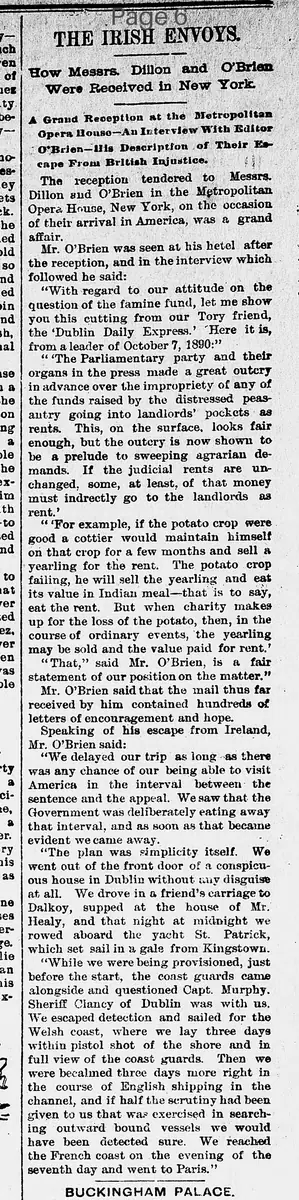
How Messrs. Dillon and O'Brien Were Received in New York.
Grand Reception at the Metropolitan Opera House—An Interview With Editor O'Brien—His Description of Their Escape From British Injustice.
The reception tendered to Messrs. Dillon and O'Brien in the Metropolitan Opera House, New York, on the occasion of their arrival in America, was a grand affair.
Mr. O'Brien was seen at his hotel after the reception, and in the interview which followed he said:
"With regard to our attitude on the question of the famine fund, let me show you this cutting from our Tory friend, the 'Dublin Daily Express.' Here it is, from a leader of October 7, 1890:
"The Parliamentary party and their organs in the press made a great outcry in advance over the impropriety of any of the funds raised by the distressed peasantry going into landlords' pockets as rents. This, on the surface, looks fair enough, but the outcry is now shown to be a prelude to sweeping agrarian demands. If the judicial rents are unchanged, some, at least, of that money must indirectly go to the landlords as rent."
" 'For example, if the potato crop were good a cottier would maintain himself on that crop for a few months and sell a yearling for the rent. The potato crop failing, he will sell the yearling and eat its value in Indian meal—that is to say, eat the rent. But when charity makes up for the loss of the potato, then, in the course of ordinary events, the yearling may be sold and the value paid for rent.'
"That," said Mr. O'Brien, "is a fair statement of our position on the matter."
Mr. O'Brien said that the mail thus far received by him contained hundreds of letters of encouragement and hope.
Speaking of his escape from Ireland Mr. O'Brien said:
"We delayed our trip as long as there was any chance of our being able to visit America in the interval between the sentence and the appeal. We saw that the Government was deliberately eating away that interval, and as soon as that became evident we came away.
"The plan was simplicity itself. We went out of the front door of a conspicuous house in Dublin without any disguise at all. We drove in a friend's carriage to Dalkey, supped at the house of Mr. Healy, and that night at midnight we rowed aboard the yacht St. Patrick, which set sail in a gale from Kingstown.
"While we were being provisioned, just before the start, the coast guards came alongside and questioned Capt. Murphy. Sheriff Clancy of Dublin was with us. We escaped detection and sailed for the Welsh coast, where we lay three days within pistol shot of the shore and in full view of the coast guards. Then we were becalmed three days more right in the course of English shipping in the channel, and if half the scrutiny had been given to us that was exercised in searching outward bound vessels we would have been detected sure. We reached the French coast on the evening of the seventh day and went to Paris."
What sub-type of article is it?
What keywords are associated?
What entities or persons were involved?
Where did it happen?
Domestic News Details
Primary Location
New York
Key Persons
Event Details
Reception tendered to Messrs. Dillon and O'Brien in the Metropolitan Opera House, New York, on arrival in America. Interview with Mr. O'Brien discussing famine fund position via Dublin Daily Express cutting from October 7, 1890, receipt of encouraging letters, and escape from Ireland: left Dublin undisguised, drove to Dalkey, supped at Mr. Healy's, rowed to yacht St. Patrick at midnight from Kingstown, evaded coast guards, sailed to Welsh coast for three days, becalmed three days in channel, reached French coast on seventh day, went to Paris.