Thank you for visiting SNEWPapers!
Sign up free
Letter to Editor
May 8, 1867
American Citizen
Butler, Butler County, Pennsylvania
What is this article about?
A letter to the editor responding to an article on ancient Christian praise practices, defending the use of metrical Psalms as inspired translations suitable for worship, arguing they reference Christ and counter uninspired hymns.
Clipping
OCR Quality
88%
Good
Full Text
For the Citizen.
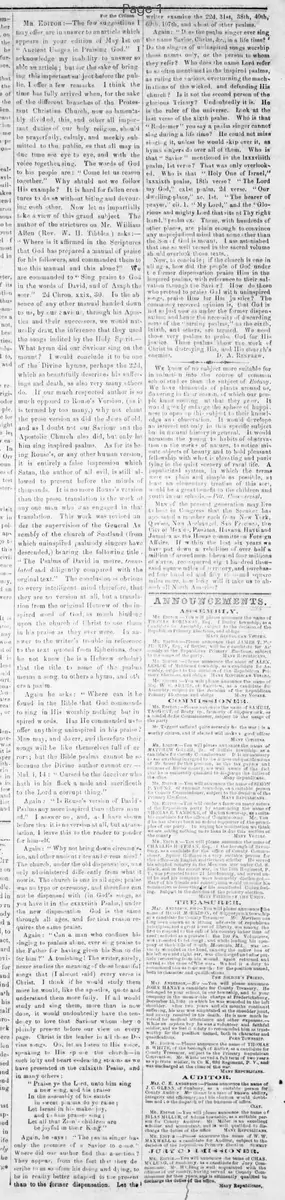
Mr. Editor: The few suggestions I may offer, are in answer to an article which appears in your edition of May 1st on "Ancient Usages in Praising God." I acknowledge my inability to answer so able an article; but for the sake of bringing this important subject before the public, I offer a few remarks. I think the time has fully arrived when, for the sake of the different branches of the Protestant Christian Church, now so lamentably divided, this, and other all important duties of our holy religion, should be prayerfully, calmly, and meekly submitted to the public, so that all may in due time see eye to eye, and with the voice together sing. The words of God to his people are: "Come let us reason together." Why should not we follow His example? It is hard for fallen creatures to do so without biting and devouring each other. Now let us impartially take a view of this grand subject. The author of the strictures on Mr. William Allen (Rev. W. H. Tibbles) asks:—
Where is it affirmed in the Scriptures that God has prepared a manual of praise for his followers, and commanded them to use this manual and this alone? We are commanded to "Sing praise to God in the words of David, and of Asaph the seer." 2d Chron. xxix. 30. In the absence of any other manual handed down to us, by our Saviour, through his Apostles and their successors, we would naturally draw the inference that they used the songs indited by the Holy Spirit.—
What hymn did our Saviour sing on the mount? I would conclude it to be one of the Divine hymns, perhaps the 22d, which so beautifully describes his sufferings and death, as also very many others do. If our much respected author is so much opposed to Rouse's Version, (as it is termed by too many,) why not chant the prose version as did the Jews of old, and as I doubt not our Saviour and the Apostolic Church also did, but only let him sing inspired psalms. As for its being Rouse's, or any other human version it is entirely a false impression which Satan, the author of all evil, is still allowed to present before the minds of thousands. It is no more Rouse's version than the prose translation is the work of any one man who was engaged in that translation. This work was revised under the supervision of the General Assembly of the church of Scotland (from which uninspired psalmody singers have descended,) bearing the following title, "The Psalms of David in metre, translated and diligently compared with the original text." The conclusion is obvious to every intelligent mind therefore, that they are no version at all, but a translation from the original (Hebrew) of the inspired word of God, as much binding upon the church of Christ to use them in his praise as they ever were. In an answer to the writer's trouble in reference to the text quoted from Ephesians, does he not know (he is a Hebrew scholar) that the title to some of the psalms means a song, to others a hymn, and others a psalm.
Again he asks: "Where can it be found in the Bible that God commands to sing in His worship nothing but inspired words. Has He commanded us to offer anything uninspired in his praise? Men may, and do err, and therefore their songs will be like themselves full of errors; but the Bible psalms cannot be so because the Divine author cannot err—
Mal. i, 14: "Cursed be the deceiver who hath in his flock a male and sacrificeth to the Lord a corrupt thing."
Again: "Is Rouse's version of David's Psalms any more inspired than others named." I answer no, and, as I have shown before that it is no version at all, but a translation. I leave this to the reader to ponder for himself.
Again: "Why not bring down circumcision, and other ancient Mosaic ceremonies? The church, under the old dispensation, was only administered differently from what it now is. The church is one in all ages; praise was no type or ceremony, and therefore cannot be dispensed with (in God's songs, as you have it in the cxxxviith Psalm.) under the new dispensation God is the same through all ages, and for that reason requires the same praise.
Again: "Can a man who confines his singing to psalms alone, ever sing praise to the Father for having given his Son to die for him?" Astonishing! The writer, surely, never studies the meaning of those beautiful songs that (I almost said) every verse is Christ, I think if he would study them more he would, like the apostles, quote and understand them more fully. If all would study and sing them, more than is now done, it would undoubtedly have the tendency to love that Saviour whom they so plainly present before our view on every page. Christ is the leader in all those Divine songs. Oh, let us listen to His voice, speaking to his spouse the church—in such lofty and heart endearing strains as we have presented in the cxlxixth Psalm, and in many others:
"Praise ye the Lord, unto him sing a new song, and his praise
In the assembly of his saints in sweet psalms do ye raise;
Let Israel in his Maker make joyful noise and sing:
Let all that Zion's children are be joyful in their King.
Again, he says: "The psalm singer has only the promise of a Savior to come." Where did our author find that assertion? They appear, from the fact that they describe to us so often his doing and dying, to be in reality better adapted to the present than to the former dispensation. Let the writer examine the 22d, 31st, 38th, 40th, 69th, 107th, and a host of other psalms.
Again: "Does the psalm singer ever sing the name Savior, Christ, &c., in a life time? Do the singers of uninspired songs worship those names only, or the person to whom they refer? Who does the name Lord refer to so often mentioned in the inspired psalms, as ruling the nations, overturning the machinations of the wicked, and defending His church? Is it not the second person of the glorious Trinity? Undoubtedly it is. He is the ruler of the universe. Look at the last verse of the xixth psalm. Who is that "Redeemer" you say a psalm singer cannot sing during a life time? He could not miss singing it, unless he would skip over it, as hymn singers do over all of them. Who is that "Savior" mentioned in the lxxxviith psalm, 1st verse? That was only overlooked. Who is that "Holy One of Israel," lxxxixth psalm, 18th verse? "The Lord my God," cxliist psalm, 2d verse. "Our dwelling place," xc. 1st. "The hearer of prayer," cii. 1. "My Lord," and the "Glorious and mighty Lord that sits at Thy right hand," psalm cx. These, with hundreds of other places, are plain enough to convince any unprejudiced mind that none other than the Son of God is meant, I am astonished that one so well versed in the sacred volume should overlook those texts.
Now, to conclude: if the church is one in all ages, how did the people of God under the former dispensation praise Him in the inspired psalms, with reference to their salvation through the Savior? How do those who pretend to praise God with uninspired songs, praise Him for His justice? The commonly received opinion is, that God is not so just now as under the former dispensation; and hence the necessity of discarding some of the "cursing psalms," as the cixth, lxixth, and others, are termed. We need those very psalms to praise God for His justice. These psalms show the work of Christ in destroying His, and His church's enemies,
D. A. RENFREW.
Mr. Editor: The few suggestions I may offer, are in answer to an article which appears in your edition of May 1st on "Ancient Usages in Praising God." I acknowledge my inability to answer so able an article; but for the sake of bringing this important subject before the public, I offer a few remarks. I think the time has fully arrived when, for the sake of the different branches of the Protestant Christian Church, now so lamentably divided, this, and other all important duties of our holy religion, should be prayerfully, calmly, and meekly submitted to the public, so that all may in due time see eye to eye, and with the voice together sing. The words of God to his people are: "Come let us reason together." Why should not we follow His example? It is hard for fallen creatures to do so without biting and devouring each other. Now let us impartially take a view of this grand subject. The author of the strictures on Mr. William Allen (Rev. W. H. Tibbles) asks:—
Where is it affirmed in the Scriptures that God has prepared a manual of praise for his followers, and commanded them to use this manual and this alone? We are commanded to "Sing praise to God in the words of David, and of Asaph the seer." 2d Chron. xxix. 30. In the absence of any other manual handed down to us, by our Saviour, through his Apostles and their successors, we would naturally draw the inference that they used the songs indited by the Holy Spirit.—
What hymn did our Saviour sing on the mount? I would conclude it to be one of the Divine hymns, perhaps the 22d, which so beautifully describes his sufferings and death, as also very many others do. If our much respected author is so much opposed to Rouse's Version, (as it is termed by too many,) why not chant the prose version as did the Jews of old, and as I doubt not our Saviour and the Apostolic Church also did, but only let him sing inspired psalms. As for its being Rouse's, or any other human version it is entirely a false impression which Satan, the author of all evil, is still allowed to present before the minds of thousands. It is no more Rouse's version than the prose translation is the work of any one man who was engaged in that translation. This work was revised under the supervision of the General Assembly of the church of Scotland (from which uninspired psalmody singers have descended,) bearing the following title, "The Psalms of David in metre, translated and diligently compared with the original text." The conclusion is obvious to every intelligent mind therefore, that they are no version at all, but a translation from the original (Hebrew) of the inspired word of God, as much binding upon the church of Christ to use them in his praise as they ever were. In an answer to the writer's trouble in reference to the text quoted from Ephesians, does he not know (he is a Hebrew scholar) that the title to some of the psalms means a song, to others a hymn, and others a psalm.
Again he asks: "Where can it be found in the Bible that God commands to sing in His worship nothing but inspired words. Has He commanded us to offer anything uninspired in his praise? Men may, and do err, and therefore their songs will be like themselves full of errors; but the Bible psalms cannot be so because the Divine author cannot err—
Mal. i, 14: "Cursed be the deceiver who hath in his flock a male and sacrificeth to the Lord a corrupt thing."
Again: "Is Rouse's version of David's Psalms any more inspired than others named." I answer no, and, as I have shown before that it is no version at all, but a translation. I leave this to the reader to ponder for himself.
Again: "Why not bring down circumcision, and other ancient Mosaic ceremonies? The church, under the old dispensation, was only administered differently from what it now is. The church is one in all ages; praise was no type or ceremony, and therefore cannot be dispensed with (in God's songs, as you have it in the cxxxviith Psalm.) under the new dispensation God is the same through all ages, and for that reason requires the same praise.
Again: "Can a man who confines his singing to psalms alone, ever sing praise to the Father for having given his Son to die for him?" Astonishing! The writer, surely, never studies the meaning of those beautiful songs that (I almost said) every verse is Christ, I think if he would study them more he would, like the apostles, quote and understand them more fully. If all would study and sing them, more than is now done, it would undoubtedly have the tendency to love that Saviour whom they so plainly present before our view on every page. Christ is the leader in all those Divine songs. Oh, let us listen to His voice, speaking to his spouse the church—in such lofty and heart endearing strains as we have presented in the cxlxixth Psalm, and in many others:
"Praise ye the Lord, unto him sing a new song, and his praise
In the assembly of his saints in sweet psalms do ye raise;
Let Israel in his Maker make joyful noise and sing:
Let all that Zion's children are be joyful in their King.
Again, he says: "The psalm singer has only the promise of a Savior to come." Where did our author find that assertion? They appear, from the fact that they describe to us so often his doing and dying, to be in reality better adapted to the present than to the former dispensation. Let the writer examine the 22d, 31st, 38th, 40th, 69th, 107th, and a host of other psalms.
Again: "Does the psalm singer ever sing the name Savior, Christ, &c., in a life time? Do the singers of uninspired songs worship those names only, or the person to whom they refer? Who does the name Lord refer to so often mentioned in the inspired psalms, as ruling the nations, overturning the machinations of the wicked, and defending His church? Is it not the second person of the glorious Trinity? Undoubtedly it is. He is the ruler of the universe. Look at the last verse of the xixth psalm. Who is that "Redeemer" you say a psalm singer cannot sing during a life time? He could not miss singing it, unless he would skip over it, as hymn singers do over all of them. Who is that "Savior" mentioned in the lxxxviith psalm, 1st verse? That was only overlooked. Who is that "Holy One of Israel," lxxxixth psalm, 18th verse? "The Lord my God," cxliist psalm, 2d verse. "Our dwelling place," xc. 1st. "The hearer of prayer," cii. 1. "My Lord," and the "Glorious and mighty Lord that sits at Thy right hand," psalm cx. These, with hundreds of other places, are plain enough to convince any unprejudiced mind that none other than the Son of God is meant, I am astonished that one so well versed in the sacred volume should overlook those texts.
Now, to conclude: if the church is one in all ages, how did the people of God under the former dispensation praise Him in the inspired psalms, with reference to their salvation through the Savior? How do those who pretend to praise God with uninspired songs, praise Him for His justice? The commonly received opinion is, that God is not so just now as under the former dispensation; and hence the necessity of discarding some of the "cursing psalms," as the cixth, lxixth, and others, are termed. We need those very psalms to praise God for His justice. These psalms show the work of Christ in destroying His, and His church's enemies,
D. A. RENFREW.
What sub-type of article is it?
Persuasive
Religious
Reflective
What themes does it cover?
Religion
Morality
What keywords are associated?
Psalm Singing
Inspired Psalms
Rouse Version
Christian Worship
Protestant Church
Bible Hymns
Divine Praise
Metrical Translation
What entities or persons were involved?
D. A. Renfrew
Mr. Editor
Letter to Editor Details
Author
D. A. Renfrew
Recipient
Mr. Editor
Main Argument
the metrical psalms are not a human version like rouse's but a faithful translation of inspired scripture, binding for christian worship; they fully reference christ and god's justice, making uninspired hymns unnecessary and erroneous.
Notable Details
References 2 Chron. Xxix. 30
Cites Mal. I, 14
Quotes Psalm 22, 31, 38, 40, 69, 107, 136, 137, 149, 19, 87, 89, 142, 90, 102, 110, 109, 69
Discusses Scottish Psalter Title And Revision
Mentions Rev. W. H. Tibbles And Mr. William Allen