Thank you for visiting SNEWPapers!
Sign up free
Editorial
January 11, 1827
Phenix Gazette
Alexandria, Virginia
What is this article about?
An editorial from the Richmond Enquirer critiques the fickleness of republican public opinion, using Virginia's changing favor toward John Randolph as an example despite his past opposition to Jefferson and Madison. It satirizes Randolph's erratic style and advocates electing principled Philip P. Barbour as U.S. Senator instead.
Clipping
OCR Quality
80%
Good
Full Text
From the Richmond Enquirer.
ORATOR.
ELECTION OF SENATOR.
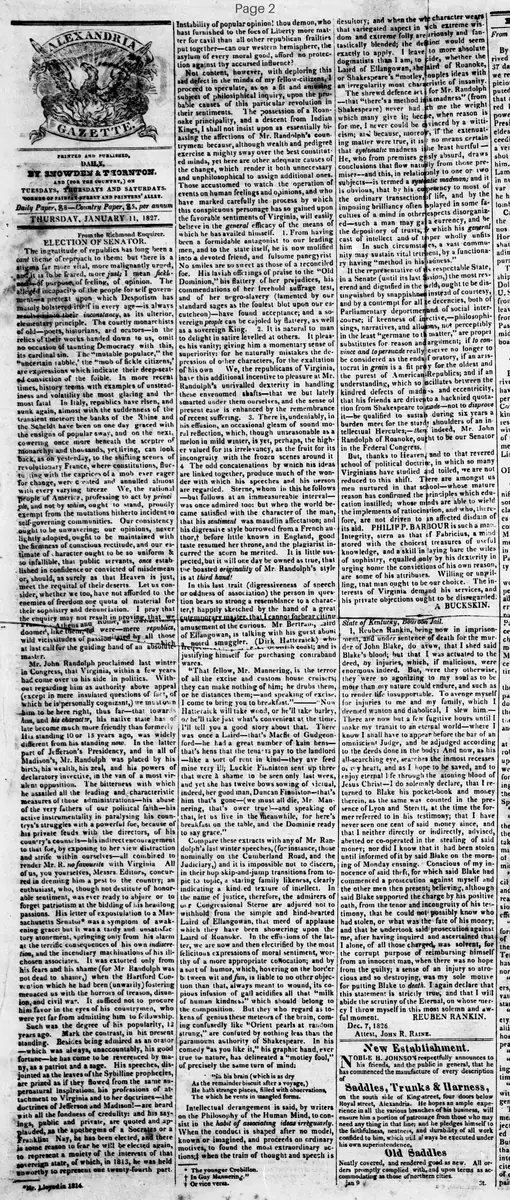
The ingratitude of republics has long been a cant theme of reproach to them: but there is a stigma far more vital, more malignantly urged, and it is to be feared, more just; I mean fickleness of purpose, of feeling, of opinion. The alleged incapacity of the people for self-government—a pretext upon which Despotism has mainly bolstered itself in every age—is always resolved into their inconstancy, as its ulterior, elementary principle. The courtly monarchists of old—poets, historians, and orators—in the relics of their works handed down to us, omit no occasion of taunting Democracy with this, its cardinal sin. The mutable populace, the uncertain rabble, the mob of fickle citizens, are expressions which indicate their deep-seated conviction of the foible. In more recent times, history teems with examples of unsteadiness and volatility the most glaring and the most fatal. In Italy, republics have risen, and sunk again, almost with the suddenness of the transient meteor: the banks of the Rhine and the Scheldt have been on one day graced with the ensigns of popular sway, and on the next, cowering once more beneath the sceptre of monarchy: and thousands, yet living, can look back, as on yesterday, to the shifting scenes of revolutionary France, where constitutions, fluctuating with the caprices of a mob ever eager for change, were created and annulled almost with every varying breeze. We, the rational people of America, professing to act by principle, and not by whim, ought to stand, proudly exempt from the mutations hitherto incident to self-governing communities. Our consistency ought to be unwavering; our opinions, never lightly adopted, ought to be maintained with the firmness of conscious rectitude, and our estimate of character ought to be so uniform and so infallible, that public servants, once established in confidence or convicted of misdemeanor, should, as surely as that Heaven is just, meet the requital of their deserts. Let us consider, whether we too, have not afforded to the enemies of freedom one quota of material for their sophistry and denunciation. I pray that the enquiry may not result in proving, that we doomed, like them, and were—mere republics, Athens and...
wild vicissitudes of passion irritated by all those at last call for the guiding hand of an absolute master.
Mr. John Randolph proclaimed last winter in Congress, that Virginia, within a few years had come over to his side in politics. Without regarding him as authority above appeal (except in mere insulated questions of fact, of which he is personally cognizant,) we must own him to be here right, thus far—that towards him, and his character, his native state has of late become much more friendly than formerly. His standing 10 or 15 years ago, was widely different from his standing now. In the latter part of Jefferson's Presidency, and in all of Madison's, Mr. Randolph was placed by his birth, his wealth, his zeal, and his powers of declamatory invective, in the van of a most virulent opposition. The bitterness with which he assailed all the leading and characteristic measures of those administrations—his abuse of the very fathers of our political faith—his active instrumentality in paralysing his country's struggles with a powerful foe, because of his private feuds with the directors of his country's counsels—his indirect encouragement to that foe, by exposing to her view distraction and strife within ourselves—all combined to render Mr. R. no favourite with Virginia. All of us, you yourselves, Messrs. Editors, concurred in deeming him a pest to the country; an enthusiast, who, though not destitute of honorable sentiment, was ever ready to abjure or to forget patriotism at the bidding of his headlong passions. His letter of expostulation to a Massachusetts Senator* was a symptom of awakening grace: but it was a tardy and unsatisfactory atonement, springing only from his alarm at the terrific consequences of his own indiscretion, and the incendiary machinations of his ill-chosen associates. It was extorted only from his ears and his shame (for Mr. Randolph was not dead to shame,) when the Hartford Convention which he had been (unwarily) fostering menaced us with the horrors of treason, disunion, and civil war. It sufficed not to procure him favor in the eyes of his countrymen, who were yet far from admitting him to fellowship. Such was the degree of his popularity, 12 years ago. Mark the contrast, in his present standing. Besides being admired as an orator—which was always, unaccountably, his good fortune—he has come to be reverenced by many, as a patriot and a sage. His speeches, disjointed as the leaves of the Sybilline prophecies, are prized as if they flowed from the same super-natural inspiration: his professions of attachment to Virginia and to her doctrines—the doctrines of Jefferson and Madison!—are heard with all the fondness of credulity: and his sayings, public and private, are quoted and applauded, as the apothegms of a Socrates or a Franklin: Nay, he has been elected, and there is some reason to fear he will be elected again, sovereign state, of which, in 1815, he was held to represent a moiety of the interests of that unworthy to represent one twenty-fourth part.
Instability of popular opinion! thou demon, who hast furnished to the foes of Liberty more matter for cavil than all other republican frailties put together—can our western hemisphere, the asylum of every moral good, afford no protection against thy accursed influence? Not content, however, with deploring this sad defect in the minds of my fellow-citizens, I proceed to speculate, as on a fit and amusing subject of philosophical inquiry, upon the probable causes of this particular revolution in their sentiments. The possession of a Roanoke principality, and a descent from Indian Kings, I shall not insist upon as essentially biassing the affections of Mr. Randolph's countrymen: because, although wealth and pedigree exercise a mighty sway over the best constituted minds, yet here are other adequate causes of the change, which render it both unnecessary and unphilosophical to assign additional ones. Those accustomed to watch the operation of events on human feelings and opinions, and who have marked carefully the process by which this conspicuous personage has so gained upon the favorable sentiments of Virginia, will easily believe in the general efficacy of the means of which he has availed himself. 1. From having been a formidable antagonist to our leading men, and to the state itself, he is now mollified into a devoted friend, and fulsome panegyrist. No smiles are so sweet as those of a reconciled foe. His lavish offerings of praise to the "Old Dominion," his flattery of her prejudices, his commendations of her freehold suffrage test, and of her negro-slavery (lamented by our standard sages as the foulest blot upon our escutcheon)—have found acceptance; and a sovereign people can be cajoled by flattery, as well as a sovereign King. 2. It is natural to man to delight in satire levelled at others. It pleases his vanity; giving him a momentary sense of superiority: for he naturally mistakes the depression of other characters, for the exaltation of his own. We, the republicans of Virginia, have this additional incentive to pleasure at Mr. Randolph's unrivalled dexterity in handling these envenomed shafts—that we but lately smarted under them ourselves, and the sense of present ease is enhanced by the remembrance of recent suffering. 3. There is, undeniably, in his effusion, an occasional gleam of sound moral reflection, which, though unseasonable as a melon in mid winter, is yet, perhaps, the higher valued for its irrelevancy, as the fruit for its incongruity with the frozen scenes around it. 4. The odd concatenations by which his ideas are linked together, produce much of the wonder with which his speeches and his version are regarded. Sterne, whom in this he follows—but follows at an immeasurable interval—was once admired too: but when the world became satisfied with the character of the man, that his sentiment was maudlin affectation; and his digressive style borrowed from a French author, theretofore little known in England, good taste resumed her throne, and the plagiarist incurred the scorn he merited. It is little suspected, but it will one day be owned as true, that the boasted originality of Mr. Randolph's style is at third hand! In this last trait (digressiveness of speech or oddness of association) the person in question bears so strong a resemblance to a character, happily sketched by the hand of a great contemporary master that I cannot forbear citing it for the amusement of the curious. Mr. Bertram, laird of Ellangowan, is talking with his guest about a noted smuggler. (Dirk Hatteraick) who frequents the Scottish coast; and is justifying himself for purchasing contraband wares. "That fellow, Mr. Mannering, is the terror of all the excise and custom house cruisers; they can make nothing of him; he drubs them, or he distances them;—and speaking of excise. I come to bring you to breakfast." "Now Hatteraick will take wood, or he'll take barley, or he'll take just what's convenient at the time. I'll tell you a good story about that. There was once a Laird—that's Macfie of Gudgeonford—he had a great number of kain hens—that's hens that the tenants pay to the landlord—like a sort of rent in kind—they ave feed mine very ill; Luckie Finniston sent up three that were a shame to be seen only last week, and yet she has twelve bows sowing of victual, indeed, her good man, Duncan Finniston—that's him that's gone—we must all die, Mr. Mannering, that's ower true)—and speaking of that, let us live in the meanwhile, for here's breakfast on the table, and the Dominie ready to say grace." Compare these extracts with any of Mr. Randolph's last winter speeches, (for instance, those nominally on the Cumberland Road, and the Judiciary,) and it is impossible not to discern, in their hop-skip-and-jump transitions from topic to topic, a staring family likeness, clearly indicating a kindred texture of intellect. In the name of justice, therefore, the admirers of our Congressional Sterne are adjured not to withhold from the simple and kind-hearted Laird of Ellangowan, that meed of applause which they have been showering upon the Laird of Roanoke. In the effusions of the latter, we are now and then electrified by the most felicitous expressions of moral sentiment, worthy of a more appropriate collocation; and by a sort of humor, which, hovering on the border between wit and fun, is liable to no other objection than that, always meant to wound, its copious infusion of gall acidifies all that "milk of human kindness" which should belong to the composition. But they who regard as tokens of genius these meteors of the brain, coming confusedly like "Orient pearls at random strung," are confuted by nothing less than the paramount authority of Shakespeare. In his comedy "as you like it," his graphic hand, ever true to nature, has delineated a "motley fool," of precisely the same turn of mind:
"In his brain (which is as dry
As the remainder biscuit after a voyage,)
He hath strange places, filled with observations,
The which he vents in mangled forms."
Intellectual derangement is said, by writers on the Philosophy of the Human Mind, to consist in the habit of associating ideas irregularly. When the conduct is shaped after no model, known or imagined, and proceeds on ordinary motives, to found the most extraordinary actions; when the train of thought and speech is desultory; and when the whole character wears that variegated aspect in which extreme wisdom and extreme folly are curiously and fantastically blended; the definition would seem exactly to apply. I leave to more absolute dogmatists than I am, to decide, whether the or Shakespeare's "motley," couples ideas with that "method in his madness" (from Shakespeare) never had with me the weight which many give it; because, when reason is eclipsed; and because, moreover, if the extenuating matter were true, it is by no means certain that systematic madness is the least hurtful—He, who from premises grossly absurd, draws conclusions that flow naturally from those premises—and this, in relation only to one or two subjects—is termed a systematic madman; and it is obvious, that by his competency to most of the ordinary transactions of life, and by the imposing brilliancy often displayed in some faculties of a mind in other respects disorganized—such a man may gain a currency, and be cast of intellect and of temper wholly unfits the depository of trusts. & which his general him In such circumstances, a vast community may sustain vital detriment, by a functionary having "method in his madness." erend and dignified in the world, ought to be dis- in a Senate (until its last Session,) the most rev- It the representative of our respectable State, unguished by snappishness instead of courtesy, and by a contempt for all the decencies, both of Parliamentary deportment and of social inter- substitutes for reason and argument; if to con- in the least "germane to the matter," are proper sings, narratives, and allusions, not perceptibly vince and to persuade really serve no longer to tocrat in grain is a fit proxy for the oldest and be considered as the ends of oratory, if an aris- the purest of American Republics; and if an understanding, which so oscillates between the kindred defects of madness and eccentricity, that his friends are driven to a hackneyed quotation from Shakespeare to made-not to disprove it-be qualified to sustain during six years a burden meet for the sturdy shoulders of an intellectual Hercules;—then, indeed, Mr. John Randolph of Roanoke, ought to be our Senator in the Federal Congress.
But, thanks to Heaven and to that revered school of political doctrine, in which so many Virginians have studied and toiled, we are not reduced to this shift. There are amongst us men nurtured in that school—whose mature reason has confirmed the principles which education instilled; whose minds are able to wield fore, are not driven to an affected disdain of the implements of ratiocination, and who, there- its aid. PHILIP P. BARBOUR is such a man. stored with the choicest treasures of useful Integrity, stern as that of Fabricius, a mind knowledge, and a skill in laying bare the wiles of sophistry, equalled only by his dexterity in urging home the convictions of his own reason, are some of his attributes. Willing or unwilling, that man ought to be our choice.—The interests of Virginia demand his services, and his private objections ought to be disregarded.
A BUCKSKIN.
ORATOR.
ELECTION OF SENATOR.
The ingratitude of republics has long been a cant theme of reproach to them: but there is a stigma far more vital, more malignantly urged, and it is to be feared, more just; I mean fickleness of purpose, of feeling, of opinion. The alleged incapacity of the people for self-government—a pretext upon which Despotism has mainly bolstered itself in every age—is always resolved into their inconstancy, as its ulterior, elementary principle. The courtly monarchists of old—poets, historians, and orators—in the relics of their works handed down to us, omit no occasion of taunting Democracy with this, its cardinal sin. The mutable populace, the uncertain rabble, the mob of fickle citizens, are expressions which indicate their deep-seated conviction of the foible. In more recent times, history teems with examples of unsteadiness and volatility the most glaring and the most fatal. In Italy, republics have risen, and sunk again, almost with the suddenness of the transient meteor: the banks of the Rhine and the Scheldt have been on one day graced with the ensigns of popular sway, and on the next, cowering once more beneath the sceptre of monarchy: and thousands, yet living, can look back, as on yesterday, to the shifting scenes of revolutionary France, where constitutions, fluctuating with the caprices of a mob ever eager for change, were created and annulled almost with every varying breeze. We, the rational people of America, professing to act by principle, and not by whim, ought to stand, proudly exempt from the mutations hitherto incident to self-governing communities. Our consistency ought to be unwavering; our opinions, never lightly adopted, ought to be maintained with the firmness of conscious rectitude, and our estimate of character ought to be so uniform and so infallible, that public servants, once established in confidence or convicted of misdemeanor, should, as surely as that Heaven is just, meet the requital of their deserts. Let us consider, whether we too, have not afforded to the enemies of freedom one quota of material for their sophistry and denunciation. I pray that the enquiry may not result in proving, that we doomed, like them, and were—mere republics, Athens and...
wild vicissitudes of passion irritated by all those at last call for the guiding hand of an absolute master.
Mr. John Randolph proclaimed last winter in Congress, that Virginia, within a few years had come over to his side in politics. Without regarding him as authority above appeal (except in mere insulated questions of fact, of which he is personally cognizant,) we must own him to be here right, thus far—that towards him, and his character, his native state has of late become much more friendly than formerly. His standing 10 or 15 years ago, was widely different from his standing now. In the latter part of Jefferson's Presidency, and in all of Madison's, Mr. Randolph was placed by his birth, his wealth, his zeal, and his powers of declamatory invective, in the van of a most virulent opposition. The bitterness with which he assailed all the leading and characteristic measures of those administrations—his abuse of the very fathers of our political faith—his active instrumentality in paralysing his country's struggles with a powerful foe, because of his private feuds with the directors of his country's counsels—his indirect encouragement to that foe, by exposing to her view distraction and strife within ourselves—all combined to render Mr. R. no favourite with Virginia. All of us, you yourselves, Messrs. Editors, concurred in deeming him a pest to the country; an enthusiast, who, though not destitute of honorable sentiment, was ever ready to abjure or to forget patriotism at the bidding of his headlong passions. His letter of expostulation to a Massachusetts Senator* was a symptom of awakening grace: but it was a tardy and unsatisfactory atonement, springing only from his alarm at the terrific consequences of his own indiscretion, and the incendiary machinations of his ill-chosen associates. It was extorted only from his ears and his shame (for Mr. Randolph was not dead to shame,) when the Hartford Convention which he had been (unwarily) fostering menaced us with the horrors of treason, disunion, and civil war. It sufficed not to procure him favor in the eyes of his countrymen, who were yet far from admitting him to fellowship. Such was the degree of his popularity, 12 years ago. Mark the contrast, in his present standing. Besides being admired as an orator—which was always, unaccountably, his good fortune—he has come to be reverenced by many, as a patriot and a sage. His speeches, disjointed as the leaves of the Sybilline prophecies, are prized as if they flowed from the same super-natural inspiration: his professions of attachment to Virginia and to her doctrines—the doctrines of Jefferson and Madison!—are heard with all the fondness of credulity: and his sayings, public and private, are quoted and applauded, as the apothegms of a Socrates or a Franklin: Nay, he has been elected, and there is some reason to fear he will be elected again, sovereign state, of which, in 1815, he was held to represent a moiety of the interests of that unworthy to represent one twenty-fourth part.
Instability of popular opinion! thou demon, who hast furnished to the foes of Liberty more matter for cavil than all other republican frailties put together—can our western hemisphere, the asylum of every moral good, afford no protection against thy accursed influence? Not content, however, with deploring this sad defect in the minds of my fellow-citizens, I proceed to speculate, as on a fit and amusing subject of philosophical inquiry, upon the probable causes of this particular revolution in their sentiments. The possession of a Roanoke principality, and a descent from Indian Kings, I shall not insist upon as essentially biassing the affections of Mr. Randolph's countrymen: because, although wealth and pedigree exercise a mighty sway over the best constituted minds, yet here are other adequate causes of the change, which render it both unnecessary and unphilosophical to assign additional ones. Those accustomed to watch the operation of events on human feelings and opinions, and who have marked carefully the process by which this conspicuous personage has so gained upon the favorable sentiments of Virginia, will easily believe in the general efficacy of the means of which he has availed himself. 1. From having been a formidable antagonist to our leading men, and to the state itself, he is now mollified into a devoted friend, and fulsome panegyrist. No smiles are so sweet as those of a reconciled foe. His lavish offerings of praise to the "Old Dominion," his flattery of her prejudices, his commendations of her freehold suffrage test, and of her negro-slavery (lamented by our standard sages as the foulest blot upon our escutcheon)—have found acceptance; and a sovereign people can be cajoled by flattery, as well as a sovereign King. 2. It is natural to man to delight in satire levelled at others. It pleases his vanity; giving him a momentary sense of superiority: for he naturally mistakes the depression of other characters, for the exaltation of his own. We, the republicans of Virginia, have this additional incentive to pleasure at Mr. Randolph's unrivalled dexterity in handling these envenomed shafts—that we but lately smarted under them ourselves, and the sense of present ease is enhanced by the remembrance of recent suffering. 3. There is, undeniably, in his effusion, an occasional gleam of sound moral reflection, which, though unseasonable as a melon in mid winter, is yet, perhaps, the higher valued for its irrelevancy, as the fruit for its incongruity with the frozen scenes around it. 4. The odd concatenations by which his ideas are linked together, produce much of the wonder with which his speeches and his version are regarded. Sterne, whom in this he follows—but follows at an immeasurable interval—was once admired too: but when the world became satisfied with the character of the man, that his sentiment was maudlin affectation; and his digressive style borrowed from a French author, theretofore little known in England, good taste resumed her throne, and the plagiarist incurred the scorn he merited. It is little suspected, but it will one day be owned as true, that the boasted originality of Mr. Randolph's style is at third hand! In this last trait (digressiveness of speech or oddness of association) the person in question bears so strong a resemblance to a character, happily sketched by the hand of a great contemporary master that I cannot forbear citing it for the amusement of the curious. Mr. Bertram, laird of Ellangowan, is talking with his guest about a noted smuggler. (Dirk Hatteraick) who frequents the Scottish coast; and is justifying himself for purchasing contraband wares. "That fellow, Mr. Mannering, is the terror of all the excise and custom house cruisers; they can make nothing of him; he drubs them, or he distances them;—and speaking of excise. I come to bring you to breakfast." "Now Hatteraick will take wood, or he'll take barley, or he'll take just what's convenient at the time. I'll tell you a good story about that. There was once a Laird—that's Macfie of Gudgeonford—he had a great number of kain hens—that's hens that the tenants pay to the landlord—like a sort of rent in kind—they ave feed mine very ill; Luckie Finniston sent up three that were a shame to be seen only last week, and yet she has twelve bows sowing of victual, indeed, her good man, Duncan Finniston—that's him that's gone—we must all die, Mr. Mannering, that's ower true)—and speaking of that, let us live in the meanwhile, for here's breakfast on the table, and the Dominie ready to say grace." Compare these extracts with any of Mr. Randolph's last winter speeches, (for instance, those nominally on the Cumberland Road, and the Judiciary,) and it is impossible not to discern, in their hop-skip-and-jump transitions from topic to topic, a staring family likeness, clearly indicating a kindred texture of intellect. In the name of justice, therefore, the admirers of our Congressional Sterne are adjured not to withhold from the simple and kind-hearted Laird of Ellangowan, that meed of applause which they have been showering upon the Laird of Roanoke. In the effusions of the latter, we are now and then electrified by the most felicitous expressions of moral sentiment, worthy of a more appropriate collocation; and by a sort of humor, which, hovering on the border between wit and fun, is liable to no other objection than that, always meant to wound, its copious infusion of gall acidifies all that "milk of human kindness" which should belong to the composition. But they who regard as tokens of genius these meteors of the brain, coming confusedly like "Orient pearls at random strung," are confuted by nothing less than the paramount authority of Shakespeare. In his comedy "as you like it," his graphic hand, ever true to nature, has delineated a "motley fool," of precisely the same turn of mind:
"In his brain (which is as dry
As the remainder biscuit after a voyage,)
He hath strange places, filled with observations,
The which he vents in mangled forms."
Intellectual derangement is said, by writers on the Philosophy of the Human Mind, to consist in the habit of associating ideas irregularly. When the conduct is shaped after no model, known or imagined, and proceeds on ordinary motives, to found the most extraordinary actions; when the train of thought and speech is desultory; and when the whole character wears that variegated aspect in which extreme wisdom and extreme folly are curiously and fantastically blended; the definition would seem exactly to apply. I leave to more absolute dogmatists than I am, to decide, whether the or Shakespeare's "motley," couples ideas with that "method in his madness" (from Shakespeare) never had with me the weight which many give it; because, when reason is eclipsed; and because, moreover, if the extenuating matter were true, it is by no means certain that systematic madness is the least hurtful—He, who from premises grossly absurd, draws conclusions that flow naturally from those premises—and this, in relation only to one or two subjects—is termed a systematic madman; and it is obvious, that by his competency to most of the ordinary transactions of life, and by the imposing brilliancy often displayed in some faculties of a mind in other respects disorganized—such a man may gain a currency, and be cast of intellect and of temper wholly unfits the depository of trusts. & which his general him In such circumstances, a vast community may sustain vital detriment, by a functionary having "method in his madness." erend and dignified in the world, ought to be dis- in a Senate (until its last Session,) the most rev- It the representative of our respectable State, unguished by snappishness instead of courtesy, and by a contempt for all the decencies, both of Parliamentary deportment and of social inter- substitutes for reason and argument; if to con- in the least "germane to the matter," are proper sings, narratives, and allusions, not perceptibly vince and to persuade really serve no longer to tocrat in grain is a fit proxy for the oldest and be considered as the ends of oratory, if an aris- the purest of American Republics; and if an understanding, which so oscillates between the kindred defects of madness and eccentricity, that his friends are driven to a hackneyed quotation from Shakespeare to made-not to disprove it-be qualified to sustain during six years a burden meet for the sturdy shoulders of an intellectual Hercules;—then, indeed, Mr. John Randolph of Roanoke, ought to be our Senator in the Federal Congress.
But, thanks to Heaven and to that revered school of political doctrine, in which so many Virginians have studied and toiled, we are not reduced to this shift. There are amongst us men nurtured in that school—whose mature reason has confirmed the principles which education instilled; whose minds are able to wield fore, are not driven to an affected disdain of the implements of ratiocination, and who, there- its aid. PHILIP P. BARBOUR is such a man. stored with the choicest treasures of useful Integrity, stern as that of Fabricius, a mind knowledge, and a skill in laying bare the wiles of sophistry, equalled only by his dexterity in urging home the convictions of his own reason, are some of his attributes. Willing or unwilling, that man ought to be our choice.—The interests of Virginia demand his services, and his private objections ought to be disregarded.
A BUCKSKIN.
What sub-type of article is it?
Partisan Politics
What keywords are associated?
Senator Election
John Randolph
Philip Barbour
Virginia Politics
Public Fickleness
Republican Instability
Political Satire
What entities or persons were involved?
John Randolph
Philip P. Barbour
Virginia
Thomas Jefferson
James Madison
Hartford Convention
Editorial Details
Primary Topic
Critique Of John Randolph's Suitability For Senator And Advocacy For Philip P. Barbour
Stance / Tone
Critical Of Public Fickleness And John Randolph's Character; Strongly Supportive Of Philip P. Barbour
Key Figures
John Randolph
Philip P. Barbour
Virginia
Thomas Jefferson
James Madison
Hartford Convention
Key Arguments
Republics Suffer From Fickleness Of Opinion, As Shown In Historical Examples From Italy, France, And Elsewhere.
Virginia's Opinion Of John Randolph Has Shifted From Viewing Him As A Pestilent Opponent During Jefferson And Madison's Presidencies To Revering Him As A Patriot.
Randolph's Past Actions Included Virulent Opposition, Abuse Of Leaders, And Indirect Aid To Enemies During War.
Causes Of Changed Sentiment Include Randolph's Flattery Of Virginia, His Satirical Skills, Occasional Moral Insights, And Erratic Speaking Style.
Randolph's Disjointed Speeches Resemble Literary Characters Like The Laird Of Ellangowan And Shakespeare's Motley Fool, Indicating Intellectual Derangement.
Electing Randolph Would Harm Virginia Due To His Eccentricity And Unsuitability For The Senate.
Philip P. Barbour, Principled And Rational, Should Be Chosen As Senator To Serve Virginia's Interests.