Thank you for visiting SNEWPapers!
Sign up free
Story
May 22, 1865
Daily Richmond Whig
Richmond, Virginia
What is this article about?
Editorial in the Richmond Whig on May 22, 1865, arguing that the Civil War settled constitutional debates over secession and nullification, affirming the Union's indissolubility, ending slavery, and ensuring national unity and prosperity under the Constitution framed by Washington and others.
Clipping
OCR Quality
98%
Excellent
Full Text
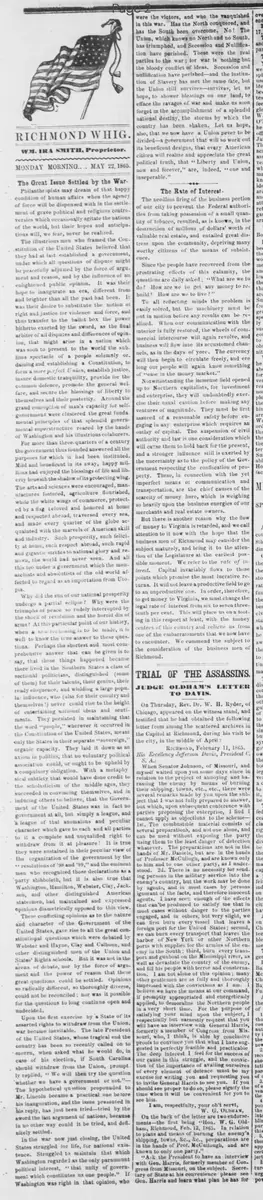
RICHMOND WHIG.
WM. IRA SMITH, Proprietor.
MONDAY MORNING, MAY 22, 1865.
The Great Issue Settled by the War—
Philanthropists may dream of that happy condition of human affairs when the agency of force will be dispensed with in the settlement of grave political and religious controversies which occasionally agitate the nations of the world, but their hopes and anticipations will, we fear, never be realized.
The illustrious men who framed the Constitution of the United States believed that they had at last established a government, under which all questions of dispute might be peaceably adjusted by the force of argument and reason, and by the influence of an enlightened public opinion. It was their hope to inaugurate an era, different from and brighter than all the past had been. It was their desire to substitute the notion of right and justice for violence and force, and thus transfer to the ballot box the power hitherto exerted by the sword, as the final arbiter of all disputes and differences of opinion, that might arise in a nation which was soon to present to the world the sublime spectacle of a people solemnly ordaining and establishing a Constitution, to form a more perfect Union, establish justice, insure domestic tranquility, provide for the common defence, promote the general welfare, and secure the blessings of liberty to themselves and their posterity. Around the grand conception of man's capacity for self-government were clustered the great fundamental principles of that splendid governmental superstructure reared by the hands of Washington and his illustrious colaborers.
For more than three-quarters of a century the government thus founded answered all the purposes for which it had been instituted. Mild and beneficent in its sway, happy millions had enjoyed the blessings of life and liberty beneath the shadow of its protecting wing. The arts and sciences were encouraged, manufactures fostered, agriculture flourished, while the white wings of commerce, protected by a flag beloved and honored at home and respected abroad, traversed every sea, and made every quarter of the globe acquainted with the marvels of American skill and industry. Such prosperity, such felicity at home, such respect abroad, such rapid and gigantic strides to national glory and renown, the world had never seen. And all this too under a government which the monarchists and absolutists of the old world affected to regard as an importation from Utopia.
Why did the sun of our national prosperity undergo a partial eclipse? Why were the triumphs of peace so rudely interrupted by the shock of revolution and the horrid din of arms? At this particular point of our history, when a new reckoning is to be made, it is well to know the true answer to these questions. Perhaps the shortest and most comprehensive answer that can be given is to say, that those things happened because there lived in the Southern States a class of sectional politicians, distinguished (some of them) for their talents, their genius, their ready eloquence, and wielding a large popular influence, who (alas for their country and themselves!) never could rise to the height of entertaining national ideas and sentiments. They persisted in maintaining that the word "people," wherever it occurred in the Constitution of the United States, meant only the States in their separate "sovereign," organic capacity. They laid it down as an axiom in politics, that no voluntary political association could, or ought to be upheld by a compulsory obligation. With a metaphysical subtlety that would have done credit to the scholasticism of the middle ages, they succeeded in convincing themselves, and in inducing others to believe, that the Government of the United States was in fact no government at all, but simply a league, and a league of that anomalous and peculiar character which gave to each and all parties to it a complete and unqualified right to withdraw from it at pleasure! It is true they were sustained in their peculiar view of the organization of the government by the "resolutions of '98 and '99," and the eminent men who recognized those declarations as a party shibboleth, but it is also true that Washington, Hamilton, Webster, Clay, Jackson, and other distinguished American statesmen, had maintained and expressed opinions diametrically opposed to this view.
These conflicting opinions as to the nature and character of the Government of the United States, gave rise to all the great constitutional questions which were debated by Webster and Hayne, Clay and Calhoun, and other distinguished men of the Union and States' Rights schools. But it was not in the arena of debate, nor by the force of argument and the power of reason that these great questions could be settled. Opinions so radically different, so thoroughly diverse, could not be reconciled: nor was it possible for the questions to long continue open and undecided.
Upon the first exercise by a State of its asserted rights to withdraw from the Union, war became inevitable. The late President of the United States, whose tragical end the country has been so recently called on to mourn, when asked what he would do, in case of his election, if South Carolina should withdraw from the Union, promptly replied, "We will then try the question whether we have a government or not."— The hypothetical question propounded to Mr. Lincoln became a practical one before his inauguration, and the issue presented in his reply, has just been tried—tried by the sword the last argument of nations, because in no other way could it be tried, and definitely settled.
In the war now just closing, the United States struggled for life, for national existence. Struggled to maintain that which Washington regarded as the only paramount political interest, "that unity of government which constitutes us one people." If Washington was right in that opinion, who were the victors, and who the vanquished in this war. Has the North conquered, and has the South been overcome. No! The Union, which knows no North and no South, has triumphed. and Secession and Nullification have perished. These were the real parties to the war;for war is nothing but the bloody conflict of ideas. Secession and nullification have perished—and the institution of Slavery has met the same fate, but the Union still survives—survives, let us hope, to shower blessings on our land, to efface the ravages of war and make us soon forget in the accomplishment of a splendid national destiny, the storms by which the country has been shaken. Let us hope, also, that we now have a Union never to be divided—a government that will so work out its beneficent designs, that every American citizen will realize and appreciate the great political truth, that "Liberty and Union, now and forever," are, indeed, "one and inseparable."
WM. IRA SMITH, Proprietor.
MONDAY MORNING, MAY 22, 1865.
The Great Issue Settled by the War—
Philanthropists may dream of that happy condition of human affairs when the agency of force will be dispensed with in the settlement of grave political and religious controversies which occasionally agitate the nations of the world, but their hopes and anticipations will, we fear, never be realized.
The illustrious men who framed the Constitution of the United States believed that they had at last established a government, under which all questions of dispute might be peaceably adjusted by the force of argument and reason, and by the influence of an enlightened public opinion. It was their hope to inaugurate an era, different from and brighter than all the past had been. It was their desire to substitute the notion of right and justice for violence and force, and thus transfer to the ballot box the power hitherto exerted by the sword, as the final arbiter of all disputes and differences of opinion, that might arise in a nation which was soon to present to the world the sublime spectacle of a people solemnly ordaining and establishing a Constitution, to form a more perfect Union, establish justice, insure domestic tranquility, provide for the common defence, promote the general welfare, and secure the blessings of liberty to themselves and their posterity. Around the grand conception of man's capacity for self-government were clustered the great fundamental principles of that splendid governmental superstructure reared by the hands of Washington and his illustrious colaborers.
For more than three-quarters of a century the government thus founded answered all the purposes for which it had been instituted. Mild and beneficent in its sway, happy millions had enjoyed the blessings of life and liberty beneath the shadow of its protecting wing. The arts and sciences were encouraged, manufactures fostered, agriculture flourished, while the white wings of commerce, protected by a flag beloved and honored at home and respected abroad, traversed every sea, and made every quarter of the globe acquainted with the marvels of American skill and industry. Such prosperity, such felicity at home, such respect abroad, such rapid and gigantic strides to national glory and renown, the world had never seen. And all this too under a government which the monarchists and absolutists of the old world affected to regard as an importation from Utopia.
Why did the sun of our national prosperity undergo a partial eclipse? Why were the triumphs of peace so rudely interrupted by the shock of revolution and the horrid din of arms? At this particular point of our history, when a new reckoning is to be made, it is well to know the true answer to these questions. Perhaps the shortest and most comprehensive answer that can be given is to say, that those things happened because there lived in the Southern States a class of sectional politicians, distinguished (some of them) for their talents, their genius, their ready eloquence, and wielding a large popular influence, who (alas for their country and themselves!) never could rise to the height of entertaining national ideas and sentiments. They persisted in maintaining that the word "people," wherever it occurred in the Constitution of the United States, meant only the States in their separate "sovereign," organic capacity. They laid it down as an axiom in politics, that no voluntary political association could, or ought to be upheld by a compulsory obligation. With a metaphysical subtlety that would have done credit to the scholasticism of the middle ages, they succeeded in convincing themselves, and in inducing others to believe, that the Government of the United States was in fact no government at all, but simply a league, and a league of that anomalous and peculiar character which gave to each and all parties to it a complete and unqualified right to withdraw from it at pleasure! It is true they were sustained in their peculiar view of the organization of the government by the "resolutions of '98 and '99," and the eminent men who recognized those declarations as a party shibboleth, but it is also true that Washington, Hamilton, Webster, Clay, Jackson, and other distinguished American statesmen, had maintained and expressed opinions diametrically opposed to this view.
These conflicting opinions as to the nature and character of the Government of the United States, gave rise to all the great constitutional questions which were debated by Webster and Hayne, Clay and Calhoun, and other distinguished men of the Union and States' Rights schools. But it was not in the arena of debate, nor by the force of argument and the power of reason that these great questions could be settled. Opinions so radically different, so thoroughly diverse, could not be reconciled: nor was it possible for the questions to long continue open and undecided.
Upon the first exercise by a State of its asserted rights to withdraw from the Union, war became inevitable. The late President of the United States, whose tragical end the country has been so recently called on to mourn, when asked what he would do, in case of his election, if South Carolina should withdraw from the Union, promptly replied, "We will then try the question whether we have a government or not."— The hypothetical question propounded to Mr. Lincoln became a practical one before his inauguration, and the issue presented in his reply, has just been tried—tried by the sword the last argument of nations, because in no other way could it be tried, and definitely settled.
In the war now just closing, the United States struggled for life, for national existence. Struggled to maintain that which Washington regarded as the only paramount political interest, "that unity of government which constitutes us one people." If Washington was right in that opinion, who were the victors, and who the vanquished in this war. Has the North conquered, and has the South been overcome. No! The Union, which knows no North and no South, has triumphed. and Secession and Nullification have perished. These were the real parties to the war;for war is nothing but the bloody conflict of ideas. Secession and nullification have perished—and the institution of Slavery has met the same fate, but the Union still survives—survives, let us hope, to shower blessings on our land, to efface the ravages of war and make us soon forget in the accomplishment of a splendid national destiny, the storms by which the country has been shaken. Let us hope, also, that we now have a Union never to be divided—a government that will so work out its beneficent designs, that every American citizen will realize and appreciate the great political truth, that "Liberty and Union, now and forever," are, indeed, "one and inseparable."
What sub-type of article is it?
Historical Event
What themes does it cover?
Triumph
Justice
Survival
What keywords are associated?
Civil War
Union
Secession
Constitution
Slavery
National Unity
Nullification
What entities or persons were involved?
Washington
Lincoln
Webster
Hayne
Clay
Calhoun
Hamilton
Jackson
Where did it happen?
United States
Story Details
Key Persons
Washington
Lincoln
Webster
Hayne
Clay
Calhoun
Hamilton
Jackson
Location
United States
Event Date
1865
Story Details
The Civil War settled the constitutional debate over the Union's nature, rejecting secession and nullification, ending slavery, and affirming national unity as envisioned by the framers, leading to a triumphant, indivisible Union.