Thank you for visiting SNEWPapers!
Sign up free
Story
June 16, 1954
Tabor City Tribune
Tabor City, Columbus County, North Carolina
What is this article about?
In Tabor City, public unconcern has prevented water shortage panics despite past low levels. The system includes three pumps, gradual meter installations, average family use of 5-6k gallons/month, tiered rates, and recent housing growth indicating prosperity. (248 chars)
Clipping
OCR Quality
97%
Excellent
Full Text
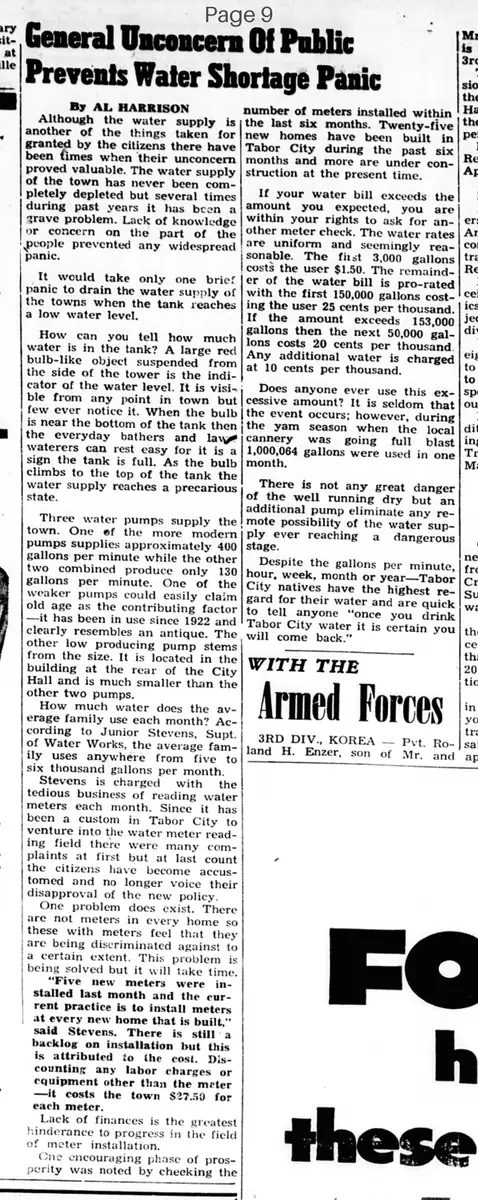
General Unconcern Of Public Prevents Water Shortage Panic
By AL HARRISON
Although the water supply is another of the things taken for granted by the citizens there have been times when their unconcern proved valuable. The water supply of the town has never been completely depleted but several times during past years it has been a grave problem. Lack of knowledge or concern on the part of the people prevented any widespread panic.
It would take only one brief panic to drain the water supply of the towns when the tank reaches a low water level.
How can you tell how much water is in the tank? A large red bulb-like object suspended from the side of the tower is the indicator of the water level. It is visible from any point in town but few ever notice it. When the bulb is near the bottom of the tank then the everyday bathers and lawn waterers can rest easy for it is a sign the tank is full. As the bulb climbs to the top of the tank the water supply reaches a precarious state.
Three water pumps supply the town. One of the more modern pumps supplies approximately 400 gallons per minute while the other two combined produce only 130 gallons per minute. One of the weaker pumps could easily claim old age as the contributing factor—it has been in use since 1922 and clearly resembles an antique. The other low producing pump stems from the size. It is located in the building at the rear of the City Hall and is much smaller than the other two pumps.
How much water does the average family use each month? According to Junior Stevens, Supt. of Water Works, the average family uses anywhere from five to six thousand gallons per month.
Stevens is charged with the tedious business of reading water meters each month. Since it has been a custom in Tabor City to venture into the water meter reading field there were many complaints at first but at last count the citizens have become accustomed and no longer voice their disapproval of the new policy.
One problem does exist. There are not meters in every home so these with meters feel that they are being discriminated against to a certain extent. This problem is being solved but it will take time.
"Five new meters were installed last month and the current practice is to install meters at every new home that is built," said Stevens. There is still a backlog on installation but this is attributed to the cost. Discounting any labor charges or equipment other than the meter—it costs the town $27.50 for each meter.
Lack of finances is the greatest hindrance to progress in the field of meter installation.
One encouraging phase of prosperity was noted by checking the number of meters installed within the last six months. Twenty-five new homes have been built in Tabor City during the past six months and more are under construction at the present time.
If your water bill exceeds the amount you expected, you are within your rights to ask for another meter check. The water rates are uniform and seemingly reasonable. The first 3,000 gallons costs the user $1.50. The remainder of the water bill is pro-rated with the first 150,000 gallons costing the user 25 cents per thousand. If the amount exceeds 150,000 gallons then the next 50,000 gallons costs 20 cents per thousand. Any additional water is charged at 10 cents per thousand.
Does anyone ever use this excessive amount? It is seldom that the event occurs; however, during the yam season when the local cannery was going full blast 1,000,064 gallons were used in one month.
There is not any great danger of the well running dry but an additional pump eliminate any remote possibility of the water supply ever reaching a dangerous stage.
Despite the gallons per minute, hour, week, month or year Tabor City natives have the highest regard for their water and are quick to tell anyone "once you drink Tabor City water it is certain you will come back."
By AL HARRISON
Although the water supply is another of the things taken for granted by the citizens there have been times when their unconcern proved valuable. The water supply of the town has never been completely depleted but several times during past years it has been a grave problem. Lack of knowledge or concern on the part of the people prevented any widespread panic.
It would take only one brief panic to drain the water supply of the towns when the tank reaches a low water level.
How can you tell how much water is in the tank? A large red bulb-like object suspended from the side of the tower is the indicator of the water level. It is visible from any point in town but few ever notice it. When the bulb is near the bottom of the tank then the everyday bathers and lawn waterers can rest easy for it is a sign the tank is full. As the bulb climbs to the top of the tank the water supply reaches a precarious state.
Three water pumps supply the town. One of the more modern pumps supplies approximately 400 gallons per minute while the other two combined produce only 130 gallons per minute. One of the weaker pumps could easily claim old age as the contributing factor—it has been in use since 1922 and clearly resembles an antique. The other low producing pump stems from the size. It is located in the building at the rear of the City Hall and is much smaller than the other two pumps.
How much water does the average family use each month? According to Junior Stevens, Supt. of Water Works, the average family uses anywhere from five to six thousand gallons per month.
Stevens is charged with the tedious business of reading water meters each month. Since it has been a custom in Tabor City to venture into the water meter reading field there were many complaints at first but at last count the citizens have become accustomed and no longer voice their disapproval of the new policy.
One problem does exist. There are not meters in every home so these with meters feel that they are being discriminated against to a certain extent. This problem is being solved but it will take time.
"Five new meters were installed last month and the current practice is to install meters at every new home that is built," said Stevens. There is still a backlog on installation but this is attributed to the cost. Discounting any labor charges or equipment other than the meter—it costs the town $27.50 for each meter.
Lack of finances is the greatest hindrance to progress in the field of meter installation.
One encouraging phase of prosperity was noted by checking the number of meters installed within the last six months. Twenty-five new homes have been built in Tabor City during the past six months and more are under construction at the present time.
If your water bill exceeds the amount you expected, you are within your rights to ask for another meter check. The water rates are uniform and seemingly reasonable. The first 3,000 gallons costs the user $1.50. The remainder of the water bill is pro-rated with the first 150,000 gallons costing the user 25 cents per thousand. If the amount exceeds 150,000 gallons then the next 50,000 gallons costs 20 cents per thousand. Any additional water is charged at 10 cents per thousand.
Does anyone ever use this excessive amount? It is seldom that the event occurs; however, during the yam season when the local cannery was going full blast 1,000,064 gallons were used in one month.
There is not any great danger of the well running dry but an additional pump eliminate any remote possibility of the water supply ever reaching a dangerous stage.
Despite the gallons per minute, hour, week, month or year Tabor City natives have the highest regard for their water and are quick to tell anyone "once you drink Tabor City water it is certain you will come back."
What sub-type of article is it?
Curiosity
Historical Event
What themes does it cover?
Misfortune
Moral Virtue
What keywords are associated?
Water Supply
Tabor City
Pumps
Meters
Panic Prevention
What entities or persons were involved?
Al Harrison
Junior Stevens
Where did it happen?
Tabor City
Story Details
Key Persons
Al Harrison
Junior Stevens
Location
Tabor City
Story Details
The article discusses the town's water supply history, potential shortages avoided by public unconcern, pump capacities, meter installations, usage statistics, and billing rates, highlighting community adaptation and growth.