Thank you for visiting SNEWPapers!
Sign up free
Editorial
December 5, 1832
The Massachusetts Spy
Worcester, Worcester County, Massachusetts
What is this article about?
The Massachusetts Spy reports on South Carolina's convention ordinance nullifying federal tariff laws as unconstitutional, prohibiting enforcement within the state, requiring oaths of obedience, and threatening secession if the federal government uses force to coerce compliance, dated December 5, 1832.
Clipping
OCR Quality
98%
Excellent
Full Text
The Massachusetts Spy.
"THE LIBERTY OF THE PRESS IS ESSENTIAL TO THE SECURITY OF FREEDOM."
WORCESTER:
WEDNESDAY, DEC. 5, 1832.
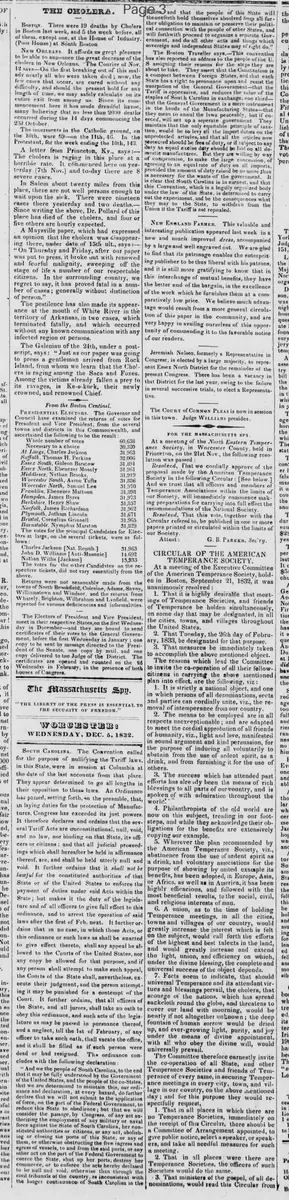
South Carolina. The Convention called for the purpose of nullifying the Tariff laws, in this State, were in session at Columbia at the date of the last accounts from that place. They appear determined to go all lengths in their opposition to these laws. An Ordinance has passed, setting forth, in the preamble, that, in laying duties for the protection of Manufactures, Congress has exceeded its just powers. It therefore declares and ordains that the several Tariff Acts are unconstitutional, null, void, and no law, nor binding on that State, its officers or citizens; and that all judicial proceedings which shall hereafter be held in affirmance thereof, are, and shall be held utterly null and void. It further ordains that it shall not be lawful for the constituted authorities of that State or of the United States to enforce the payment of duties under said Acts within the State; but makes it the duty of the legislature and of all officers to give full effect to this ordinance, and to arrest the operation of said laws after the first of Feb. next. It further ordains that in no case, in which those Acts, or this ordinance or such laws as shall be enacted to give effect thereto, shall any appeal be allowed to the Courts of the United States, nor any copy be allowed for that purpose, and if any person shall attempt to make such appeal, the Courts of the State shall, nevertheless, execute their judgment, and the person attempting it may be punished for a contempt of the Court. It further ordains, that all officers of the State, and all jurors, shall take an oath to obey this ordinance, and such acts of the legislature as may be passed in pursuance thereof, and a neglect, till the 1st of February, of any officer to take such oath, shall vacate the office, and it shall be filled as if such person were dead or had resigned. The ordinance concludes with the following declaration:
"And we the people of South Carolina, to the end that it may be fully understood by the Government of the United States, and the people of the co-States, that we are determined to maintain this, our ordinance and declaration, at every hazard, do further declare that we will not submit to the application of force, on the part of the Federal Government, to reduce this State to obedience; but that we will consider the passage, by Congress, of any act authorizing the employment of any military or naval force against the State of South Carolina, her constituted authorities or citizens, or any act, abolishing or closing the ports of this State, or any of them, or otherwise obstructing the free ingress and egress of vessels, to and from the said ports, or any other act on the part of the Federal Government to coerce the State, shut up her ports, destroy her commerce, or to enforce the acts hereby declared to be null and void, otherwise than through the civil tribunals of the country, as inconsistent with the longer continuance of South Carolina in the Union; and that the people thereof will thenceforth hold themselves absolved from all further obligation to maintain or preserve their political connection with the people of other States, and will forthwith proceed to organize a separate Government, and do all other acts and things which sovereign and independent States may of right do."
The Boston Traveller says,—This convention has also reported an address to the people of the U. S. assigning their reasons for the steps they are about to take. They assert that the Constitution is a compact between Sovereign States, and that each State has a right to pronounce upon and resist the usurpation of the General Government—that the Tariff is oppressive, and reduces the value of the staples of South Carolina in exchange, one third—that the General Government is a mere instrument in the hands of the Manufacturing States—that they mean to annul the laws peaceably, but if coerced, will set up a separate government They maintain that the only equitable principle of taxation, would be to levy all the import duties on the unprotected articles, and that all the articles now protected should be free of duty, or if subject to any duty an equal excise duty should be laid on all domestic manufactures. But they are willing by way of compromise, to make the large concession, of agreeing to an equal rate of duty on all imports, provided the amount of duty raised be no more than is necessary for the wants of the government. It is clear that South Carolina is in earnest, and that this Convention, which is a legally organized body under the law of the State, is determined to carry out the experiment, and be the consequences what they may to the State, to withdraw from the Union if the Tariff is not repealed.
"THE LIBERTY OF THE PRESS IS ESSENTIAL TO THE SECURITY OF FREEDOM."
WORCESTER:
WEDNESDAY, DEC. 5, 1832.
South Carolina. The Convention called for the purpose of nullifying the Tariff laws, in this State, were in session at Columbia at the date of the last accounts from that place. They appear determined to go all lengths in their opposition to these laws. An Ordinance has passed, setting forth, in the preamble, that, in laying duties for the protection of Manufactures, Congress has exceeded its just powers. It therefore declares and ordains that the several Tariff Acts are unconstitutional, null, void, and no law, nor binding on that State, its officers or citizens; and that all judicial proceedings which shall hereafter be held in affirmance thereof, are, and shall be held utterly null and void. It further ordains that it shall not be lawful for the constituted authorities of that State or of the United States to enforce the payment of duties under said Acts within the State; but makes it the duty of the legislature and of all officers to give full effect to this ordinance, and to arrest the operation of said laws after the first of Feb. next. It further ordains that in no case, in which those Acts, or this ordinance or such laws as shall be enacted to give effect thereto, shall any appeal be allowed to the Courts of the United States, nor any copy be allowed for that purpose, and if any person shall attempt to make such appeal, the Courts of the State shall, nevertheless, execute their judgment, and the person attempting it may be punished for a contempt of the Court. It further ordains, that all officers of the State, and all jurors, shall take an oath to obey this ordinance, and such acts of the legislature as may be passed in pursuance thereof, and a neglect, till the 1st of February, of any officer to take such oath, shall vacate the office, and it shall be filled as if such person were dead or had resigned. The ordinance concludes with the following declaration:
"And we the people of South Carolina, to the end that it may be fully understood by the Government of the United States, and the people of the co-States, that we are determined to maintain this, our ordinance and declaration, at every hazard, do further declare that we will not submit to the application of force, on the part of the Federal Government, to reduce this State to obedience; but that we will consider the passage, by Congress, of any act authorizing the employment of any military or naval force against the State of South Carolina, her constituted authorities or citizens, or any act, abolishing or closing the ports of this State, or any of them, or otherwise obstructing the free ingress and egress of vessels, to and from the said ports, or any other act on the part of the Federal Government to coerce the State, shut up her ports, destroy her commerce, or to enforce the acts hereby declared to be null and void, otherwise than through the civil tribunals of the country, as inconsistent with the longer continuance of South Carolina in the Union; and that the people thereof will thenceforth hold themselves absolved from all further obligation to maintain or preserve their political connection with the people of other States, and will forthwith proceed to organize a separate Government, and do all other acts and things which sovereign and independent States may of right do."
The Boston Traveller says,—This convention has also reported an address to the people of the U. S. assigning their reasons for the steps they are about to take. They assert that the Constitution is a compact between Sovereign States, and that each State has a right to pronounce upon and resist the usurpation of the General Government—that the Tariff is oppressive, and reduces the value of the staples of South Carolina in exchange, one third—that the General Government is a mere instrument in the hands of the Manufacturing States—that they mean to annul the laws peaceably, but if coerced, will set up a separate government They maintain that the only equitable principle of taxation, would be to levy all the import duties on the unprotected articles, and that all the articles now protected should be free of duty, or if subject to any duty an equal excise duty should be laid on all domestic manufactures. But they are willing by way of compromise, to make the large concession, of agreeing to an equal rate of duty on all imports, provided the amount of duty raised be no more than is necessary for the wants of the government. It is clear that South Carolina is in earnest, and that this Convention, which is a legally organized body under the law of the State, is determined to carry out the experiment, and be the consequences what they may to the State, to withdraw from the Union if the Tariff is not repealed.
What sub-type of article is it?
Constitutional
Economic Policy
Taxation
What keywords are associated?
Nullification
Tariff Laws
South Carolina
States Rights
Secession Threat
Constitutional Compact
Federal Coercion
What entities or persons were involved?
South Carolina Convention
Congress
Federal Government
People Of South Carolina
Boston Traveller
Editorial Details
Primary Topic
South Carolina's Nullification Ordinance Against Federal Tariff Laws
Stance / Tone
Neutral Reporting Of Serious Opposition And Potential Secession
Key Figures
South Carolina Convention
Congress
Federal Government
People Of South Carolina
Boston Traveller
Key Arguments
Tariff Acts Exceed Congress's Powers And Are Unconstitutional
Tariff Acts Null, Void, And Not Binding On South Carolina
State Authorities Must Prevent Enforcement Of Tariffs After February 1
No Appeals To U.S. Courts Allowed; State Courts To Execute Judgments
Officers And Jurors Must Oath To Obey Ordinance Or Vacate Office
Will Not Submit To Federal Force; Will Secede If Coerced
Constitution Is Compact Between Sovereign States
Tariff Oppressive, Reduces Value Of South Carolina Staples By One Third
General Government Instrument Of Manufacturing States
Willing To Compromise With Equal Duties Only For Government Needs