Thank you for visiting SNEWPapers!
Sign up free
Alexandria Gazette, Commercial And Political
Alexandria, Virginia
What is this article about?
A Virginia farmer defends merchants' importations of goods after the British orders in council were revoked, arguing against enforcing their bonds as proposed by Mr. Johnson. He contends that these imports provided essential revenue, clothing, and economic benefits during the War of 1812, promoting national unity and justice.
Clipping
OCR Quality
Full Text
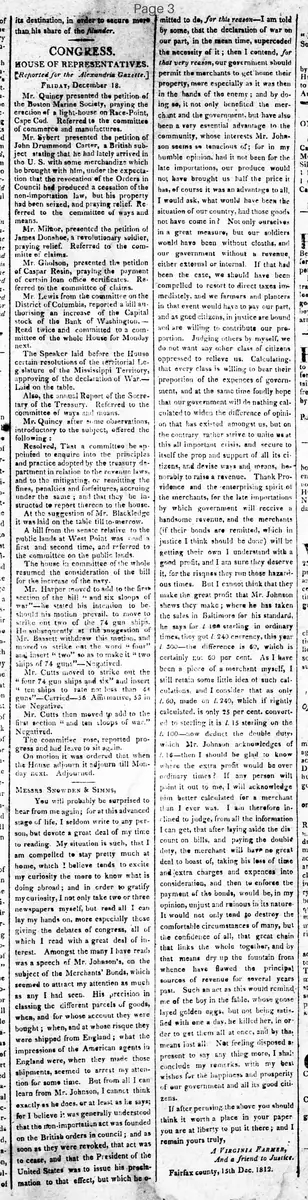
You will probably be surprised to hear from me again; for at this advanced stage of life, I seldom write to any person, but devote a great deal of my time to reading. My situation is such, that I am compelled to stay pretty much at home, which I believe tends to excite my curiosity the more to know what is doing abroad; and in order to gratify my curiosity, I not only take two or three newspapers myself, but read all I can lay my hands on, more especially those giving the debates of congress, all of which I read with a great deal of interest. Amongst the many I have read was a speech of Mr. Johnson's, on the subject of the Merchants' Bonds, which seemed to attract my attention as much as any I had seen. His precision in classing the different parcels of goods, when, and for whose account they were bought; when, and at whose risque they were shipped from England; what the impressions of the American agents in England were, when they made those shipments, seemed to arrest my attention for some time. But from all I can learn from Mr. Johnson, I cannot think exactly as he does, or at least as he says; for I believe it was generally understood that the non-importation act was founded on the British orders in council; and as soon as they were revoked, that act was to cease, and that the President of the United States was to issue his proclamation to that effect, but which he omitted to do, for this reason--I am told by some, that the declaration of war on our part, in the mean time, superseded the necessity of it; then I contend, for that very reason, our government should permit the merchants to get home their property, more especially as it was then in the hands of the enemy; and by doing so, it not only benefited the merchant and the government, but have also been a very essential advantage to the community, whose interests Mr. Johnson seems so tenacious of; for in my humble opinion, had it not been for the late importations, our produce would not have brought us half the price it has, of course it was an advantage to all.
I would ask, what would have been the situation of our country, had those goods not have come in? Not only ourselves in a great measure, but our soldiers would have been without cloaths, and our government without a revenue either external or internal. If that had been the case, we should have been compelled to resort to direct taxes immediately, and we farmers and planters in that event would have to pay our part, and as good citizens, in justice are bound and are willing to contribute our proportion. Judging others by myself, we do not want any other class of citizens oppressed to relieve us. Calculating that every class is willing to bear their proportion of the expences of government, and at the same time fondly hope that our government will do nothing calculated to widen the difference of opinion that has existed amongst us, but on the contrary rather strive to unite us all at this all important crisis, and secure to itself the prop and support of all its citizens, and devise ways and means, honourably to raise a revenue. Thank Providence and the enterprising spirit of the merchants, for the late importations by which government will receive a handsome revenue, and the merchants (if their bonds are remitted, which in justice I think should be done) will be getting their own I understand with a good profit, and I am sure they deserve it, for the risques they run those hazardous times. But I cannot think that they make the great profit that Mr. Johnson shows they make; where he has taken the sales in Baltimore for his standard, he says for £100 sterling in ordinary times, they got £240 currency, this year £500--the difference is £260. which is certainly not 60 per cent. as I have been a piece of a merchant myself, I still retain some little idea of such calculations, and I consider that as only £60, made on £240, which if rightly calculated, is only 25 per cent. converted to sterling it is £15 sterling on the £100--now deduct the double duties which Mr. Johnson acknowledges of £16--then I should be glad to know where the extra profit would be over ordinary times? If any person will point it out to me, I will acknowledge him better calculated for a merchant than I ever was. I am therefore inclined to judge, from all the information I can get, that after laying aside the discount on bills, and paying the double duty, the merchant will have no great deal to boast of, taking his loss of time and extra charges and expences into consideration, and then to enforce the payment of the bonds, would be, in my opinion, unjust and ruinous in its nature It would not only tend to destroy the comfortable circumstances of many, but the confidence of all, that great chain that links the whole together, and by that means dry up the fountain from whence have flowed the principal sources of revenue for several years past. Such an act as this would remind me of the boy in the fable, whose goose layed golden eggs, but not being satisfied with one a day, he killed her, in order to get them all at once, and by that means lost all. Not feeling disposed at present to say any thing more, I shall conclude my remarks, with my best wishes for the happiness and prosperity of our government and all its good citizens.
If after perusing the above you should think it worth a place in your paper you are at liberty to put it there; and I remain yours truly,
A VIRGINIA FARMER,
And a friend to Justice.
Fairfax county, 15th Dec. 1812.
What sub-type of article is it?
What themes does it cover?
What keywords are associated?
What entities or persons were involved?
Letter to Editor Details
Author
A Virginia Farmer, And A Friend To Justice.
Recipient
Messrs Snowden & Simms
Main Argument
the government should remit merchants' bonds for goods imported after the revocation of british orders in council, as these imports provided vital revenue, goods, and economic benefits during the war of 1812, countering mr. johnson's criticisms and promoting justice and unity.
Notable Details