Thank you for visiting SNEWPapers!
Sign up free
Alexandria Gazette
Alexandria, Alexandria County, District Of Columbia
What is this article about?
Great Britain offers mediation to resolve difficulties between the United States and France over unpaid debts. The US Executive accepts, hoping for amicable settlement without war. Reports from US and UK papers express optimism and distinguish mediation from arbitration.
Clipping
OCR Quality
Full Text
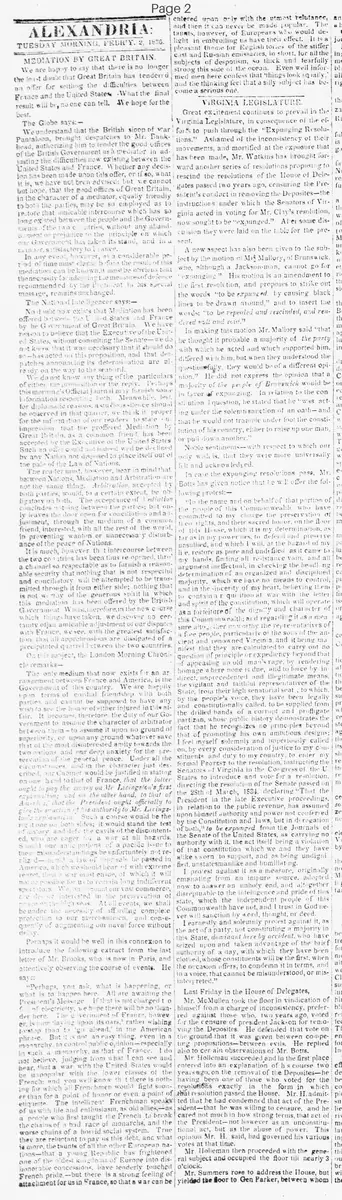
TUESDAY MORNING, FEBRUARY 2, 1836.
MEDIATION BY GREAT BRITAIN
We are happy to say that there is no longer the least doubt that Great Britain has tendered an offer for settling the difficulties between France and the United States. What the final result will be, no one can tell. We hope for the best.
The Globe says:
We understand that the British sloop of war Pantaloon, brought despatches to Mr. Stevenson, authorizing him to tender the good offices of the British Government as a mediator in adjusting the difficulties now existing between the United States and France. Whether any decision has been made upon this offer, or if so, what it is, we have not been advised; but we cannot but hope, that the good offices of Great Britain, in the character of a mediator, equally friendly to both the parties, may be so employed as to restore that amicable intercourse which has so long existed between the people and the Governments of the two countries, without any abandonment of principle on which our Government has taken its stand, and in a manner satisfactory to France.
In any event, however, as a considerable period of time must elapse before the result of this mediation can be known, it must be obvious that the necessity of adopting the measures of defence recommended by the President in his special message, remains unchanged.
The National Intelligencer says:
No doubt now exists that Mediation has been offered between the United States and France by the Government of Great Britain. We have reason to believe that the Executive of the United States, without consulting the Senate—we do not know that it was necessary that it should do so—has acted on this proposition, and that despatches announcing its determination are already on the way to the seaboard.
We do not know anything of the particulars of either the proposition or the reply. Perhaps this morning's Official Journal may furnish some information respecting both. Meantime, lest for diplomatic reasons, a studious silence should be observed in that quarter, we think it proper for the information of our readers to state our impression that the proffered Mediation by Great Britain, as a common friend, has been accepted by the Executive of the United States.
Such an offer would indeed well be declined by any Nation not disposed to place itself out of the pale of the Law of Nations.
The reader must, however, bear in mind that between Nations, Mediation and Arbitration are not the same thing. Arbitration, accepted by both parties, would, to a certain extent, be obligatory on both. The acceptance of Mediation concludes nothing between the parties; but only leaves the door open for conciliation and adjustment, through the medium of a common friend, interested, with all the rest of the world in preventing wanton or unnecessary disturbance of the peace of Nations.
It is much, however, that intercourse between the two countries has been thus re-opened, through a channel so respectable as to furnish a reasonable security that nothing that is not respectful and conciliatory will be attempted to be transmitted through it from either side; nothing that is not worthy of the generous spirit in which this mediation has been offered by the British Government. Without therefore, in the new course which things have taken, we discover no certainty of an amicable adjustment of our disputes with France, we see, with the greatest satisfaction that all apprehensions are dissipated of a precipitated quarrel between the two countries.
On this subject, the London Morning Chronicle remarks:
The only medium that now exists for an arrangement between France and America, is the Government of this country. We are happily upon terms of cordial friendship with both parties, and cannot be supposed to have any wish to see the honor of either injured in this affair. It becomes, therefore, the duty of our Government to assume the character of arbitrator between them—to assume it upon no ground of superiority, or upon any ground whatever save that of the most disinterested amity towards the two nations and our deep anxiety for the preservation of the general peace. Under all the circumstances, and in the character just described, a Cabinet would be justified in stating on one hand to that of France, that the latter ought to pay the money on Mr. Livingston's first capitulation; and on the other hand, to that of America, that the President ought officially to give the sanction of his authority to Mr. Livingston's arrangement. Such a course would be the right one on both sides; it would stand the test of history and defy the cavils of the discontented, who are eager for a war at all hazards.
Should our anticipations of a pacific issue to these misunderstandings be unfortunately not realized—should a law of reprisal be passed in America, which we should hear with extreme regret—then we must engage of which it will not be possible to us to remain long indifferent spectators. We will count on our vast commerce, and so interested in the preservation of the honor of nations. At all events, we shall be under the necessity of affording complete protection to our merchantmen, and consequently of augmenting our naval force without delay.
Perhaps it would be well in this connexion to introduce the following extract from the last letter of Mr. Brooks, who is now in Paris, and attentively observing the course of events. He says:
"Perhaps, you ask, what is happening, or what is to happen here. All are awaiting the President's Message. If that is not charged too highly with electricity, we hope there will be no thunder here. The government of France, however, is now lying upon its oars, rather wishing to stop than to go ahead, in the American phrase. But it is not an easy thing, even in a monarchy, to control public opinion—especially in such a monarchy, as that of France. I do not believe, judging from what I can see and hear, that a war with the United States would be popular with the lower classes of the French; and you well know that there is nothing for which all Frenchmen would fight sooner than for a point of honor or even a point of etiquette. The intelligent Frenchman speaks of us with life and enthusiasm, as old allies,—as a people who first taught the French to break the chains of a bad race of monarchs, and the worse chains of a horrid social system. True they are reluctant to pay us this debt, and what is more, the taunts of all the other European nations—that a young Republic has frightened one of the oldest kingdoms of Europe into dishonorable concessions, have tenderly touched French pride—but there is a strong feeling of attachment for us in France, so that a war can be entered upon only with the utmost reluctance,"
What sub-type of article is it?
What keywords are associated?
What entities or persons were involved?
Where did it happen?
Foreign News Details
Primary Location
Great Britain
Event Date
February 2, 1836
Key Persons
Outcome
mediation offered by great britain and accepted by the united states executive; hopes for amicable resolution without war or abandonment of principles; defensive measures remain necessary pending outcome.
Event Details
Great Britain tenders mediation via despatches brought by the sloop Pantaloon to Mr. Stevenson to settle US-France difficulties. US accepts as a common friend. Reports from The Globe, National Intelligencer, and London Morning Chronicle express optimism for conciliation, distinguish mediation from arbitration, and note French reluctance for war despite honor concerns. Mr. Brooks reports from Paris on awaiting US President's message and French public opinion.