Thank you for visiting SNEWPapers!
Sign up free
The New Hampshire Gazette And Historical Chronicle
Portsmouth, Greenland, Rockingham County, New Hampshire
What is this article about?
A French royal council at Compiègne confirmed 1727 prohibitive laws on colonial commerce but established free ports at St. Lucia for Windward Islands and St. Nicholas for Leeward Islands, allowing foreign imports like ship timber, waiving duties on slaves and cod-fish, and halving duties on American produce imported in exchange for slaves. Reported in a Paris letter dated August 7.
Clipping
OCR Quality
Full Text
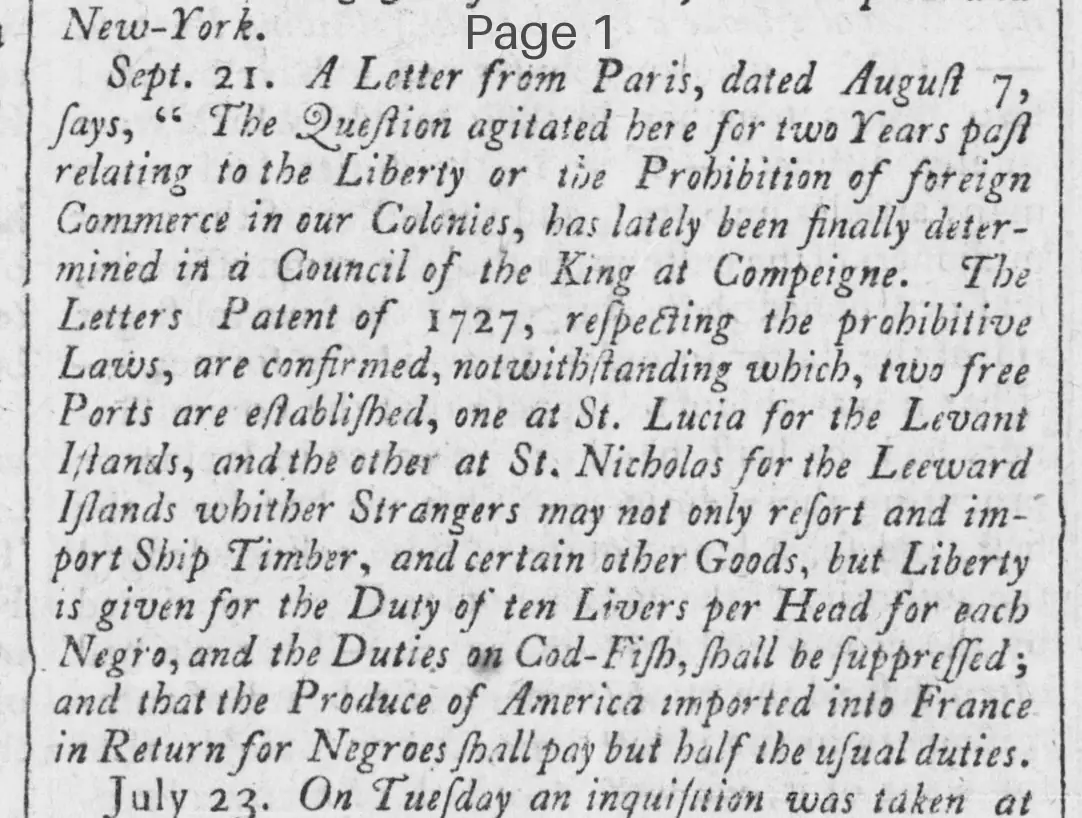
"The Question agitated here for two Years past relating to the Liberty or the Prohibition of foreign Commerce in our Colonies, has lately been finally determined in a Council of the King at Compeigne.
The Letters Patent of 1727, respecting the prohibitive Laws, are confirmed, notwithstanding which, two free Ports are established, one at St. Lucia for the Levant Islands, and the other at St. Nicholas for the Leeward Islands whither Strangers may not only resort and import Ship Timber, and certain other Goods, but Liberty is given for the Duty of ten Livres per Head for each Negro, and the Duties on Cod-Fish, shall be suppressed; and that the Produce of America imported into France in Return for Negroes shall pay but half the usual duties."
What sub-type of article is it?
What keywords are associated?
Where did it happen?
Foreign News Details
Primary Location
Compeigne, France
Event Date
August 7
Outcome
confirmation of 1727 prohibitive laws; establishment of free ports at st. lucia and st. nicholas; suppression of duties on slaves (10 livres per head) and cod-fish; half duties on american produce imported for slaves.
Event Details
The long-debated question of liberty versus prohibition of foreign commerce in French colonies was resolved in a royal council at Compeigne, confirming the 1727 Letters Patent on prohibitive laws while creating two free ports: St. Lucia for the Levant Islands and St. Nicholas for the Leeward Islands. Foreigners can import ship timber and other goods; duties on Negroes and cod-fish are eliminated, and American produce brought to France in exchange for slaves pays only half the usual duties.