Thank you for visiting SNEWPapers!
Sign up free
Atlanta Daily World
Atlanta, Fulton County, Georgia
What is this article about?
Marshall Plan provides $179,000 in trucks and $12,661 for dusting machines to fight red and desert locust plagues threatening crops and famine in Africa, especially Tanganyika's Rukwa Valley, amid risks from drought and rainy season.
Merged-components note: Merge due to explicit continuation '(Continued on page 6 Column 4)' in the text of the first component.
Clippings
1 of 2
OCR Quality
Full Text
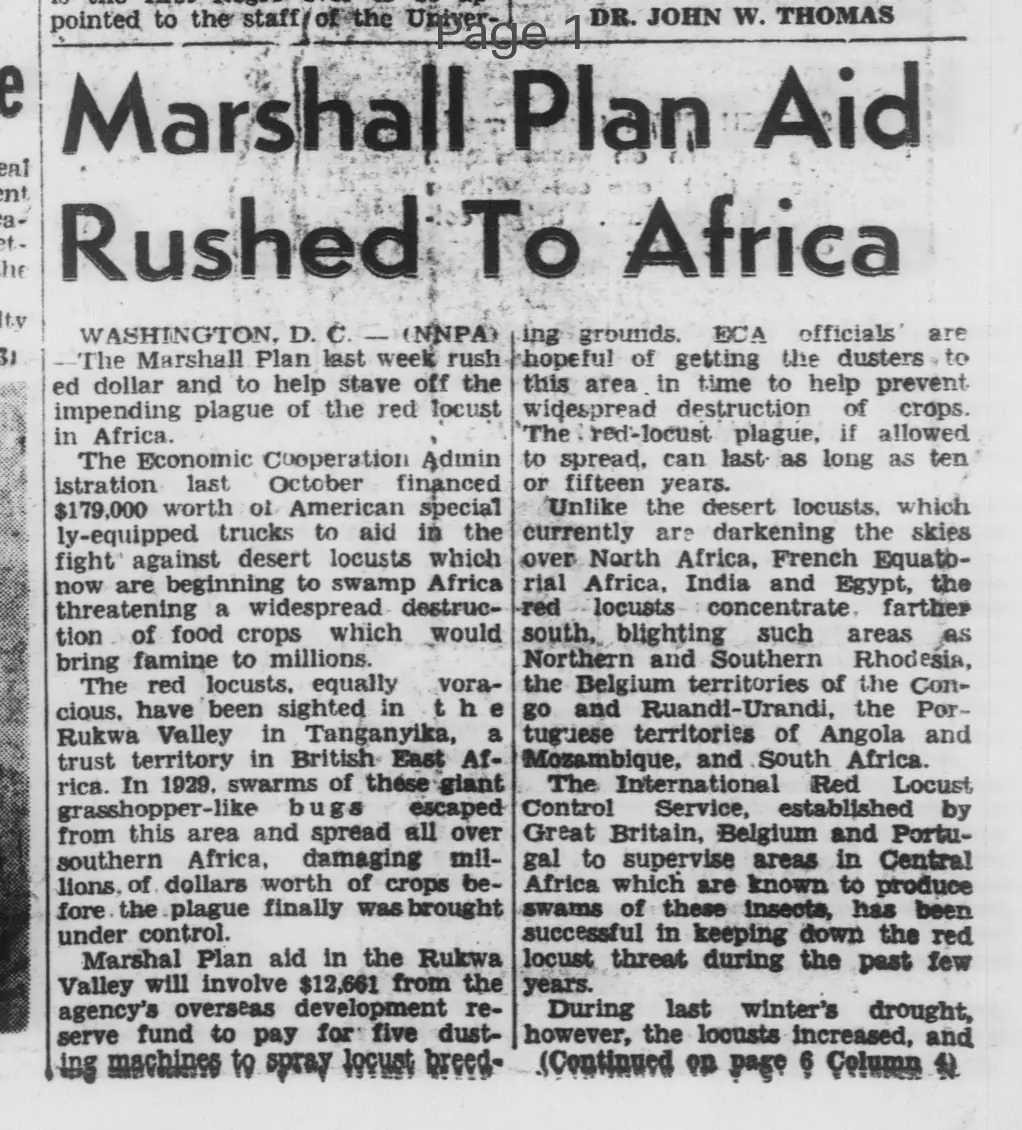
WASHINGTON, D. C. - (NNPA) The Marshall Plan last week rushed dollars to help stave off the impending plague of the red locust in Africa.
The Economic Cooperation Administration last October financed $179,000 worth of American specially-equipped trucks to aid in the fight against desert locusts which now are beginning to swamp Africa threatening a widespread destruction of food crops which would bring famine to millions.
The red locusts, equally voracious, have been sighted in the Rukwa Valley in Tanganyika, a trust territory in British East Africa. In 1929, swarms of these giant grasshopper-like bugs escaped from this area and spread all over southern Africa, damaging millions of dollars worth of crops before the plague finally was brought under control.
Marshall Plan aid in the Rukwa Valley will involve $12,661 from the agency's overseas development reserve fund to pay for five dusting machines to spray locust breeding grounds. ECA officials are hopeful of getting the dusters to this area in time to help prevent widespread destruction of crops.
The red-locust plague, if allowed to spread, can last as long as ten or fifteen years.
Unlike the desert locusts, which currently are darkening the skies over North Africa, French Equatorial Africa, India and Egypt, the red-locusts concentrate farther south, blighting such areas as Northern and Southern Rhodesia, the Belgian territories of the Congo and Ruanda-Urundi, the Portuguese territories of Angola and Mozambique, and South Africa.
The International Red Locust Control Service, established by Great Britain, Belgium and Portugal to supervise areas in Central Africa which are known to produce swarms of these insects, has been successful in keeping down the red locust threat during the past few years.
During last winter's drought however, the locusts increased, and (Continued on page 6 Column 4)
Marshall Plan
(Continued from Page One)
serious danger exists that during and after the current rainy season -December through February-the locusts may get out of control.
In the current battle against desert locusts, caravans of insect fighters are crossing the vast Saudi Arabian territory in 1,000 trucks specially armed with poison bait, sprayers and other insecticide equipment.
What sub-type of article is it?
What keywords are associated?
Where did it happen?
Foreign News Details
Primary Location
Tanganyika
Event Date
Last Week
Outcome
threat of famine to millions from crop destruction; potential red locust plague lasting 10-15 years; $179,000 in trucks financed last october; $12,661 for five dusting machines
Event Details
The Marshall Plan rushed aid to combat red locust plague in Rukwa Valley, Tanganyika, British East Africa. Trucks financed last October fight desert locusts swamping Africa. Red locusts sighted, recalling 1929 swarm that damaged crops across southern Africa. Aid includes dusting machines to spray breeding grounds. International Red Locust Control Service monitors Central Africa. Drought increased locusts last winter; danger during rainy season December-February. Desert locust battle involves 1,000 trucks in Saudi Arabia.