Thank you for visiting SNEWPapers!
Sign up free
Boon's Lick Times
Fayette, Howard County, Missouri
What is this article about?
Whig newspaper account of a poorly attended Democratic rally in Howard County on Wednesday, featuring speeches against the tariff, abuse of Whigs, and hypocrisy in using banners despite past criticisms; aimed to secure county for Polk but seen as a failure.
Merged-components note: These components continue the same story about the democratic rally, with sequential reading order and coherent topic flow.
Clipping
OCR Quality
Full Text
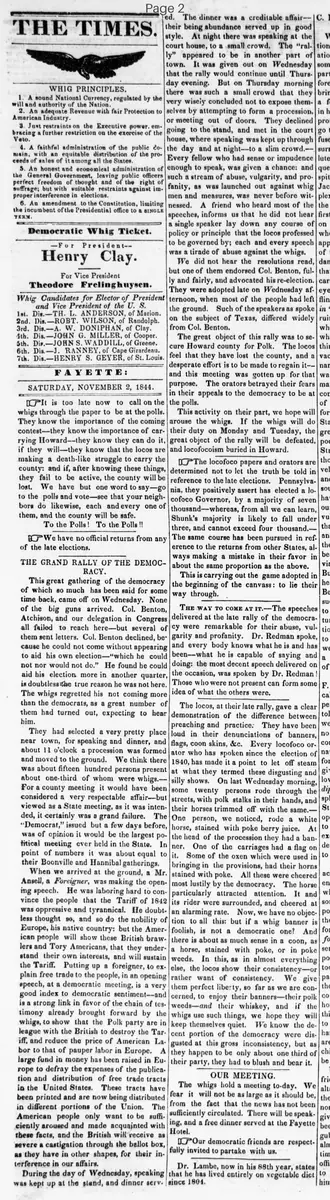
THE GRAND RALLY OF THE DEMOCRACY.
This great gathering of the democracy of which so much has been said for some time back, came off on Wednesday. None of the big guns arrived. Col. Benton, Atchison, and our delegation in Congress all failed to reach here--but several of them sent letters. Col. Benton declined, because he could not come without appearing to aid his own election--"which he could not nor would not do." He found he could aid his election more in another quarter, is doubtless the true reason he was not here. The whigs regretted his not coming more than the democrats, as a great number of them had turned out, expecting to hear him.
They had selected a very pretty place near town, for speaking and dinner, and about 11 o'clock a procession was formed and moved to the ground. We think there was about fifteen hundred persons present about one-third of whom were whigs.-- For a county meeting it would have been considered a very respectable affair--but viewed as a State meeting, as it was intended, it certainly was a grand failure. The "Democrat," issued but a few days before, was of opinion it would be the largest political meeting ever held in the State. In point of numbers it was about equal to their Boonville and Hannibal gatherings.
When we arrived at the ground, a Mr. Ansell, a Foreigner, was making the opening speech. He was laboring hard to convince the people that the Tariff of 1842 was oppressive and tyrannical. He doubtless thought so, and so do the nobility of Europe, his native country: but the American people will show these British brawlers and Tory Americans, that they understand their own interests, and will sustain the Tariff. Putting up a foreigner, to explain free trade to the people, in an opening speech, at a democratic meeting, is a very good index to democratic sentiment--and is a strong link in favor of the chain of testimony already brought forward by the whigs, to show that the Polk party are in league with the British to destroy the Tariff, and reduce the price of American Labor to that of pauper labor in Europe. A large fund in money has been raised in Europe to defray the expenses of the publication and distribution of free trade tracts in the United States. These tracts have been printed and are now being distributed in different portions of the Union. The American people only want to be sufficiently aroused and made acquainted with these facts, and the British will receive as severe a castigation through the ballot box, as they have in other shapes, for their interference in our affairs.
During the day of Wednesday, speaking was kept up at the stand, and dinner served. The dinner was a creditable affair-- there being abundance served up in good style. At night there was speaking at the court house, to a small crowd. The "rally" appeared to be in another part of town. It was given out on Wednesday that the rally would continue until Thursday evening. But on Thursday morning there was such a small crowd that they very wisely concluded not to expose themselves by attempting to form a procession, or meeting out of doors. They declined going to the stand, and met in the court house, where speaking was kept up through the day and at night--to a slim crowd.-- Every fellow who had sense or impudence enough to speak, was given a chance: and such a stream of abuse, vulgarity, and profanity, as was launched out against whig men and measures, was never before witnessed. A friend who heard most of the speeches, informs us that he did not hear a single speaker lay down any course of policy or principle that the locos professed to be governed by; each and every speech was a tirade of abuse against the whigs. We did not hear the resolutions read, but one of them endorsed Col. Benton, fully and fairly, and advocated his re-election They were adopted late on Wednesday afternoon, when most of the people had left the ground. Such of the speakers as spoke on the subject of Texas, differed widely from Col. Benton.
The great object of this rally was to secure Howard county for Polk. The locos feel that they have lost the county, and a desperate effort is to be made to regain it-- and this meeting was gotten up for that purpose. The orators betrayed their fears in their appeals to the democracy to be at the polls.
This activity on their part, we hope will arouse the whigs. If the whigs will do their duty on Monday and Tuesday, the great object of the rally will be defeated and locofocoism buried in Howard.
The locofoco papers and orators are determined not to let the truth be told in reference to the late elections. Pennsylvania, they positively assert has elected a locofoco Governor, by a majority of seven thousand--whereas, from all we can learn, Shunk's majority is likely to fall under three, and cannot exceed four thousand.-- The same course has been pursued in reference to the returns from other States, always making a mistake in their favor in about the same proportion as the above. This is carrying out the game adopted in the beginning of the canvass: to lie their way through.
THE WAY TO COME AT IT.--The speeches delivered at the late rally of the democracy were remarkable for their abuse, vulgarity and profanity. Dr. Redman spoke, and every body knows what he is and has been--what he is capable of saying and doing: the most decent speech delivered on the occasion, was spoken by Dr. Redman! Those who were not present can form some idea of what the others were.
The locos, at their late rally, gave a clear demonstration of the difference between preaching and practice: They have been loud in their denunciations of banners, flags, coon skins, &c. Every locofoco orator who has spoken since the election of 1840, has made it a point to let off steam at what they termed these disgusting and silly shows. On last Wednesday morning, some twenty persons rode through the streets, with polk stalks in their hands, and their horses trimmed off with the same.- One person, we noticed, rode a white horse, stained with poke berry juice. At the head of the procession they had a banner. One of the carriages had a flag on it. Some of the oxen which were used in bringing in the provisions, had their horns stained with poke. All these were cheered most lustily by the democracy. The horse particularly attracted attention. It and its rider were surrounded, and cheered at an alarming rate. Now, we have no objection to all this: but if a whig banner is foolish, is not a democratic one? And there is about as much sense in a coon, as a horse, stained with poke, or in poke weeds. In this, as in almost everything else, the locos show their consistency--or rather want of consistency. We give them perfect liberty, so far as we are concerned, to enjoy their banners--their polk weeds--and their whiskey, and if the whigs use such things, we hope they will keep themselves quiet. We know the decent portion of the democracy were disgusted at this gross inconsistency, but as they happen to be only about one third of their party, they had to blush and bear it.
What sub-type of article is it?
What themes does it cover?
What keywords are associated?
What entities or persons were involved?
Where did it happen?
Story Details
Key Persons
Location
Howard County
Event Date
Wednesday And Thursday
Story Details
A Democratic rally in Howard County, intended as a major state gathering but attended by only 1500, mostly locals; featured speeches by Mr. Ansell against the tariff and others abusing Whigs; endorsed Benton but conflicted on Texas; criticized for hypocrisy in using banners and poke weeds; aimed to win county for Polk amid fears of loss; Whig reporter sees it as failure and calls for Whig turnout.