Thank you for visiting SNEWPapers!
Sign up free
Story
June 30, 1913
The Daily Inter Mountain
Elkins, Randolph County, West Virginia
What is this article about?
Article metaphorically compares farmland to a bank needing fertility deposits via practices like manure saving, legumes, liming, and rotation, rather than a mine to exhaust, to sustain and improve productivity.
Clipping
OCR Quality
95%
Excellent
Full Text
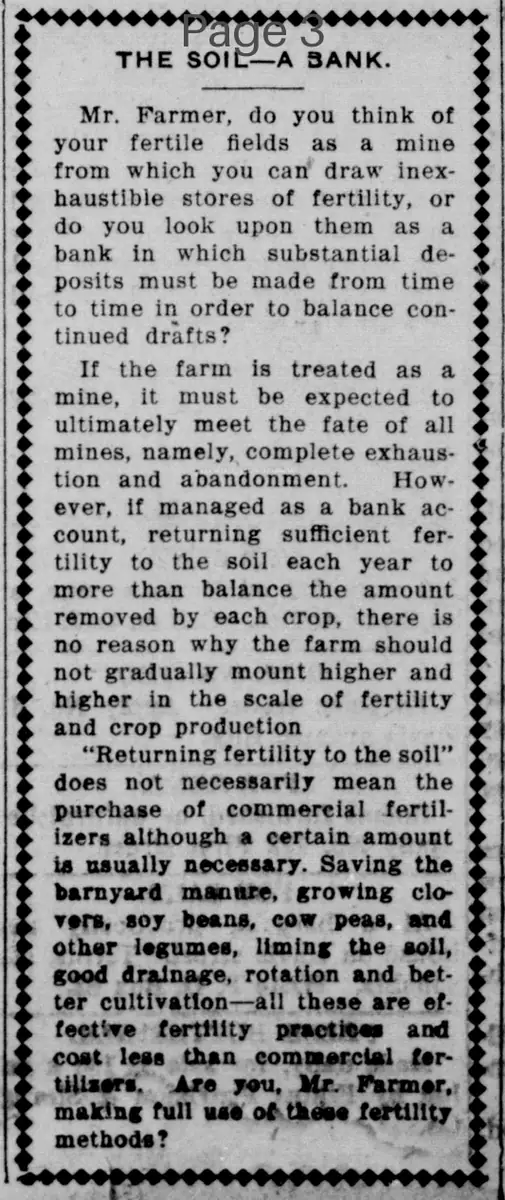
THE SOIL BANK.
Mr. Farmer, do you think of your fertile fields as a mine from which you can draw inexhaustible stores of fertility, or do you look upon them as a bank in which substantial deposits must be made from time to time in order to balance continued drafts?
If the farm is treated as a mine, it must be expected to ultimately meet the fate of all mines, namely, complete exhaustion and abandonment. However, if managed as a bank account, returning sufficient fertility to the soil each year to more than balance the amount removed by each crop, there is no reason why the farm should not gradually mount higher and higher in the scale of fertility and crop production.
"Returning fertility to the soil" does not necessarily mean the purchase of commercial fertilizers although a certain amount is usually necessary. Saving the barnyard manure, growing clovers, soy beans, cow peas, and other legumes, liming the soil, good drainage, rotation and better cultivation-all these are effective fertility practices and cost less than commercial fertilizers. Are you, Mr. Farmer, making full use of these fertility methods?
Mr. Farmer, do you think of your fertile fields as a mine from which you can draw inexhaustible stores of fertility, or do you look upon them as a bank in which substantial deposits must be made from time to time in order to balance continued drafts?
If the farm is treated as a mine, it must be expected to ultimately meet the fate of all mines, namely, complete exhaustion and abandonment. However, if managed as a bank account, returning sufficient fertility to the soil each year to more than balance the amount removed by each crop, there is no reason why the farm should not gradually mount higher and higher in the scale of fertility and crop production.
"Returning fertility to the soil" does not necessarily mean the purchase of commercial fertilizers although a certain amount is usually necessary. Saving the barnyard manure, growing clovers, soy beans, cow peas, and other legumes, liming the soil, good drainage, rotation and better cultivation-all these are effective fertility practices and cost less than commercial fertilizers. Are you, Mr. Farmer, making full use of these fertility methods?
What sub-type of article is it?
Agricultural Advice
Sustainability Lesson
What themes does it cover?
Moral Virtue
Nature
What keywords are associated?
Soil Fertility
Farming Practices
Crop Rotation
Manure Saving
Legumes
Sustainable Agriculture
Story Details
Story Details
Advises treating soil as a bank requiring fertility returns through natural practices to avoid exhaustion and improve production.