Thank you for visiting SNEWPapers!
Sign up free
North Carolina Standard
Raleigh, Wake County, North Carolina
What is this article about?
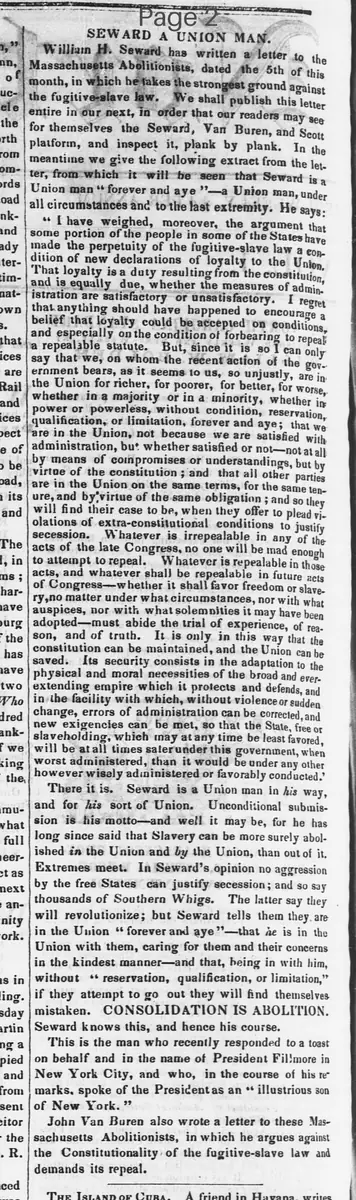
William H. Seward writes to Massachusetts Abolitionists opposing the fugitive-slave law and affirming unconditional loyalty to the Union regardless of administration policies. Commentary criticizes Seward's stance as promoting consolidation for abolition. John Van Buren also demands repeal of the law.
Clipping
OCR Quality
Full Text
William H. Seward has written a letter to the Massachusetts Abolitionists, dated the 5th of this month, in which he takes the strongest ground against the fugitive-slave law. We shall publish this letter entire in our next, in order that our readers may see for themselves the Seward, Van Buren, and Scott platform, and inspect it, plank by plank. In the meantime we give the following extract from the letter, from which it will be seen that Seward is a Union man "forever and aye"—a Union man, under all circumstances and to the last extremity. He says:
"I have weighed, moreover, the argument that some portion of the people in some of the States have made the perpetuity of the fugitive-slave law a condition of new declarations of loyalty to the Union. That loyalty is a duty resulting from the constitution, and is equally due, whether the measures of administration are satisfactory or unsatisfactory. I regret that anything should have happened to encourage a belief that loyalty could be accepted on conditions, and especially on the condition of forbearing to repeal a repealable statute. But, since it is so I can only say that we, on whom the recent action of the government bears as it seems to us so unjustly are the Union for richer, for poorer, for better, for worse, whether in a majority or in a minority, whether in power or powerless, without condition, reservation, qualification, or limitation, forever and aye; that we are in the Union, not because we are satisfied with administration, but whether satisfied or not—not at all by means of compromises or understandings, but by virtue of the constitution; and that all other parties are in the Union on the same terms, for the same tenure, and by virtue of the same obligation; and so they will find their case to be, when they offer to plead violations of extra-constitutional conditions to justify secession. Whatever is irrepealable in any of the acts of the late Congress, no one will be mad enough to attempt to repeal." Whatever is repealable in those acts, and whatever shall be repealable in future acts of Congress—whether it shall favor freedom or slavery, no matter under what circumstances, nor with what auspices, nor with what solemnities it may have been adopted—must abide the trial of experience, of reason, and of truth. It is only in this way that the constitution can be maintained, and the Union can be saved. Its security consists in the adaptation to the physical and moral necessities of the broad and ever-extending empire which it protects and defends, and in the facility with which, without violence or sudden change, errors of administration can be corrected, and new exigencies can be met, so that the State, free or slaveholding, which may at any time be least favored, will be at all times safer under this government, when worst administered, than it would be under any other however wisely administered or favorably conducted."
There it is. Seward is a Union man in his way, and for his sort of Union. Unconditional submission is his motto—and well it may be, for he has long since said that Slavery can be more surely abolished in the Union and by the Union, than out of it. Extremes meet. In Seward's opinion no aggression by the free States can justify secession; and so say thousands of Southern Whigs. The latter say they will revolutionize; but Seward tells them they are in the Union "forever and aye"—that he is in the Union with them, caring for them and their concerns in the kindest manner and that, being in with him, without "reservation, qualification, or limitation," if they attempt to go out they will find themselves mistaken. CONSOLIDATION IS ABOLITION. Seward knows this, and hence his course.
This is the man who recently responded to a toast on behalf and in the name of President Fillmore in New York City, and who, in the course of his remarks, spoke of the President as an illustrious son of New York."
John Van Buren also wrote a letter to these Massachusetts Abolitionists, in which he argues against the Constitutionality, of the fugitive-slave law and demands its repeal.
What sub-type of article is it?
What themes does it cover?
What keywords are associated?
What entities or persons were involved?
Where did it happen?
Story Details
Key Persons
Location
Massachusetts, New York City
Event Date
5th Of This Month
Story Details
Seward's letter opposes fugitive-slave law and affirms unconditional Union loyalty via constitutional duty, rejecting conditional loyalty. Commentary portrays this as promoting consolidation for abolition. Van Buren argues against the law's constitutionality and demands repeal.