Thank you for visiting SNEWPapers!
Sign up free
The Enquirer
Richmond, Henrico County, Virginia
What is this article about?
A letter detailing recent French scientific essays by Malus and Biot on light polarization, contrasting Huygens' wave theory with Newton's corpuscular theory, referencing historical experiments with Iceland crystals and Laplace's analysis using the principle of least action. The writer plans to replicate the experiments.
Merged-components note: Merged continuation of scientific letter on optics experiments across components.
Clipping
OCR Quality
Full Text
SIR,
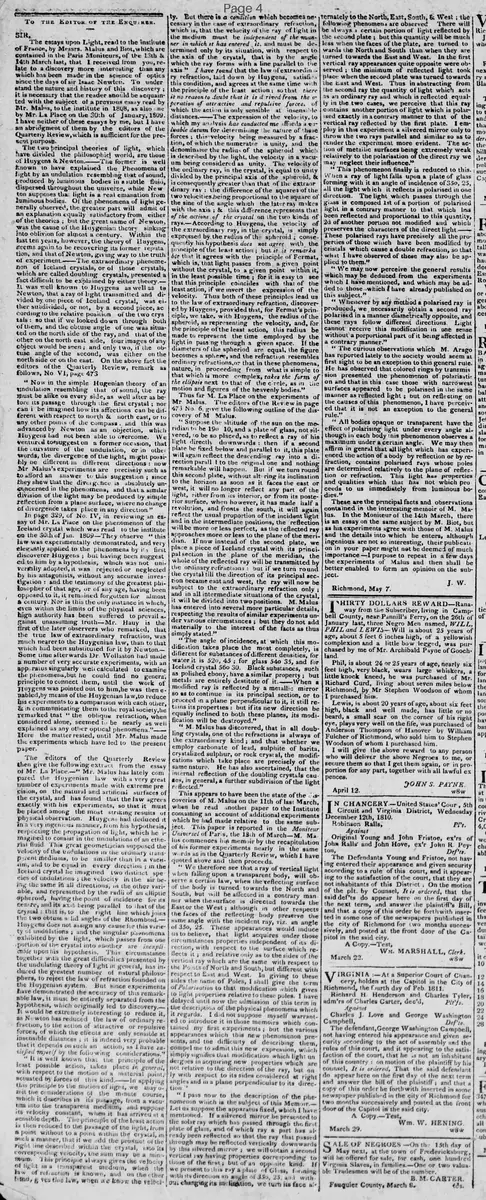
The essays upon Light, read to the Institute of France, by Messrs. Malus and Biot, which are contained in the Paris Moniteurs, of the 13th & 14th March last, that I received from you, relate to a discovery more interesting than any which has been made in the science of optics since the days of Sir Isaac Newton. To understand the nature and history of this discovery; it is necessary that the reader should be acquainted with the subject of a previous essay read by Mr. Malus, to the Institute in 1808, as also one by Mr. La Place on the 30th of January, 1809.
I have neither of these essays by me, but I have an abridgment of them by the editors of the Quarterly Review, which is sufficient for the present purpose.
The two principal theories of light, which have divided the philosophical world, are those of Huygens & Newton.
The former is well known to have explained the phenomena of light by an undulation resembling that of sound, produced by luminous bodies in a subtle fluid, dispersed throughout the universe, while Newton supposes that light is a real emanation from luminous bodies. Of the phenomena of light generally observed, the greater part will admit of an explanation equally satisfactory from either of the theories; but the great name of Newton, was the cause of the Huygenian theory sinking into oblivion for almost a century. Within the last ten years, however, the theory of Huygens, seems again to be recovering its former reputation, and that of Newton, giving way to the truth of experiment.
The extraordinary phenomenon of Iceland crystals, or of those crystals, which are called doubling crystals, presented a fact difficult to be explained by either theory.
It was well known to Huygens as well as to Newton, that a ray of light transmitted and divided by one piece of Iceland crystal, was either subdivided, or not, by a second piece, according to the relative position of the two crystals: so that if we looked down through both of them, and the obtuse angle of one was situated on the north side of the ray, and that of the other on the north east side, four images of any object would be seen; and only two, if the obtuse angle of the second, was either on the north side or on the east. On the above fact the editors of the Quarterly Review, remark as follows, No VI, page 473
"Now in the simple Hugenian theory of an undulation resembling that of sound, the ray must be alike on every side, as well after as before its passage through the first crystal: nor can it be imagined how its affections can be different with respect to north & north east, or to any other points of the compass. and this was advanced by Newton as an objection, which Huygens had not been able to overcome. We ventured to suggest on a former occasion, that the curvature of the undulation, or in other words, the divergence of the light, might possibly be different in different directions: now Mr Malus's experiments are precisely such as to afford an answer to this suggestion; since they shew that the divergence is absolutely unconcerned in the phenomena, and that a similar division of the light may be produced by simple reflection from a plane surface, where no change of divergence takes place in any direction"
In page 329, of No. IV, in reviewing an essay of Mr. La Place on the phenomenon of the Iceland crystal which was read to the Institute on the 30th of Jan. 1809-They observe "this law was experimentally demonstrated, and very elegantly applied to the phenomena by its first discoverer Huygens; but having been suggested to him by a hypothesis, which was not universally adopted, it was rejected or neglected by his antagonists, without any accurate investigation: and the testimony of the greatest philosopher of that age, or of any age, having been opposed to it, it remained forgotten for almost a century. Nor is this the only instance in which, even within the limits of the physical sciences, high authority has been suffered to prevail against unassuming truth--Mr. Hauy is the first of the later observers who remarked, that the true law of extraordinary refraction, was much nearer to the Huygenian law, than to that which had been substituted for it by Newton.
Some time afterwards Dr. Wollaston had made a number of very accurate experiments, with an apparatus singularly well calculated to examine the phenomena, but he could find no general principle to connect them, until the work of Huygens was pointed out to him, he was then enabled, by means of the Huygenian law, to reduce his experiments to a comparison with each other, & in communicating them to the royal society, he remarked that "the oblique refraction, when considered alone, seemed to be nearly as well explained as any other optical phenomena."
Here the matter rested, until Mr. Malus made the experiments which have led to the present paper.
The editors of the Quarterly Review then give the following extract from the essay of Mr. La Place.-"Mr. Malus has lately compared the Huygenian law with a very great number of experiments made with extreme precision, on the natural and artificial surfaces of the crystal, and has found that the law agrees exactly with his experiments, so that it must be placed among the most striking results of physical observation. Huygens had deduced it in a very ingenious manner, from his hypothesis, respecting the propagation of light, which he imagined to consist in the undulations of an ethereal fluid. This great geometrician supposed the velocity of the undulations in the ordinary transparent mediums, to be smaller than in a vacuum, and to be equal in every direction; in the Iceland crystal he imagined two distinct species of undulations; the velocity in the air being the same in all directions, in the other variable, and represented by the radii of an elliptic spheroid, having the point of incidence for its centre, and its axis being parallel to that of the crystal: that is, to the right line which joins the two obtuse solid angles of the Rhomboid.
Huygens does not assign any cause for this variety of undulations; and the singular phenomena exhibited by the light, which passes from one portion of the crystal into another are inexplicable upon his hypothesis. This circumstance together with the great difficulties presented by the undulating theory of light in general, has induced the greatest number of natural philosophers, to reject the law of refraction founded on the Huygenian system. But since experiments have demonstrated the accuracy of this remarkable law, it must be entirely separated from the hypothesis, which originally led to discovery.
It would be extremely interesting to reduce it, as Newton has reduced the law of ordinary refraction, to the action of attractive or repulsive forces, of which the effects are only sensible at insensible distances; it is indeed very probable that it depends on such an action, as I have satisfied myself by the following considerations."
"It is well known that the principle of the least possible action, takes place in general, with respect to the motion of a material point, actuated by forces of this kind.--In applying this principle to the motion of light, we may omit the considerations of the minute course, which it describes in its passage, from a vacuum into the transparent medium, and suppose its velocity constant, when it has arrived at a sensible depth. The principle of the least action is then reduced to the passage of the light, from a point without to a point within the crystal, in such a manner, that if we add the product of the right line described within the crystal, into its corresponding velocity, the sum may be a minimum. This principle always gives the velocity of light in a transparent medium, when the law of refraction is known, and on the other hand, gives this law, when we know the velocity.
ty. But there is a condition which becomes necessary in the case of extraordinary refraction, which is, that the velocity of the ray of light in the medium must be independent of the manner in which it has entered it, and must be determined only by its situation, with respect to the axis of the crystal, that is by the angle which the ray forms with a line parallel to the axis" I have found that the law of extraordinary refraction, laid down by Huygens, satisfies this condition, and agrees at the same time with the principle of the least action: so that there is no reason to doubt that it is derived from the operation of attractive and repulsive forces, of which the action is only sensible at insensible distances.--The expression of the velocity, to which my analysis has conducted me affords a valuable datum for determining the nature of these forces; this velocity being measured by a fraction, of which the numerator is unity, and the denominator the radius of the spheroid which is described by the light, the velocity in a vacuum being considered as unity. The velocity of the ordinary ray, in the crystal, is equal to unity divided by the principal axis of the spheroid, & is consequently greater than that of the extraordinary ray: the difference of the squares of the two velocities being proportional to the square of the sine of the angle which the latter ray makes with the axis; & "this difference represents that of the actions of the crystal on the two kinds of rays.-According to Huygens, the velocity of the extraordinary ray, in the crystal, is simply expressed by the radius of the spheroid; consequently his hypothesis does not agree with the principle of the least action; but it is remarkable that it agrees with the principle of Fermat, which is, that light passes from, a given point without the crystal, to a given point within it, in the least possible time: for it is easy to see that this principle coincides with that of the least action, if we invert the expression of the velocity. Thus both of these principles lead us to the law of extraordinary refraction, discovered by Huygens, provided that, for Fermat's principle, we take, with Huygens, the radius of the spheroid, as representing the velocity, and, for the principle of the least action, this radius be made to represent the time employed by the light in passing through a given space. If the diameters of the spheroid are equal, the figure becomes a sphere, and the refraction resembles ordinary refractions, or that in these phenomena, nature, in proceeding from what is simple to that which is more complex, takes the form of the ellipsis next to that of the circle, as in the motion and figures of the heavenly bodies."
Thus far M. La Place on the experiments of Mr Malus. The editors of the Review in page 473 No. 6. give the following outline of the discovery of M Malus.
"Suppose the altitude of the sun on the meridian to be 19° 10', and a plate of glass, not silvered, to be so placed, as to reflect a ray of his light directly downwards: then if a second plate be fixed below and parallel to it, this plate will again reflect the descending ray into a direction parallel to the original one and nothing remarkable will happen. But if we turn round this second plate, without altering its inclination to the horizon as soon as it faces the east or west, it will no longer reflect any part of the light, either from its interior, or from its posterior surface, when however, it has made half a revolution, and fronts the south, it will again reflect the usual proportion of the incident light and in the intermediate positions, the reflection will be more or less perfect, as the reflected ray approaches more or less to the plane of the meridian. If now instead of the second plate, we place a piece of Iceland crystal with its principal section in the plane of the meridian, the whole of the reflected ray will be transmitted by the ordinary refractions: but if we turn round the crystal till the direction of its principal section became east and west, the ray will now be subject to the extraordinary refraction only: and in all intermediate situations of the crystal, it will be divided into two positions. M. Malus has entered into several more particular details, respecting the results of similar experiments under various circumstances; but they do not add materially to the interest of the facts as thus simply stated."
"The angle of incidence, at which this modification takes place the most completely, is different for substances of different densities, for water it is 52° 45'; for glass 54° 35', and for Iceland crystal 56° 30', Black substances, such as polished ebony, have a similar property: but metals are entirely destitute of it.-When a modified ray is reflected by a metallic mirror so as to continue in its principal section, or to proceed in a plane perpendicular to it, it still retains its properties: but if its new direction be equally inclined to both these planes, its modification will be destroyed."
"M. Malus has discovered, that in all doubling crystals, one of the refractions is always of the extraordinary kind; and that whether we employ carbonate of lead, sulphite of barita, crystalized sulphur, or rock crystal, the modifications which take place are precisely of the same nature. He has also ascertained, that the internal reflection of the doubling crystals causes, in general, a further subdivision of the light reflected."
This appears to have been the state of the discoveries of M. Malus on the 11th of last March, when he read another paper to the Institute containing an account of additional experiments which he had made relative to the same subject. This paper is reported in the Moniteur Universel of Paris, the 13th of March-M. Malus commences his memoir by the recapitulation of his former experiments nearly in the same words as in the Quarterly Review, which I have quoted above and then proceeds.
"We therefore see that a ray of vertical light when falling upon a transparent body, will observe a certain law, when the reflecting surface of the body is turned towards the North and South, but will be affected in a contrary manner when the surface is directed towards the East or the West; although in other respects the faces of the reflecting body preserve the same angle with the incident ray, viz. an angle of 35° 25'. These appearances would induce us to believe, that light acquires under those circumstances properties independent of its direction, with respect to the surface which reflects it: and relative only as to the sides of the vertical ray which are the same with respect to the Points of North and South, but different with respect to East and West. In giving to these sides the name of Poles, I shall give the term of Polarisation to that modification which gives to light properties relative to these poles. I have delayed until now the admission of this term in the description of the physical phenomena which it regards. I did not suppose myself warranted to introduce it in those memoirs which contained my first experiments: but the various appearances which this new phenomenon presents, and the difficulty of describing them, compel me to admit this new expression, which simply signifies that modification which light undergoes in acquiring new properties which are not relative to the direction of the ray, but only with respect to its sides considered at right angles and in a plane perpendicular to its direction"
"I pass now to the description of the phenomenon which is the subject of this Memoir. Let us suppose the apparatus fixed, which I have mentioned. If a silvered mirror be presented to the solar ray which has passed through the first plate of glass, and of which ray a part has already been reflected so that the ray that passed through may be reflected vertically downwards by this silvered mirror; we will obtain a second vertical ray having properties corresponding to those of the first; but of an opposite kind. If we present to this ray a plate of Glass, forming with its direction an angle of 35°, 25, and without changing its inclination, we turn its face alternately to the North, East, South, & West; the following phenomena are observed There will be always a certain portion of light reflected by the second plate; but this quantity will be much less when the faces of the plate, are turned towards the North and South than when they are turned towards the East and West. In the first vertical ray appearances quite opposite were observed: the minimum of reflected light took place when the second plate was turned towards the East and West. Thus in abstracting from the second ray the quantity of light which acts as an ordinary ray and which is reflected equally in the two cases, we perceive that this ray contains another portion of light which is polarised exactly in a contrary manner to that of the vertical ray reflected by the first plate. I employ in this experiment a silvered mirror only to throw the two rays parallel and similar so as to render the experiment more evident. The action of metallic surfaces being extremely weak relatively to the polarisation of the direct ray we may neglect their influence."
"This phenomenon finally is reduced to this. When a ray of light falls upon a plate of glass forming with it an angle of incidence of 35° 25', all the light which it reflects is polarised in one direction. The light which passes through the glass is composed 1st of a portion of polarised light in a contrary manner to that which has been reflected and proportional to this quantity, 2d of another portion not modified and which preserves the characters of the direct light.--These polarised rays have precisely all the properties of those which have been modified by crystals which cause a double refraction, so that what I have observed of these may also be applied to them."
"We may now perceive the general results which may be deduced from the experiments which I have mentioned, and which may be added to those which I have already published on this subject."
"Whenever by any method a polarised ray is produced, we necessarily obtain a second ray polarised in a manner diametrically opposite, and these rays follow different directions. Light cannot receive this modification in one sense without a proportional part of it being affected in a contrary manner?"
"The curious observations which M. Arago has reported lately to the society would seem at first sight to be an exception to this general rule. He has observed that colored rings by transmission presented the phenomenon of polarisation and that in this case those with narrowest surfaces appeared to be polarised in the same manner as reflected light; but on reflecting on the causes of this phenomenon, I have perceived that it is not an exception to the general rule."
"All bodies opaque or transparent have the effect of polarising light under every angle although in each body this phenomenon observes a maximum under a certain angle. We may then affirm in general that all light which has experienced the action of a body by reflection or by refraction, contains polarised rays whose poles are determined relatively to the plane of reflection or refraction. This light has properties and qualities which that has not which proceeds to us immediately from luminous bodies."
These are the principal facts and observations contained in the interesting memoir of M. Malus. In the Moniteur of the 14th March, there is an essay on the same subject by M. Biot, but as his experiments agree with those of M. Malus and the details into which he enters, although ingenious are not so interesting, their publication in your paper might not be deemed of much importance - I purpose to repeat in a few days the experiments of Malus and then shall be better enabled to form an opinion on the subject.
J. W.
Richmond, May 7.
What sub-type of article is it?
What themes does it cover?
What keywords are associated?
What entities or persons were involved?
Letter to Editor Details
Author
J. W.
Recipient
To The Editor Of The Enquirer.
Main Argument
summarizes the groundbreaking discoveries in optics by malus and biot on light polarization, highlighting how they support huygens' wave theory over newton's, with historical context from prior experiments and laplace's theoretical analysis.
Notable Details