Thank you for visiting SNEWPapers!
Sign up free
Alexandria Gazette
Alexandria, Alexandria County, District Of Columbia
What is this article about?
1830 political dialogues: Judge Rowan urges Van Buren for better communication with Congress; Jackson presses editor Green to attack Senate over delayed nominations, amid accusations of Van Buren favoritism and Cabinet manipulations, revealing executive-Senate tensions and hypocrisy.
Clipping
OCR Quality
Full Text
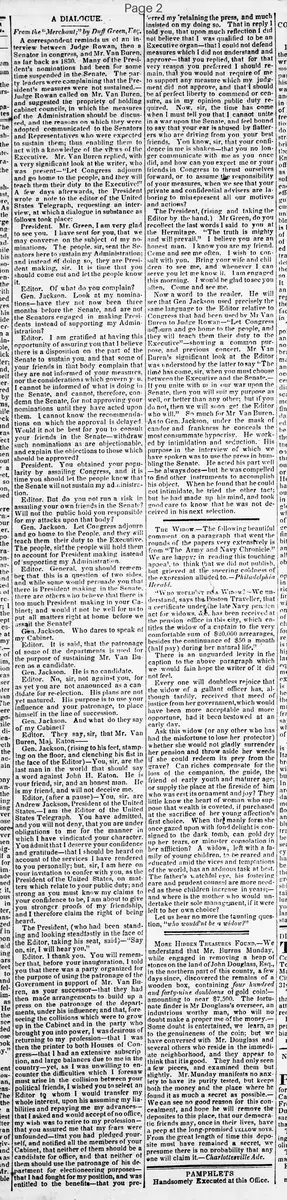
From the "Merchant:" by Duff Green, Esq.
A correspondent reminds us of an interview between Judge Rowan, then a Senator in congress, and Mr. Van Buren, as far back as 1830. Many of the President's nominations had been for some time suspended in the Senate. The party leaders were complaining that the President's measures were not sustained. Judge Rowan called on Mr. Van Buren, and suggested the propriety of holding cabinet councils, in which the measures of the Administration should be discussed, and the reasons on which they were adopted communicated to the Senators and Representatives who were expected to sustain them; thus enabling them to act with a knowledge of the views of the Executive. Mr. Van Buren replied, with a very significant look at the writer, who was present—"Let Congress adjourn and go home to the people, and they will teach them their duty to the Executive!"
A few days afterwards, the President wrote a note to the editor of the United States Telegraph, requesting an interview, at which a dialogue in substance as follows took place:
President. Mr. Green, I am very glad to see you. I have sent for you, that we may converse on the subject of my nominations: The people, sir, sent the Senators here to sustain my Administration: and instead of doing so, they are President making, sir. It is time that you should come out and let the people know it.
Editor. Of what do you complain?
Gen. Jackson. Look at my nominations—have they not now been three months before the Senate, and are not the Senators engaged in making Presidents instead of supporting my Administration?
Editor. I am gratified at having this opportunity of assuring you that I believe there is a disposition on the part of the Senate to sustain you, and that some of your friends in that body complain that they are not informed of your measures, nor the considerations which govern you. I cannot be informed of what is doing in the Senate, and cannot, therefore, condemn the Senate, for not approving your nominations until they have acted upon them. I cannot know the recommendations on which the approval is delayed. Would it not be best for you to consult your friends in the Senate—withdraw such nominations as are objectionable, and explain the objections to those which should be approved?
President. You obtained your popularity by assailing Congress, and it is time you should let the people know that the Senate will not sustain my administration.
Editor. But do you not run a risk in assailing your own friends in the Senate? Will not the public hold you responsible for my attacks upon that body?
Gen. Jackson. Let Congress adjourn and go home to the People, and they will teach them their duty to the Executive. The people, sir! the people will hold them to account for President making instead of supporting my Administration.
Editor. General, you should remember that this is a question of two sides and while some would persuade you that there is President making in the Senate, there are others who believe that there is too much President making in your Cabinet; and would it not be well for us to put all matters right at home before we assail the Senate?
Gen. Jackson. Who dares to speak of my Cabinet.
Editor. It is said, that the patronage of some of the departments is used for the purpose of sustaining Mr. Van Buren as a candidate.
Gen. Jackson. He is no candidate.
Editor. No, sir, not against you, for as yet you are not announced as a candidate for re-election. His plans are not yet matured. His purpose is to use your influence and your patronage, to place himself in the line of succession.
Gen. Jackson. And what do they say of my Cabinet?
Editor. They say, sir, that Mr. Van Buren, Maj. Eaton
Gen. Jackson, (rising to his feet, stamping on the floor, and clenching his fist in the face of the Editor)—You, sir, are the last man in the world that should say a word against John H. Eaton. He is your friend, sir, and an honest man. He is my friend, and will not deceive me.
Editor, (after a pause)— You, sir, are Andrew Jackson, President of the United States.—I am the Editor of the United States Telegraph. You have admitted, and you will not deny, that you are under obligations to me for the manner in which I have vindicated your character. You admit that I deserve your confidence and gratitude—that I should be heard on account of the services I have rendered to you personally; but, sir, I am here on your invitation to confer with you, as the President of the United States, on matters which relate to your public duty; and strong as you must know my claims to your confidence to be, I am about to give you stronger proofs of my friendship and I therefore claim the right of being heard.
The President. (who had been standing and looking steadfastly in the face of the Editor, taking his seat, said)—"Say on, sir, I will hear you."
Editor. I thank you. You will remember that, before your inauguration, I told you that there was a party organized for the purpose of using the patronage of the Government in support of Mr. Van Buren, as your successor—that they had then made arrangements to build up a press on the patronage of the departments, under his influence; and that, foreseeing the collisions which were to grow up in the Cabinet and in the party who brought you into power, I was desirous of returning to my profession—that I was then the printer to both Houses of Congress—that I had an extensive subscription, and large balances due to me in the country—yet, as I was unwilling to encounter the difficulties which I foresaw must arise in the collision between your political friends, I wished you to select an Editor to whom I would transfer my whole interest, upon his assuming my liabilities and repaying me my advances—that I asked and would accept of no office, my wish was to retire to my profession—that you assured me that my fears were unfounded—that you had pledged your self, and notified all the members of your Cabinet, that neither of them should be a candidate for office, and that neither of them should use the patronage of his department for electioneering purposes—that I had fought for my position, and was entitled to the benefits—that you preferred my remaining the press, and much insisted on my doing so." That in reply I told you, that upon much reflection I did not believe that I was qualified to be an Executive organ—that I could not defend measures which I did not understand and approve—that you replied, that for that very reason you preferred I should remain, that you would not require of me to support any measure which my judgment did not approve, and that I should be at perfect liberty to commend or censure, as in my opinion public duty required. Now, sir, the time has come when I must tell you that I cannot unite in a war upon the Senate, and feel bound to say that your ear is abused by flatterers who are driving from you your best friends. You know, sir, that your confidence in me is shaken—that you no longer communicate with me as you once did, and how can you expect me or your friends in Congress to thrust ourselves forward, or to assume the responsibility of your measures, when we see that your private and confidential advisers are laboring to misrepresent all our motives and actions?
The President, (rising and taking the Editor by the hand.) Mr Green, do you recollect the last words I said to you at the Hermitage. "The truth is mighty and will prevail." I believe you are an honest man. I know you are my friend. Come and see me often. I wish to consult with you. Bring your wife and children to see me, and whenever I can serve you let me know it. I am engaged this morning. I would be glad to see you often, Come and see me.
Now a word to the reader. He will see that Gen Jackson used precisely the same language to the Editor relative to Congress that had been used by Mr Van Buren to Judge Rowan—"Let Congress adjourn and go home to the people, and they will teach them their duty to the Executive"—showing a common purpose, and previous concert. Mr Van Buren's significant look at the Editor was understood by the latter to say "The time has come, sir, when you must choose between the Executive and the Senate.— If you unite with us in our war upon the Senate, then you will suit my purpose as well, or better than any other; but if you do not, then we will soon get the Editor who will." So much for Mr Van Buren. As to Gen. Jackson, under the mask of candor and frankness he conceals the most consummate hypocrisy. He worked by intimidation and seduction. His purpose in the interview of which we have spoken was to use the press in humbling the Senate. He acted his part well—he always does—but he was compelled to find other instruments to accomplish his object. When he found that he could not intimidate, he tried the other tact; but he had made up his mind, and took good care to know that he was not deceived in his next selection.
What sub-type of article is it?
What themes does it cover?
What keywords are associated?
What entities or persons were involved?
Where did it happen?
Story Details
Key Persons
Location
Senate/Congress
Event Date
1830
Story Details
In 1830, Judge Rowan suggests to Van Buren the need for cabinet councils to inform Congress of administration measures. Van Buren replies to let Congress go home to the people. Later, President Jackson urges editor Green to criticize the Senate for delaying nominations and 'President making.' Green advises consultation and warns of Cabinet favoritism towards Van Buren. Jackson defends Eaton and recalls past assurances. Green asserts independence. Jackson reconciles, but the narrative accuses Jackson and Van Buren of hypocrisy and concert against the Senate.