Thank you for visiting SNEWPapers!
Sign up free
Lincoln County Advocate
Canton, Lincoln County, South Dakota
What is this article about?
In 1846, during a Virginia militia encampment near Winchester, Capt. Summerville is shot dead by an unknown assassin. Lt. Hersey is arrested on suspicion but exonerated at trial when evidence reveals Lt. Scoresby, motivated by jealousy over a romantic rejection, committed the murder and attempted to frame Hersey. Scoresby is convicted and sentenced to life imprisonment.
Clipping
OCR Quality
Full Text
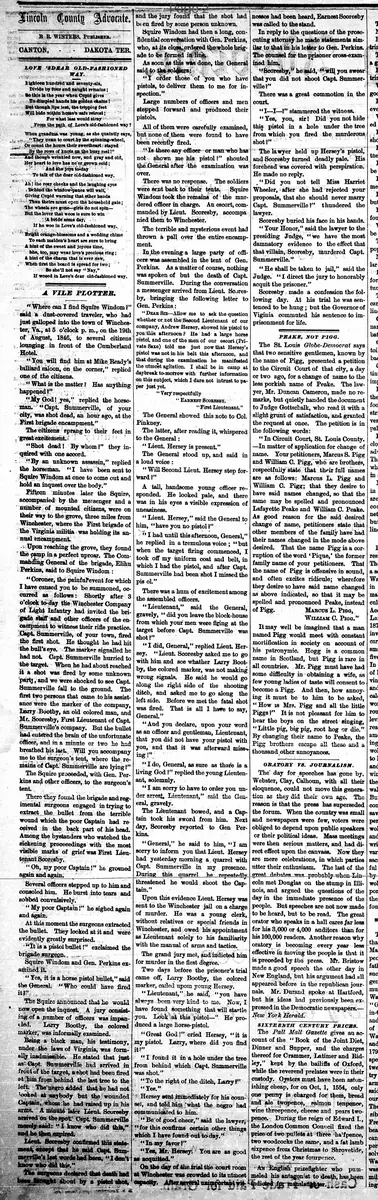
"Where can I find Squire Windom?" said a dust-covered traveler, who had just galloped into the town of Winchester, Va., at 5 o'clock p. m., on the 19th of August, 1846, to several citizens lounging in front of the Cumberland Hotel.
"You will find him at Mike Ready's billiard saloon, on the corner," replied one of the citizens. "What is the matter? Has anything happened?"
"My God! yes," replied the horseman. "Capt. Summerville, of your city, was shot dead, an hour ago, at the First brigade encampment."
The citizens sprang to their feet in great excitement.
"Shot dead! By whom?" they inquired with one accord.
"By an unknown assassin," replied the horseman. "I have been sent to Squire Windom at once to come out and hold an inquest over the body."
Fifteen minutes later the Squire, accompanied by the messenger and a number of mounted citizens, were on their way to the grove, three miles from Winchester, where the First brigade of the Virginia militia was holding its annual encampment.
Upon reaching the grove, they found the camp in a perfect uproar. The Commanding General of the brigade, Elihu Perkins, said to Squire Windom:
"Coroner, the painful event for which I have caused you to be summoned, occurred as follows: Shortly after 3 o'clock to-day the Winchester Company of Light Infantry had invited the brigade staff and other officers of the encampment to witness their rifle practice. Capt. Summerville, of your town, fired the first shot. He thought he had hit the bull's eye. The marker signalled he had not. Capt. Summerville hurried to the target. When he had about reached it a shot was fired by some unknown party, and we were shocked to see Capt. Summerville fall to the ground. The first two persons that came to his assistance were the marker of the company, Larry Bootby, an old colored man, and Mr. Scoresby, First Lieutenant of Capt. Summerville's company. But the bullet had entered the brain of the unfortunate officer, and in a minute or two he had breathed his last. Will you accompany me to the surgeon's tent, where the remains of Capt. Summerville are lying?"
The Squire proceeded, with Gen. Perkins and other officers, to the surgeon's tent.
There they found the brigade and regimental surgeons engaged in trying to extract the bullet from the terrible wound which the poor Captain had received in the back part of his head.
Among the bystanders who watched the sickening proceedings with the most visible marks of grief was First Lieutenant Scoresby.
"Oh, my poor Captain!" he groaned again and again.
Several officers stepped up to him and consoled him. He burst into tears and sobbed convulsively.
"My poor Captain!" he sighed again and again.
At this moment the surgeons extracted the bullet. They looked at it and were evidently greatly surprised.
"It is a pistol bullet!" exclaimed the brigade surgeon.
Squire Windom and Gen. Perkins examined it.
"Yes, it is a horse pistol bullet," said the General. "Who could have fired it?"
The Squire announced that he would now open the inquest. A jury consisting of a number of officers was impaneled. Larry Bootby, the colored marker, was informally examined. Being a black man, his testimony, under the laws of Virginia, was formally inadmissible. He stated that just as Capt. Summerville had arrived in front of the target, a shot had been fired at him from behind the last tree to the left. The negro added that he had not looked at anybody but the wounded Captain, whom he had raised up in his arms. A minute later Lieut. Scoresby arrived on the spot. Capt. Summerville merely said: "I know who did this." and he then expired.
Lieut. Scoresby confirmed this statement except that he said Capt. Summerville's last words had been, "I don't know who did this."
Surgeons declared that death had been instantaneous.
and the jury found that the shot had been fired by some person unknown.
Squire Windom had then a long, confidential conversation with Gen. Perkins, who, at its close, ordered the whole brigade to be formed in line.
As soon as this was done, the General said to the soldiers:
"I order those of you who have pistols, to deliver them to me for inspection."
Large numbers of officers and men stepped forward and produced their pistols.
All of them were carefully examined but none of them were found to have been recently fired.
"Is there any officer or man who has not shown me his pistol?" shouted the General after the examination was over.
There was no response. The soldiers were sent back to their tents. Squire Windom took the remains of the murdered officer in charge. An escort, commanded by Lieut. Scoresby, accompanied them to Winchester.
The terrible and mysterious event had thrown a pall over the entire encampment.
In the evening a large party of officers was assembled in the tent of Gen. Perkins. As a matter of course, nothing was spoken of but the death of Capt. Summerville. During the conversation a messenger arrived from Lieut. Scoresby, bringing the following letter to Gen. Perkins:
"DEAR SIR—Allow me to ask the question whether or not the Second Lieutenant of our company, Andrew Hersey, showed his pistol to you this afternoon? He had a large horse pistol, and one of the men of our escort (Private Saxe) told me just now that Hersey's pistol was not in his belt this afternoon, and that during the examination he manifested the utmost agitation. I shall be in camp at daybreak to-morrow with further information on this subject, which I dare not intrust to paper just yet.
"Very respectfully,
"EARNEST SCORESBY,
"First Lieutenant."
The General showed this note to Col. Pinkney.
The latter, after reading it, whispered to the General:
"Lieut. Hersey is present."
The General stood up, and said in a loud voice:
"Will Second Lieut. Hersey step forward?"
A tall, handsome young officer responded. He looked pale, and there was in his eyes a visible expression of uneasiness.
"Lieut. Hersey," said the General to him, "have you no pistol?"
"I had until this afternoon, General," he replied in a tremulous voice; "but when the target firing commenced, I took off my uniform coat and belt, in which I had the pistol, and after Capt. Summerville had been shot I missed the pistol."
There was a hum of excitement among the assembled officers.
"Lieutenant," said the General gravely, "did you leave the block-house from which your men were firing at the target before Capt. Summerville was shot?"
"I did, General," replied Lieut. Hersey. "Lieut. Scoresby asked me to go with him and see whether Larry Bootby, the colored marker, was not making wrong signals. He said he would go along the right side of the shooting ditch, and asked me to go along the left side. Before we met the fatal shot was fired. That is all I have to say, General."
"And you declare, upon your word as an officer and gentleman, Lieutenant, that you did not have your pistol with you, and that it was afterward missing!"
"I do, General, as sure as there is a living God," replied the young Lieutenant, solemnly.
"I am sorry to have to order you under arrest, Lieutenant," said the General, gravely.
The Lieutenant bowed, and a Captain took his sword from him. Next day, Scoresby reported to Gen. Perkins.
"General," he said to him, "I am sorry to inform you that Lieut. Hersey had yesterday morning a quarrel with Capt. Summerville in my presence. During this quarrel he repeatedly threatened he would shoot the Captain."
Upon this evidence Lieut. Hersey was sent to the Winchester jail on a charge of murder. He was a young clerk, without relatives or special friends in Winchester, and owed his appointment as Lieutenant solely to his familiarity with the manual of arms and tactics.
The grand jury met, and indicted him for murder in the first degree.
Two days before the prisoner's trial came off, Larry Bootby, the colored marker, called upon young Hersey.
"Lieutenant," he said, "you have always been very kind to me. Now, I have found something that will startle you. Look at this pistol." He produced a large horse-pistol.
"Great God!" cried Hersey, "it is my pistol. Larry, where did you find it?"
"I found it in a hole under the tree from behind which Capt. Summerville was shot."
"To the right of the ditch, Larry?"
"Yes."
Hersey sent immediately for his counsel, and told him what the negro had communicated to him:
"Be of good cheer," said the lawyer, "for this confirms certain other things which I have found out to-day."
"In my favor?"
"Yes, Mr. Hersey. You are as good as acquitted."
On the day of the trial the court room at Winchester was crowded to its utmost capacity. After several unimportant witnesses had been heard, Earnest Scoresby was called to the stand.
In reply to the questions of the prosecuting attorney he made statements similar to that in his letter to Gen. Perkins.
The counsel for the prisoner cross-examined him.
"Scoresby," he said, "will you swear that you did not shoot Capt. Summerville?"
There was a great commotion in the court.
"I?" stammered the witness.
"Yes, you, sir! Did you not hide this pistol in a hole under the tree from which you fired the murderous shot?"
The lawyer held up Hersey's pistol, and Scoresby turned deadly pale. His forehead was covered with perspiration. He made no reply.
"Did you not tell Miss Harriet Wheeler, after she had rejected your proposals, that she should never marry Capt. Summerville?" thundered the lawyer.
Scoresby buried his face in his hands.
"Your Honor," said the lawyer to the presiding Judge, "we have the most damnatory evidence to the effect that that villain, Scoresby, murdered Capt. Summerville."
"He shall be taken to jail," said the Judge. "I direct the jury to honorably acquit the prisoner."
Scoresby made a confession the following day. At his trial he was sentenced to be hung; but the Governor of Virginia commuted his sentence to imprisonment for life.
What sub-type of article is it?
What themes does it cover?
What keywords are associated?
What entities or persons were involved?
Where did it happen?
Story Details
Key Persons
Location
Winchester, Va., And Encampment Grove Three Miles Away
Event Date
1846 08 19
Story Details
During rifle practice at a militia encampment, Capt. Summerville is shot in the head with a pistol bullet by Lt. Scoresby, who acts out of jealousy after Miss Harriet Wheeler rejects his proposal and favors the captain. Scoresby attempts to frame Lt. Hersey by stealing and hiding his pistol, but the plot unravels at trial when the pistol is found and Scoresby's motives are exposed, leading to Hersey's acquittal and Scoresby's life sentence.