Thank you for visiting SNEWPapers!
Sign up free
The Enquirer
Richmond, Henrico County, Virginia
What is this article about?
A large meeting of Westminster electors on Thursday last, reported in a London paper of October 24, condemned the Convention of Cintra in Portugal, calling for a parliamentary inquiry into its causes and criticizing ministers for the military and diplomatic failure after the Battle of Vimeiro.
Clipping
OCR Quality
Full Text
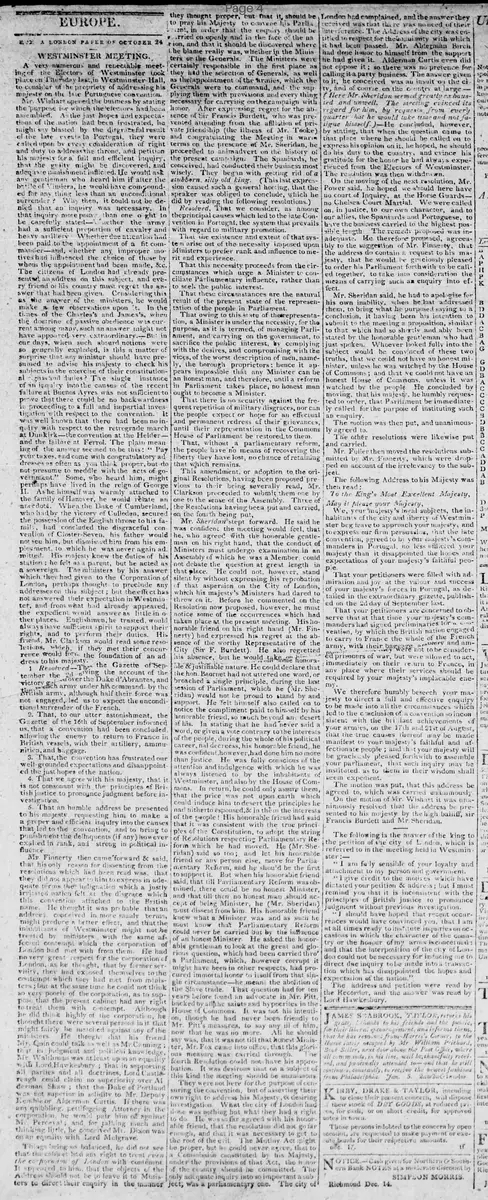
FROM A LONDON PAPER OF OCTOBER 24
WESTMINSTER MEETING.
A very numerous and respectable meeting of the Electors of Westminster took place on Thursday last, in Westminster-Hall, to consider of the propriety of addressing his majesty on the late Portuguese convention.
Mr. Wishart opened the business by stating the purpose for which the electors had been assembled. As the just hopes and expectations of the nation had been frustrated, he might say blasted by the disgraceful result of the late events in Portugal, they were called upon by every consideration of right and duty to address the throne, and petition his majesty for a full and efficient inquiry, that the guilty might be discovered, and adequate punishment inflicted. He would ask any gentleman who heard him if after the battle of Vimiera, he would have conjectured for any thing less than an unconditional surrender? Why then, it could not be denied that an inquiry was necessary. In that inquiry more points than one ought to be carefully stated--whether the army had a sufficient proportion of cavalry and heavy artillery: Whether due attention had been paid to the appointment of a fit commander--and, whether any improper motives had influenced the choice of those by whom the appointment had been made, &c.
The citizens of London had already presented an address on this subject, and every friend of his country must regret the answer that had been given. Considering this as the answer of the ministers, he would make a few observations upon it. In the times of the Charles's and James's, when the doctrine of passive obedience was current among many, such an answer might not have appeared very extraordinary.--But in our days, when such absurd notions were so generally exploded, is this a matter of surprise that any minister should have presumed to advise his majesty to check his subjects in the exercise of their constitutional rights and duties? The single instance of an inquiry into the causes of the recent failure at Buenos Ayres was not sufficient to prove that there could be no backwardness in proceeding to a full and impartial investigation with respect to the convention. It was well known that there had been no inquiry with respect to the retrograde march at Dunkirk--the convention at the Helder--and the failure at Ferrol. The plain meaning of the answer seemed to be this: "Pay your taxes, and come with congratulatory addresses as often as you think proper, but do not presume to meddle with the acts of government." Some, who heard him, might perhaps have lived in the reign of George II. As he himself was warmly attached to the family of Hanover, he would relate an anecdote. When the Duke of Cumberland, who had by the victory of Culloden, secured the possession of the English throne to his family, had concluded the disgraceful convention of Closter-Seven, his father would not see him, but dismissed him from his employment, to which he was never again admitted. His majesty knew the duties of his station; he felt as a parent, but he acted as a sovereign. The ministers by his answer which they had given to the Corporation of London, perhaps thought to preclude any addresses on this subject; but the effect has not answered their expectation in Westminster, and from what had already appeared, the expedient would answer as little in other places. Englishmen, he trusted, would always have sufficient spirit to support their rights, and to perform their duties. His friend, Mr. Clarkson would read some resolutions, which, if they met their concurrence, would form the foundation of an address to his majesty.
1. Resolved--That the Gazette of September the 2d giving the account of the overture like d'Abrantes, and British army, although half their force was not engaged, led us to expect the unconditional surrender of the French.
2. That, to our utter astonishment, the Gazette of the 16th of September informed us, that a convention had been concluded allowing the enemy to return to France in British vessels, with their artillery, ammunition, and baggage.
3. That, the convention has frustrated our well-grounded expectations and disappointed the just hopes of the nation.
4. That we agree with his majesty, that it is not consonant with the principles of British justice to pronounce judgment before investigation.
5. That an humble address be presented to his majesty requesting him to make a proper and efficient inquiry into the causes that led to the convention, and to bring to punishment the delinquents (if any) however exalted in rank, and strong in political influence.
Mr. Finnerty then came forward & said, that his only reason for dissenting from the resolutions which had been read was, that they did not appear to him to express in adequate terms the indignation which a justly irritated nation felt at the disgrace which this Convention attached to the British name. He thought it was probable that an address conceived in more manly terms, might produce a better effect, and that the inhabitants of Westminster might not be treated by ministers with the same affected contempt which the corporation of London had met with from them. He had no very great respect for the corporation of London, as he thought, that by former servility, they had exposed themselves to the contempt which they had met from ministers; but at the same time he could not think so very poorly of the corporation, as to suppose that the present cabinet had any right to treat them with contempt. Although he did think highly of the corporation, he thought there were several persons in it that might fairly be matched against any of the ministers. He thought that his friend Mr. Quin could talk as well as Mr. Canning: that in judgment and political knowledge, Mr. Waithman was at least upon an equality with Lord Hawkesbury; that in supporting all parties and all doctrines, Lord Castlereagh could claim no superiority over Alderman Shaw; that the Duke of Portland was not superior in solidity to Mr. Deputy Kemble or Alderman Curtis. If there was any nibbling, pettifogging Attorney in the corporation, he would pair him off against Mr. Perceval; and for talking much and thinking little, he conceived Mr. Dixon was on an equality with Lord Mulgrave.
Things being so balanced, he did not see that the cabinet had any right to treat even the corporation of London with contempt. It appeared to him, that the objects of the Address should not be to leave it to Ministers to direct their enquiry in the manner they thought proper, but that it, should be to pray his Majesty to convene his Parliament, in order that the enquiry should be carried on openly and in the face of the nation, and that it should be discovered where the blame really was, whether in the Ministers or the Generals. The Ministers were certainly responsible in the first place as they had the selection of Generals, as well as the appointment of the armies, which the Generals were to command, and the supplying them with provisions and every thing necessary for carrying on the campaign with honor. After expressing regret for the absence of Sir Francis Burdett, who was prevented attending from the affliction of private friendship (the illness of Mr. Tooke) and congratulating the Meeting in warm terms on the presence of Mr. Sheridan, he proceeded to animadvert on the history of the present campaign. The Spaniards, he conceived, had conducted their business most wisely. They began with getting rid of a stubborn, silly old king. (This last expression caused such a general hooting, that the speaker was obliged to conclude, which he did by reading the following resolutions.)
Resolved, That we consider, as among the principal causes which led to the late Convention in Portugal, the system that prevails with regard to military promotion.
That the existence and extent of that system arise out of the necessity imposed upon Ministers to prefer rank and influence to merit and experience.
That this necessity proceeds from the circumstances which urge a Minister to conciliate Parliamentary influence, rather than to seek the public interest.
That these circumstances are the natural result of the present state of the representation of the people in Parliament.
That owing to this state of the representation, a Minister is under the necessity, for the purpose, as it is termed, of managing Parliament, and carrying on the government, to sacrifice the public interest, by complying with the desires, and compromising with the vices, of the worst description of men, namely, the borough proprietors: hence it appears impossible that any Minister can be an honest man, and therefore, until a reform in Parliament takes place, no honest man ought to become a Minister.
That there is no security against the frequent repetition of military disgraces, nor can the people expect or hope for an effectual and permanent redress of their grievances until their representation in the Commons House of Parliament be restored to them.
That, without a parliamentary reform the people have no means of recovering the liberty they have lost, no chance of retaining that which remains.
This amendment, or addition to the original Resolutions, having been proposed previous to their being severally read, Mr. Clarkson proceeded to submit them one by one to the sense of the Assembly. Three of the Resolutions having been put and carried on the fourth being put,
Mr. Sheridan stept forward. He said he was confident the meeting would feel, that he, who agreed with the honorable gentleman on his right hand, that the conduct of Ministers must undergo examination in an Assembly of which he was a Member, could not debate the question at great length in that place. He could not, however, stand by without expressing his reprobation of that aspersion on the City of London, which his majesty's Ministers had dared to throw on it. Before he commented on the Resolution now proposed, however, he must notice some of the occurrences which had taken place at the present meeting. His honorable friend on his right hand (Mr. Finnerty) had expressed his regret at the absence of the worthy Representative of the City (Sir F. Burdett). He also regretted his absence, but he would take some honorable & justifiable notice. He could declare that the hon. Baronet had not uttered one word, or broached a single principle, during the last session of Parliament, which he (Mr. Sheridan) would not be proud to stand by and support. He felt himself also called on to notice the compliment paid to him.self by his honorable friend, so much beyond any desert of his. In stating that he had never said a word, or given a vote contrary to the interests of the people, during the whole of his political career, his honorable friend, he was confident, however, had done him no more than justice. He was fully conscious of the attention and indulgence with which he was always listened to by the inhabitants of Westminster, and also by the House of Commons. In return, he could only assure them that the price was not upon earth which could induce him to desert the principles he had hitherto espoused, & in the interests of the people! His honorable friend had said that it was consistent with the true principles of the Constitution, to adopt the string of Resolutions respecting Parliamentary Reform which he had moved. He (Mr. Sheridan) said so too; and let his honorable friend or any person else, move for Parliamentary Reform, and he should be the first to support it. But when his honorable friend said, that till Parliamentary Reform was obtained, there could be no honest Minister and that till then no honest man should accept of being Minister, he (Mr. Sheridan) must dissent from him. His honorable friend knew what a Minister was. and as such he must know that Parliamentary Reform could never be carried but by the influence of an honest Minister. He asked the honorable gentleman to look at the great and glorious question, which had been carried through a Parliament, which, however corrupt it might have been in other respects, had procured immortal honor to itself from that single circumstance--he meant the abolition of the Slave trade. That question had for ten years before found an advocate in Mr. Pitt, backed by all the saints and hypocrites in the House of Commons. It was not his intention, though he had never been friendly to Mr. Pitt's measures, to say any ill of him, now that he was no more. All he should say was, that it was not till that honest Minister, Mr. Fox came into office. that this glorious measure was carried through. The fourth Resolution could not have his approbation. It was desirable that on a subject of this kind the meeting should be unanimous They were not here for the purpose of censuring the convention, but of asserting their own right to address his Majesty, & desiring investigation. What the City of London had done was nothing but what they had a right to do He was so far agreed with his honor. able friend, that the resolution did not go far enough, and that it was necessary to get to the root of the evil. The Mutiny Act might be proper, but he could never agree, that to a Commission constituted by his Majesty, under the provisions of that Act, the honor of the country should be committed. The only adequate inquiry into so important a subject; was a parliamentary one. The city of London had complained, and the answer they received was that there was no need of their interference. The Address of the city was entitled to respect for the unanimity with which it had been passed. Mr. Alderman Birch had done honor to himself from the support he had given it. Alderman Curtis even did not oppose it; so there was no pretence for calling it a party business. The answer given to it, he conceived was an insult on the city, and of course on the country at large.-- (Here Mr. Sheridan seemed greatly exhausted and unwell. The meeting evinced its regard for him, by requests from every quarter that he would take care and not fatigue himself.)--He concluded, however, by stating, that when the question came to that place where he should be called on to express his opinion on it. he hoped, he should do his duty to the country. and evince his gratitude for the honor he had always experienced from the Electors of Westminster.
The resolution was then withdrawn.
On the moving of the next resolution, Mr. Power said, he hoped we should here have no court of Inquiry. at the Horse Guards-- no Chelsea. Court Martial. We were called on, in justice, to our own character, and to our allies, the Spaniards and Portuguese, to have the business carried to the highest possible length. The remedy proposed was inadequate. He therefore proposed, agreeably to the suggestion of Mr. Finnerty, that the address do contain a request to his majesty, that he would be graciously pleased to order his Parliament forthwith to be called together, to take into consideration the means of carrying such an enquiry into effect.
Mr. Sheridan said, he had to apologise for his own inability. when he last addressed them, to bring what he purposed saying to a conclusion, it having been his intention to submit to the meeting a proposition. similar to that which had so shortly and ably been stated by the honorable gentleman who had just spoken. Whoever looked fully into the subject would be convinced of these two truths. that we could not have an honest minister, unless he was watched by the House of Commons : and that we could not have an honest House of Commons. unless it was watched by the people He concluded by moving, that his majesty, he humbly requested to order, that Parliament be immediately called for the purpose of instituting such an enquiry.
The motion was then put, and unanimously agreed to.
The other resolutions were likewise put and carried.
Mr. Fuller then moved the resolutions submitted by Mr. Finnerty, which were dropped on account of the irrelevancy to the subject.
The following Address to his Majesty was then read:
To the King's Most Excellent Majesty,
May it please your Majesty,
We, your majesty's loyal subjects, the inhabitants of the city and liberty of Westminster beg leave to approach your majesty, and to express our firm persuasion, that the late convention, agreed to by your majesty's commanders in Portugal. no less afflicted your majesty than it disappointed the hopes and expectations of your majesty's faithful people.
That your petitioners were filled with admiration and joy at the valour and success of your majesty's forces in Portugal, as detailed in the extraordinary gazette, published on the 2d day of September last.
That your petitioners are concerned to observe that at that time your majesty's commanders had signed preliminaries for a convention, by which the British nation engaged to carry to France the whole of the French army, with their baggage, artillery and ammunition--they were not to be considered prisoners of war, but were allowed to act, immediately on their return to France, in any place where their services should be required by your majesty's implacable enemy.
We therefore humbly beseech your majesty to direct a full and effective enquiry to be made into all the circumstances which led to the conclusion of a convention so inconsistent with the brilliant achievements of your armies, on the 17th and 21st of August, that the true causes thereof may be made manifest to your majesty's faithful and affectionate people ; and that your majesty will be graciously pleased forthwith to assemble your parliament, that such inquiry may be instituted. as to them in their wisdom shall seem expedient.
The motion was put, that this address be agreed to, which was carried unanimously
On the motion of Mr. Wishart it was unanimously resolved that the address be presented to his majesty by the high bailiff, sir Francis Burdett and Mr. Sheridan.
The following is the answer of the king to the petition of the city of London, which is referred to in the meeting held in Westminster:-
" I am fully sensible of your loyalty and attachment to my person and government.
"I give credit to the motives which have dictated your petition & address; but I must remind you that it is inconsistent with the principles of British justice to pronounce judgment without previous investigation.
"I should have hoped that recent occurrences would have convinced you, that I am at all times ready to institute inquiries on occasions in which the character of the country or the honour of my arms is concerned: and that the interposition of the city of London could not be necessary for inducing me to direct due inquiry to be made into a transaction which has disappointed the hopes and expectation of the nation."
The address and petition were read by the Recorder, and the answer was read by Lord Hawkesbury.
What sub-type of article is it?
What keywords are associated?
What entities or persons were involved?
Where did it happen?
Foreign News Details
Primary Location
Portugal
Event Date
Thursday Last, As Reported October 24
Key Persons
Outcome
unanimous agreement to present an address to the king requesting a parliamentary inquiry into the portuguese convention; resolutions criticizing the convention and calling for punishment of delinquents passed.
Event Details
Electors of Westminster met in Westminster-Hall to address the King on the late Portuguese convention following the Battle of Vimiera. Speakers including Mr. Wishart, Mr. Finnerty, and Mr. Sheridan criticized the convention allowing French forces to return to France with arms, expressed indignation at ministerial handling, and passed resolutions for a full inquiry and parliamentary assembly. An address was agreed upon and to be presented by Sir Francis Burdett and Mr. Sheridan.