Thank you for visiting SNEWPapers!
Sign up free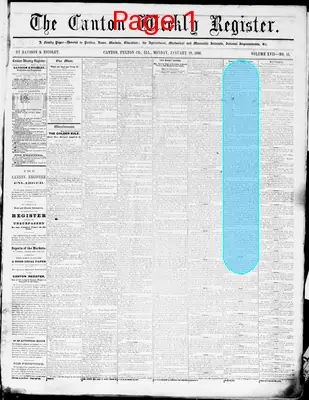
Editorial
January 29, 1866
Canton Weekly Register
Canton, Fulton County, Illinois
What is this article about?
The editorial criticizes a Thanksgiving sermon by Rev. John Chambers of Philadelphia, praised by Southern Democratic papers, for its partisan political content. It highlights the sermon's thanks for ending the Civil War, restoration of habeas corpus, concerns over post-war conditions, and opposition to negro equality, attributing responsibility to Northern states.
Clipping

OCR Quality
95%
Excellent
Full Text
Democratic Pulpit Politics.
On Thanksgiving day Rev. John Chambers, of Philadelphia, preached a sermon which has been published, with high encomiums, in many of the Democratic papers of the South. We find it in the Cincinnati Enquirer, introduced with the following head line: "A Truly Religious View of our Political Condition." It is interesting to discover that all these journals are not opposed to political preaching per se, but only to that not strictly in accordance with the Democrat creed. The following extracts will show the character of the sermon:
We are here in compliance with the request of the Chief Magistrate of the United States, and the Chief Magistrate of the Commonwealth of Pennsylvania, but their influence upon us is not very powerful. I did respect, at least, a request, for I say that no President, Magistrate or King upon earth has a right to interfere with religious worship and services. I am always disposed to respect a request, when respectfully made, of the Chief Magistrate of the United States, of the Governor of the State, or of the Municipal authorities.
We are here at their request, to give thanks to God for our deliverance from one of the most frightful, cruel, bloody, destructive and damning wars that ever cursed God's land. If any people ought to be grateful, we should be, perhaps. While we should be grateful for this, there are many things we have to deplore. The consequences of war are so fraught with evil, and only evil, that the human heart must melt before God in penitence.
Mr. Chambers then addressed the Throne of Grace, in which he gave thanks for the return of freedom, and glorified God that the writ of habeas corpus had been restored, and that men could not now be torn from their homes without due process of law.
The past four or five years have been among the most eventful periods in the world's history: never before were such scenes witnessed as have been witnessed upon the theatre of this nation. This great experiment of self-government has been stretched to its utmost tension: we have been on the verge of ruin, and I confess that my mind is not satisfied that the Ship of State is entirely off the lee-shore yet, nor is safely moored. There are signs in the political heavens which to me are portentous, and the sea of life is fearfully agitated. Now we have the question: "What is our present condition, and what our prospects for the future?"
As I view it, our present condition is appalling.
If slavery was to be got rid of in this country—if the people had wished it—it should have been done gradually. Their condition is deplorable in the extreme, and the hot breath of pestilence is sweeping over them like the sirocco of the desert. It is the duty of those who brought them to this condition to provide for them, for they are mostly that portion of the American people whose ancestors were chiefly concerned in bringing African slaves to this country, and who reaped immense fortunes thereby, the inhabitants of the States of Massachusetts and Rhode Island should take care of these people now.
I do not say they injured the negro by bringing him here; I have an entirely different view of the subject. In their native Africa they were merely animals; but here their minds were raised from darkness and degradation, and exposed to the consoling influences of Christianity and civilization. Was that doing him a wrong? I have always been a true friend to the negro, and would have him treated with all kindness and humanity, and Christian sentiment, in his place, and nowhere else.
I have no hostility to the negro, but he must not be put on an equality with the white man. God does not mean it. The moment you admit him to citizenship he is eligible to a seat in the White House, and you cannot help pushing him there if the majority say so. If you bring him into your drawing rooms and give him a seat on your crimson-cushioned sofa, by the side of your daughter, holding her hand, and telling him that that hand shall be his if he ask it, I will reject your consistency. There is no difference in the condition of life which always exists, and always will exist. There must be no outrage on the community.
Let a man gaze earnestly as he will on beautiful prospects, all nature is composed, for him, of but two or three points for which his whole soul yearns. Take from life the heart that loves you; efface from it the home and scenery your thoughts dwell on most tenderly, and nature becomes a frightful void in which your glance falls wearily, finding neither rest nor path.
On Thanksgiving day Rev. John Chambers, of Philadelphia, preached a sermon which has been published, with high encomiums, in many of the Democratic papers of the South. We find it in the Cincinnati Enquirer, introduced with the following head line: "A Truly Religious View of our Political Condition." It is interesting to discover that all these journals are not opposed to political preaching per se, but only to that not strictly in accordance with the Democrat creed. The following extracts will show the character of the sermon:
We are here in compliance with the request of the Chief Magistrate of the United States, and the Chief Magistrate of the Commonwealth of Pennsylvania, but their influence upon us is not very powerful. I did respect, at least, a request, for I say that no President, Magistrate or King upon earth has a right to interfere with religious worship and services. I am always disposed to respect a request, when respectfully made, of the Chief Magistrate of the United States, of the Governor of the State, or of the Municipal authorities.
We are here at their request, to give thanks to God for our deliverance from one of the most frightful, cruel, bloody, destructive and damning wars that ever cursed God's land. If any people ought to be grateful, we should be, perhaps. While we should be grateful for this, there are many things we have to deplore. The consequences of war are so fraught with evil, and only evil, that the human heart must melt before God in penitence.
Mr. Chambers then addressed the Throne of Grace, in which he gave thanks for the return of freedom, and glorified God that the writ of habeas corpus had been restored, and that men could not now be torn from their homes without due process of law.
The past four or five years have been among the most eventful periods in the world's history: never before were such scenes witnessed as have been witnessed upon the theatre of this nation. This great experiment of self-government has been stretched to its utmost tension: we have been on the verge of ruin, and I confess that my mind is not satisfied that the Ship of State is entirely off the lee-shore yet, nor is safely moored. There are signs in the political heavens which to me are portentous, and the sea of life is fearfully agitated. Now we have the question: "What is our present condition, and what our prospects for the future?"
As I view it, our present condition is appalling.
If slavery was to be got rid of in this country—if the people had wished it—it should have been done gradually. Their condition is deplorable in the extreme, and the hot breath of pestilence is sweeping over them like the sirocco of the desert. It is the duty of those who brought them to this condition to provide for them, for they are mostly that portion of the American people whose ancestors were chiefly concerned in bringing African slaves to this country, and who reaped immense fortunes thereby, the inhabitants of the States of Massachusetts and Rhode Island should take care of these people now.
I do not say they injured the negro by bringing him here; I have an entirely different view of the subject. In their native Africa they were merely animals; but here their minds were raised from darkness and degradation, and exposed to the consoling influences of Christianity and civilization. Was that doing him a wrong? I have always been a true friend to the negro, and would have him treated with all kindness and humanity, and Christian sentiment, in his place, and nowhere else.
I have no hostility to the negro, but he must not be put on an equality with the white man. God does not mean it. The moment you admit him to citizenship he is eligible to a seat in the White House, and you cannot help pushing him there if the majority say so. If you bring him into your drawing rooms and give him a seat on your crimson-cushioned sofa, by the side of your daughter, holding her hand, and telling him that that hand shall be his if he ask it, I will reject your consistency. There is no difference in the condition of life which always exists, and always will exist. There must be no outrage on the community.
Let a man gaze earnestly as he will on beautiful prospects, all nature is composed, for him, of but two or three points for which his whole soul yearns. Take from life the heart that loves you; efface from it the home and scenery your thoughts dwell on most tenderly, and nature becomes a frightful void in which your glance falls wearily, finding neither rest nor path.
What sub-type of article is it?
Partisan Politics
Moral Or Religious
Slavery Abolition
What keywords are associated?
Democratic Pulpit Politics
Thanksgiving Sermon
Civil War Aftermath
Habeas Corpus Restoration
Negro Equality Opposition
Racial Hierarchy
Political Preaching
What entities or persons were involved?
Rev. John Chambers
Philadelphia
Chief Magistrate Of The United States
Governor Of Pennsylvania
Cincinnati Enquirer
Democratic Papers
Negroes
Massachusetts
Rhode Island
Editorial Details
Primary Topic
Critique Of Democratic Endorsed Sermon On Post Civil War Politics And Negro Rights
Stance / Tone
Critical Of Partisan Political Preaching And Racial Equality Views
Key Figures
Rev. John Chambers
Philadelphia
Chief Magistrate Of The United States
Governor Of Pennsylvania
Cincinnati Enquirer
Democratic Papers
Negroes
Massachusetts
Rhode Island
Key Arguments
Democratic Papers Praise Sermons Aligning With Their Creed But Oppose Others
Sermon Thanks God For End Of Civil War And Restoration Of Habeas Corpus
Post War Condition Is Appalling, With Concerns For The Ship Of State
Slavery Should Have Been Abolished Gradually; Northern States Responsible For Freed Slaves
Bringing Africans To America Civilized Them, Not Wronged Them
Negroes Should Be Treated Kindly But Not Granted Equality Or Citizenship