Thank you for visiting SNEWPapers!
Sign up free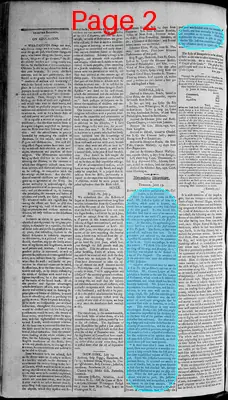
Editorial
July 13, 1802
Alexandria Advertiser And Commercial Intelligencer
Alexandria, Virginia
What is this article about?
Extract from James Callender's letter in his Recorder, detailing Thomas Jefferson's praise for Callender's political writings, including recognition of his style, curiosity about 'The Prospect,' a remark on John Adams, compliments via Thomas Leiper, and unsolicited $100 financial support, arguing Jefferson valued his contributions highly.
Clipping
OCR Quality
95%
Excellent
Full Text
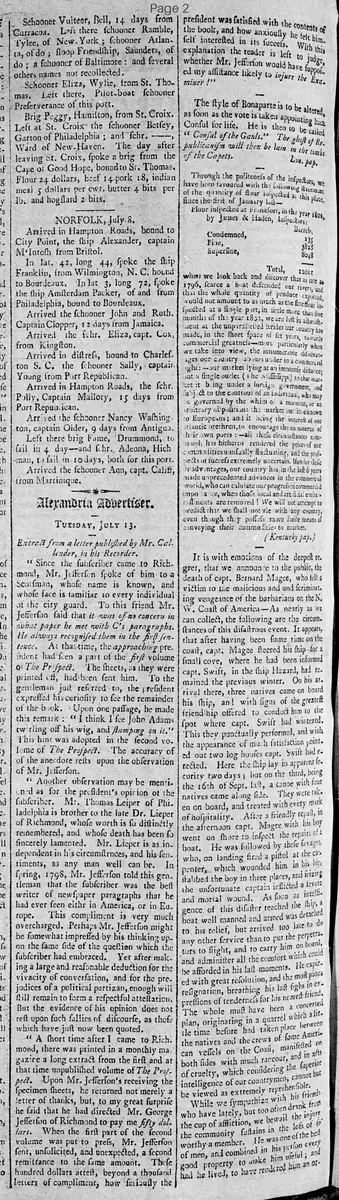
Extract from a letter published by Mr. Callender, in his Recorder.
"Since the subscriber came to Richmond, Mr. Jefferson spoke of him to a Scotsman, whose name is known, and whose face is familiar to every individual of the city guard. To this friend Mr. Jefferson said that it was of no concern in what paper he met with C's paragraphs. He always recognised them in the first sentence. At that time, the approaching president had seen a part of the first volume of The Prospect. The sheets, as they were printed off, had been sent him. To the gentleman just referred to, the president expressed his curiosity to see the remainder of the book. Upon one passage, he made this remark: "I think I see John Adams twirling off his wig, and stamping at it."
This hint was adopted in the second volume of The Prospect. The accuracy of the anecdote rests upon the observation of Mr. Jefferson.
Another observation may be mentioned as for the president's opinion of the subscriber. Mr. Thomas Leiper of Philadelphia is brother to the late Dr. Leiper of Richmond, whose worth is so distinctly remembered, and whose death has been so sincerely lamented. Mr. Leiper is as independent in his circumstances, and his sentiments, as any man well can be. In spring, 1798, Mr. Jefferson told this gentleman that the subscriber was the best writer of newspaper paragraphs that he had ever seen either in America, or in Europe. This compliment is very much overcharged. Perhaps Mr. Jefferson might be somewhat impressed by his thinking upon the same side of the question which the subscriber had embraced. Yet after making a large and reasonable deduction for the vivacity of conversation, and for the prejudices of a political partizan, enough will still remain to form a respectful attestation.
But the evidence of his opinion does not rest upon such allies of discourse, as those which have just now been quoted.
A short time after I came to Richmond, there was printed in a monthly magazine a long extract from the first and at that time unpublished volume of The Prospect. Upon Mr. Jefferson's receiving the specimen sheets, he returned not merely a letter of thanks, but, to my great surprise he said that he had directed Mr. George Jefferson of Richmond to pay me fifty dollars. When the first part of the second volume was put to press, Mr. Jefferson sent, unsolicited, and unexpected, a second remittance to the same amount. These hundred dollars attest, beyond a thousand letters of compliment, how seriously the president was satisfied with the contents of the book, and how anxiously he felt himself interested in its success. With this explanation the reader is left to judge, whether Mr. Jefferson would have supposed my assistance likely to injure the Examiner!"
"Since the subscriber came to Richmond, Mr. Jefferson spoke of him to a Scotsman, whose name is known, and whose face is familiar to every individual of the city guard. To this friend Mr. Jefferson said that it was of no concern in what paper he met with C's paragraphs. He always recognised them in the first sentence. At that time, the approaching president had seen a part of the first volume of The Prospect. The sheets, as they were printed off, had been sent him. To the gentleman just referred to, the president expressed his curiosity to see the remainder of the book. Upon one passage, he made this remark: "I think I see John Adams twirling off his wig, and stamping at it."
This hint was adopted in the second volume of The Prospect. The accuracy of the anecdote rests upon the observation of Mr. Jefferson.
Another observation may be mentioned as for the president's opinion of the subscriber. Mr. Thomas Leiper of Philadelphia is brother to the late Dr. Leiper of Richmond, whose worth is so distinctly remembered, and whose death has been so sincerely lamented. Mr. Leiper is as independent in his circumstances, and his sentiments, as any man well can be. In spring, 1798, Mr. Jefferson told this gentleman that the subscriber was the best writer of newspaper paragraphs that he had ever seen either in America, or in Europe. This compliment is very much overcharged. Perhaps Mr. Jefferson might be somewhat impressed by his thinking upon the same side of the question which the subscriber had embraced. Yet after making a large and reasonable deduction for the vivacity of conversation, and for the prejudices of a political partizan, enough will still remain to form a respectful attestation.
But the evidence of his opinion does not rest upon such allies of discourse, as those which have just now been quoted.
A short time after I came to Richmond, there was printed in a monthly magazine a long extract from the first and at that time unpublished volume of The Prospect. Upon Mr. Jefferson's receiving the specimen sheets, he returned not merely a letter of thanks, but, to my great surprise he said that he had directed Mr. George Jefferson of Richmond to pay me fifty dollars. When the first part of the second volume was put to press, Mr. Jefferson sent, unsolicited, and unexpected, a second remittance to the same amount. These hundred dollars attest, beyond a thousand letters of compliment, how seriously the president was satisfied with the contents of the book, and how anxiously he felt himself interested in its success. With this explanation the reader is left to judge, whether Mr. Jefferson would have supposed my assistance likely to injure the Examiner!"
What sub-type of article is it?
Partisan Politics
Press Freedom
What keywords are associated?
Thomas Jefferson
James Callender
The Prospect
Political Writing
John Adams
Newspaper Paragraphs
Financial Support
What entities or persons were involved?
Thomas Jefferson
James Callender
John Adams
Thomas Leiper
Dr. Leiper
George Jefferson
Editorial Details
Primary Topic
Thomas Jefferson's Endorsement Of James Callender's Political Writings
Stance / Tone
Defensive And Complimentary Towards Jefferson's Support
Key Figures
Thomas Jefferson
James Callender
John Adams
Thomas Leiper
Dr. Leiper
George Jefferson
Key Arguments
Jefferson Recognized Callender's Writing Style Immediately
Jefferson Expressed Curiosity About 'The Prospect' And Remarked On A Passage Mocking John Adams
Jefferson Complimented Callender As The Best Newspaper Paragraph Writer In America Or Europe Via Thomas Leiper In 1798
Jefferson Provided Unsolicited $50 Remittances Twice For 'The Prospect' Volumes
These Actions Show Jefferson's Serious Satisfaction And Interest In Callender's Work