Thank you for visiting SNEWPapers!
Sign up free
Story
October 25, 1875
The Weston Democrat
Weston, Lewis County, West Virginia
What is this article about?
Guidance on selecting and preparing high-quality wheat seed to improve crop yields, emphasizing culling over seasons and avoiding mixed or immature grain, as it produces like results.
Clipping
OCR Quality
98%
Excellent
Full Text
Selecting Seed.
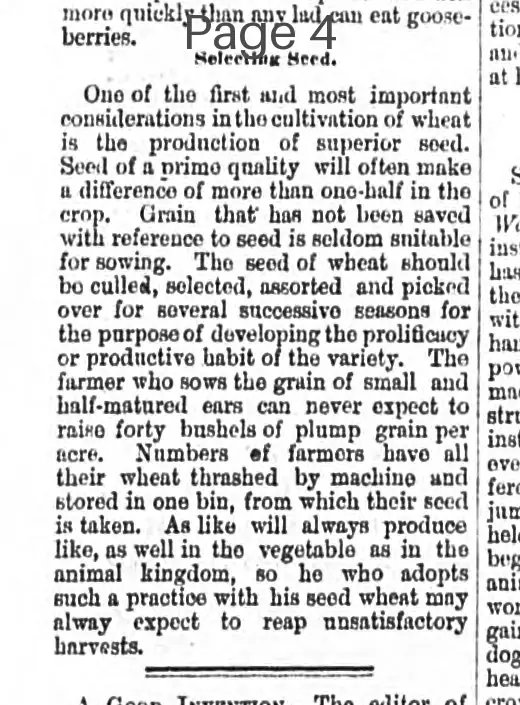
One of the first and most important considerations in the cultivation of wheat is the production of superior seed. Seed of a prime quality will often make a difference of more than one-half in the crop. Grain that has not been saved with reference to seed is seldom suitable for sowing. The seed of wheat should be culled, selected, assorted and picked over for several successive seasons for the purpose of developing the prolificacy or productive habit of the variety. The farmer who sows the grain of small and half-matured ears can never expect to raise forty bushels of plump grain per acre. Numbers of farmers have all their wheat thrashed by machine and stored in one bin, from which their seed is taken. As like will always produce like, as well in the vegetable as in the animal kingdom, so he who adopts such a practice with his seed wheat may always expect to reap unsatisfactory harvests.
One of the first and most important considerations in the cultivation of wheat is the production of superior seed. Seed of a prime quality will often make a difference of more than one-half in the crop. Grain that has not been saved with reference to seed is seldom suitable for sowing. The seed of wheat should be culled, selected, assorted and picked over for several successive seasons for the purpose of developing the prolificacy or productive habit of the variety. The farmer who sows the grain of small and half-matured ears can never expect to raise forty bushels of plump grain per acre. Numbers of farmers have all their wheat thrashed by machine and stored in one bin, from which their seed is taken. As like will always produce like, as well in the vegetable as in the animal kingdom, so he who adopts such a practice with his seed wheat may always expect to reap unsatisfactory harvests.
What sub-type of article is it?
Agricultural Advice
What keywords are associated?
Wheat Seed
Cultivation
Seed Selection
Crop Yield
Farming Practice
Story Details
Story Details
Importance of producing superior wheat seed through culling, selection, and assorting over seasons to develop prolificacy; warns against using grain from small or half-matured ears or mixed thrashing, as like produces like leading to unsatisfactory harvests.