Thank you for visiting SNEWPapers!
Sign up free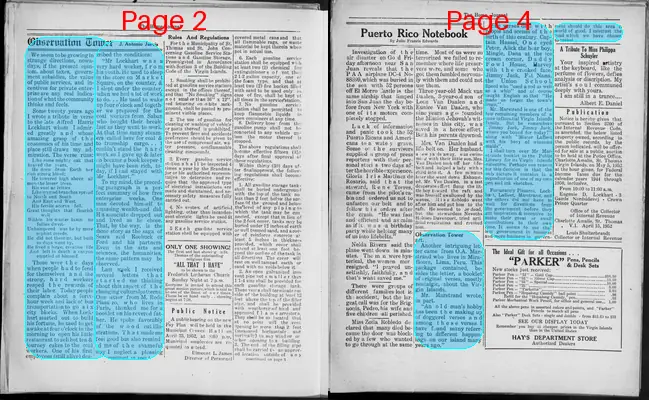
The Home Journal
Charlotte Amalie, Saint Thomas County, Virgin Islands
What is this article about?
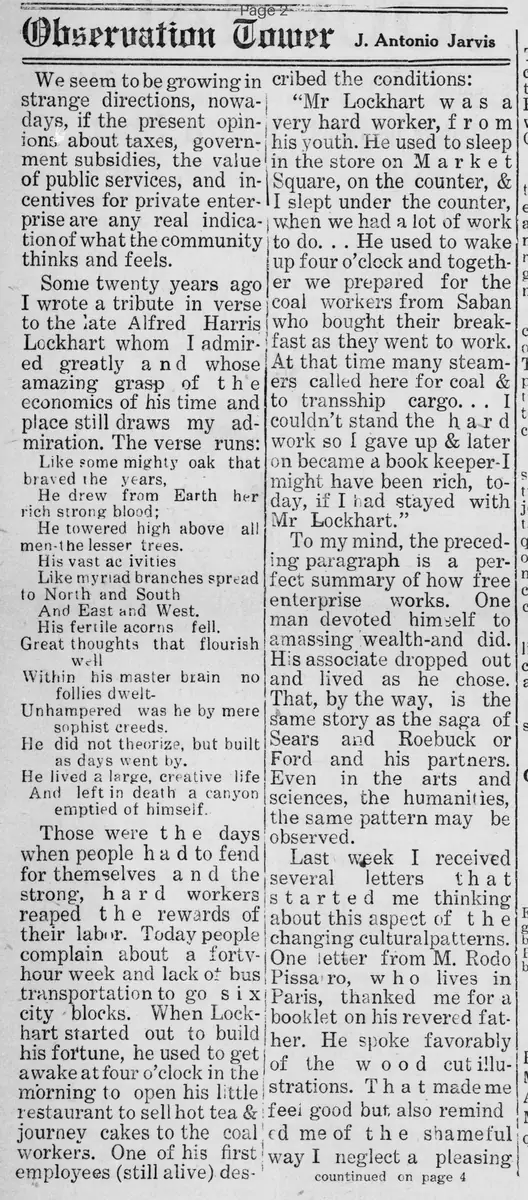
The editorial reflects on changing societal attitudes toward taxes, government subsidies, and private enterprise, contrasting past self-reliance exemplified by Alfred Harris Lockhart's hard work with modern complaints. It includes anecdotes from Lockhart's employee and letters from Pissarro and Marstrand about art and Virgin Islands history, advocating less government in business.
Merged-components note: This is a continuation of the editorial 'Observation Tower' from page 2 to page 4. The page 4 portion was incorrectly labeled as 'story' but is part of the same opinion piece.
Clippings
1 of 2
OCR Quality
Full Text
We seem to be growing in strange directions, nowadays, if the present opinions about taxes, government subsidies, the value of public services, and incentives for private enterprise are any real indication of what the community thinks and feels.
Some twenty years ago I wrote a tribute in verse to the late Alfred Harris Lockhart whom I admired greatly and whose amazing grasp of the economics of his time and place still draws my admiration. The verse runs:
Like some mighty oak that braved the years,
He drew from Earth her rich strong blood;
He towered high above all men-the lesser trees.
His vast activities
Like myriad branches spread to North and South
And East and West.
His fertile acorns fell.
Great thoughts that flourish well
Within his master brain no follies dwelt-
Unhampered was he by mere sophist creeds.
He did not theorize, but built as days went by.
He lived a large, creative life
And left in death a canyon emptied of himself.
Those were the days when people had to fend for themselves and the strong, hard workers reaped the rewards of their labor. Today people complain about a forty-hour week and lack of bus transportation to go six city blocks. When Lockhart started out to build his fortune, he used to get awake at four o'clock in the morning to open his little restaurant to sell hot tea & journey cakes to the coal workers. One of his first employees (still alive) described the conditions:
J. Antonio Jarvis
"Mr. Lockhart was a very hard worker, from his youth. He used to sleep in the store on Market Square, on the counter, & I slept under the counter, when we had a lot of work to do... He used to wake up four o'clock and together we prepared for the coal workers from Saban who bought their breakfast as they went to work. At that time many steamers called here for coal & to transship cargo... I couldn't stand the hard work so I gave up & later on became a book keeper-I might have been rich, today, if I had stayed with Mr. Lockhart."
To my mind, the preceding paragraph is a perfect summary of how free enterprise works. One man devoted himself to amassing wealth-and did. His associate dropped out and lived as he chose. That, by the way, is the same story as the saga of Sears and Roebuck or Ford and his partners. Even in the arts and sciences, the humanities, the same pattern may be observed.
Last week I received several letters that started me thinking about this aspect of the changing cultural patterns. One letter from M. Rodolphe Pissarro, who lives in Paris, thanked me for a booklet on his revered father. He spoke favorably of the wood cut illustrations. That made me feel good but also reminded me of the shameful way I neglect a pleasing continued on page 4
Observation Tower
art.
Another intriguing letter came from O.A. Marstrand who lives in Miraflores, Lima, Peru. This package contained, besides the letter, a booklet of original verses, mostly nostalgic, about the Virgin Islands.
Mr. Marstrand wrote, in part.
"An old man's hobby has been the making up of doggerel verses and among these verses I have found many referring to different happenings on our island many years ago."
The verses deal with people and scenes of the birth of this century. Captain Hassel. One eyed Peter. Alick the bear boy, Mingle, Dana at the ice cream corner, Daddy Fowl House, Harvey with the crooked face, Jimmy Jack, Fat Nana, the Union School, Speed who "used a rod as well as a whip' and of course taught English so that "He made us forget the town's lingo."
Mr. Marstrand is one of the few remaining members of a once influential Virgin Islands family. But he remembers "Jimmy Jack, Jimmy Jack, where you'bound for today?" along with 'Mister LaBeet with his bevy of winsome maids".
I shall turn over Mr Marstrand's booklet to the Public Library for its Virgin Islands collection. Perhaps one reason for this decision is that the only picture it contains is a reproduction of one of my own pen and ink sketches.
Fortunately Pissarro, Lockhart, LaBeet, Marstrand, and the others did not have to wait for directions from the government before, they got inspiration & incentive to make their great or small contributions to their own time. It seems to me that less government in business and more business in government should do this area a world of good. I mistrust the road which we have chosen to travel.
What sub-type of article is it?
What keywords are associated?
What entities or persons were involved?
Editorial Details
Primary Topic
Critique Of Government Intervention And Praise For Free Enterprise
Stance / Tone
Supportive Of Private Enterprise And Mistrustful Of Government Involvement
Key Figures
Key Arguments