Thank you for visiting SNEWPapers!
Sign up free
Wilmington Daily Gazette
Wilmington, New Castle County, Delaware
What is this article about?
This editorial critiques the Republican Senate's rejection of Caleb Cushing's nomination as Chief Justice due to his pre-war Democratic affiliations and a letter to Jefferson Davis, portraying it as shabby treatment and a victory over President Grant. It includes quotes from newspapers like the Philadelphia Press and Baltimore Sun defending Cushing, contrasts with the Commercial's ridicule, and briefly notes the unfortunate timing of a local miners' strike amid high coal supply.
Clipping
OCR Quality
Full Text
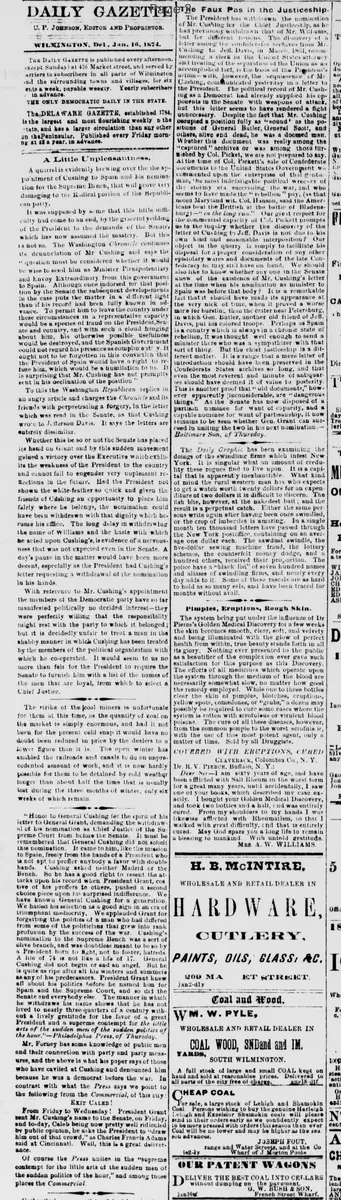
A quarrel is evidently brewing over the appointment of Cushing to Spain and his nomination for the Supreme Bench, that will prove very damaging to the Radical portion of the Republican party.
It was supposed by some that this little difficulty had come to an end, by the graceful yielding of the President to the demands of the Senate which has now assumed the mastery. But this is not so. The Washington Chronicle continues its denunciation of Mr. Cushing and says the question must be considered whether it would be wise to send him as Minister Plenipotentiary and Envoy Extraordinary from this government to Spain. Although once endorsed for that position by the Senate the subsequent developments in the case puts the matter in a different light than if his record had been fully known in advance. To permit him to leave the country under these circumstances in a representative capacity would be a species of fraud on the President, Senate and country, and with such a cloud hanging about him, his otherwise possible usefulness would be destroyed, and the Spanish Government could not regard his presence as complimentary. It ought not to be forgotten in this connection that the President of Spain would have a right to refuse him, which would be a humiliation to us. It is surprising that Mr. Cushing has not promptly sent in his declination of the position.
To this the Washington Republican replies in an angry article and charges the Chronicle and its friends with perpetrating a forgery, in the letter which was read in the Senate, as that Cushing wrote to J. Jefferson Davis. It says the letters are entirely dissimilar.
Whether this be so or not the Senate has placed its hand on Grant and by this sudden movement gained a victory over the Executive which exhibits the weakness of the President to the country and cannot fail to engender very unpleasant reflections in the future. Had the President not shown the white feather so quick and given the friends of Cushing an opportunity to place him fairly where he belongs, the nomination could have been withdrawn with that dignity which became his office. The long delay in withdrawing the name of Williams and the haste with which he acted upon Cushing's, is evidence of a nervousness that was not expected even in the Senate. A day's pause in the matter would have been more decent, especially as the President had Cushing's letter requesting a withdrawal of the nomination in his hands.
With reference to Mr. Cushing's appointment the members of the Democratic party have so far manifested politically no decided interest—they were perfectly willing that the responsibility might rest with the party to which it belonged; but it is decidedly unfair to treat a man in the shabby manner in which Cushing has been treated by the members of the political organization with which he co-operated. It would seem to us no more than fair for the President to require the Senate to furnish him with a list of the names of the men that are loyal, from which to select a Chief Justice.
The strike of the local miners is unfortunate for them at this time, as the quantity of coal on the market is simply enormous, and had it not been for the present cold snap it would have no doubt been reduced in price by the dealers to a lower figure than it is. The open winter has enabled the railroads and canals to do an unprecedented amount of work, and it is now hardly possible for them to be detained by cold weather longer than about half the time that is usually lost during the three months of winter, only six weeks of which remain.
"Honor to General Cushing for the spirit of his letter to General Grant, demanding the withdrawal of his nomination as Chief Justice of the Supreme Court from before the Senate. It must be remembered that General Cushing did not solicit this nomination. It came to him, like the mission to Spain, freely from the hands of a President who is not apt to proffer anybody a favor with double hands. Cushing asked neither Madrid nor the Bench. So he has a good right to resent the attacks upon his record when President Grant, covetous of his proffers to others, pushed a second choice piece upon his surprised indifference. We have known General Cushing for a generation. We hailed his selection as a good sign in an era of triumphant mediocrity. We applauded Grant for forgetting the politics of a man who had differed from some of the politicians that grew into rank profusion by the success of the war. Cushing's nomination to the Supreme Bench was a sort of olive branch, and was doubtless meant to be so by a President born to fight, not to foster, hatreds. A life of 74 is not like a life of 17. General Cushing did not begin or end an angel. But he is quite as ripe after all his winters and summers as any of his predecessors. President Grant knew all about his politics before he named him for Spain and the Supreme Court, and so did the Senate and everybody else. The manner in which he withdraws his name shows that he has not lived to nearly three-quarters of a century without a lively gratitude for the favor of a great President and a supreme contempt for the little arts of the sudden men of the sudden politics of the hour."—Philadelphia Press, of Thursday.
Mr. Forney has some knowledge of public men and their connection with party and party measures, and the above is what his paper says of those who have caviled at Cushing and denounced him because he was a Democrat before the war. In contrast with what the Press says we point to the following from the Commercial, of this city:
EXIT CALEB!
From Friday to Wednesday! President Grant sent Mr. Cushing's name to the Senate, on Friday, and to-day, Caleb being now pretty well ridiculed by public opinion, he asks the President to "draw him out of that crowd," as Charles Francis Adams said at Cincinnati.
Well, this is a great deliverance.
Of course the Press unites in the "supreme contempt for the little arts of the sudden men of the sudden politics of the hour," and among those places the Commercial.
The President has withdrawn the nomination of Mr. Cushing for the Chief Justiceship, as he had previously withdrawn that of Mr. Williams but for different reasons. The discovery of a letter among the Confederate archives from Mr. Cushing to Jeff. Davis, in March, 1861, recommending a clerk in the United States Attorney and treating of the separation of the Union as an accomplished fact, is the basis of the President's action—with, however, the acquiescence of Mr. Cushing, communicated yesterday in a letter to the President. The political record of Mr. Cushing as a Democrat had already supplied his opponents in the Senate with weapons of attack, but this letter seems to have rendered a fight unnecessary. Despite the fact that Mr. Cushing occupied a position fully as "sound" as the positions of General Butler, General Scott, and others, alive and dead, he was a doomed man.
Whether this document was really among the "captured" archives or was among those furnished by Col. Pickett, we are not prepared to say. At the time of Col. Pickett's sale of Confederate documents to the United States Government commented upon the enterprise of that gentleman, the most indefatigable political wrecker of the stormy era succeeding the war, and who seems to have made the "rebellion" pay, (as that noted Maryland wit, Col. Hanson, said the Americans beat the British at the battle of Bladensburg)—"in the long run." Our great respect for the commercial capacity of Col. Pickett prompts us to the inquiry whether the discovery of the letter of Cushing to Jeff. Davis is not due to his own kind and seasonable interposition? Our object in the query is simply to facilitate his disposal for a proper consideration of any other epistolary wares and documents of the late Confederacy he may still have on hand. We should also like to know whether any one in the Senate knew of the existence of Mr. Cushing's letter at the time when his nomination as minister to Spain was before that body? It is a remarkable fact that it should have made its appearance at the very nick of time, when it proved a worse mire for bursting than the crater near Petersburg, in which Gen. Butler, another old friend of Jeff. Davis, put his colored troops. Perhaps as Spain is a country which is always in a chronic state of rebellion, it was thought well enough to send a minister there who was a sympathizer with that sort of thing. But the chief justiceship is a different matter. It is strange that a mere letter of introduction should have been preserved in the Confederate States archives so long, and that even the most reverent and minute of antiquaries should have deemed it of value to posterity. This is another proof that "old documents," however apparently inconsiderable, are "dangerous things."
As the Senate has now disposed of a partisan nominee for want of capacity, and a capable nominee for want of partisanship, it now remains to be seen whether Gen. Grant can succeed in uniting the two in his next nomination.—Baltimore Sun, of Thursday.
What sub-type of article is it?
What keywords are associated?
What entities or persons were involved?
Editorial Details
Primary Topic
Controversy Over Caleb Cushing's Supreme Court Nomination
Stance / Tone
Critical Of Senate's Treatment Of Cushing And Supportive Of His Character
Key Figures
Key Arguments