Thank you for visiting SNEWPapers!
Sign up free
Story
November 28, 1831
Lynchburg Virginian
Lynchburg, Virginia
What is this article about?
Advice for farmers on fall ploughing in autumn: benefits include saving spring time, frost pulverizing soil, destroying pests; considerations for depth based on soil type, starting shallow for thin soils and gradually deepening with manure; techniques for breaking land and turning furrows.
Clipping
OCR Quality
88%
Good
Full Text
FARMERS WORK FOR NOVEMBER.
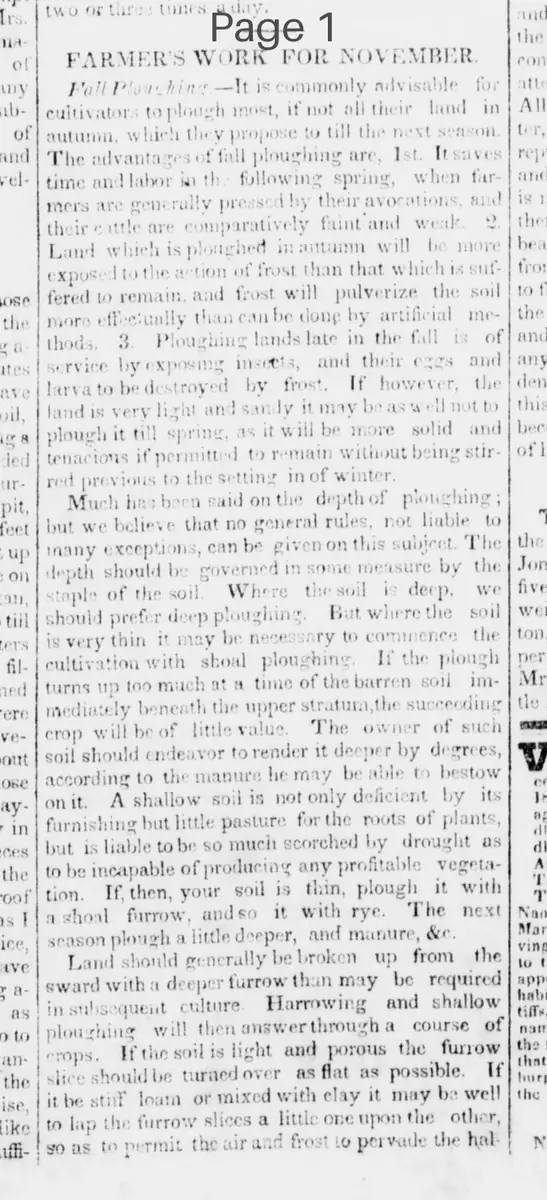
Fall Ploughing--It is commonly advisable for the cultivator, to plough most, if not all their land in autumn, which they propose to till the next season. The advantages of fall ploughing are, 1st It saves time and labor in the following spring, when farmers are generally pressed by their avocations, and their cattle are comparatively fat and weak.
Land which is ploughed in autumn will be more exposed to the action of frost than that which is suffered to remain and frost will pulverize the soil more effectually than can be done by artificial methods. 3d Ploughing lands late in the fall is of service by exposing worms, and then grubs and larva to be destroyed by frost. If however, the land is very high and sandy it may be well not to plough it till spring, as it will be more solid and tenacious if permitted to remain without being stirred previous to the setting in of winter.
Much has been said on the depth of ploughing. but we believe that no general rules, not liable to many exceptions, can be given on this subject. The depth should be governed in some measure by the quality of the soil. Where the soil is deep, we should prefer deep ploughing. But where the soil is very thin it may be necessary to commence the cultivation with shallow ploughing. If the plough turns up too much at a time of the barren soil immediately beneath the upper strata, the succeeding crop will be of little value. The owner of such soil should endeavor to render it deeper by degrees, according to the manure he may be able to bestow on it. A shallow soil is not only deficient by its furnishing but little pasture for the roots of plants, but is liable to be so much scorched by drought as to be incapable of producing any profitable vegetation. If, then, your soil is thin, plough it with a shallow furrow, and sow it with rye. The next season plough a little deeper, and manure, &c.
Land should generally be broken up from the sward with a deeper furrow than may be required in subsequent culture. Harrowing and shallow ploughing will then answer through a course of crops. If the soil is light and porous the furrow slice should be turned over as flat as possible. If it be stiff loam or mixed with clay it may be well to lap the furrow slices a little one upon the other, so as to permit the air and frost to pervade the whole surface.
Fall Ploughing--It is commonly advisable for the cultivator, to plough most, if not all their land in autumn, which they propose to till the next season. The advantages of fall ploughing are, 1st It saves time and labor in the following spring, when farmers are generally pressed by their avocations, and their cattle are comparatively fat and weak.
Land which is ploughed in autumn will be more exposed to the action of frost than that which is suffered to remain and frost will pulverize the soil more effectually than can be done by artificial methods. 3d Ploughing lands late in the fall is of service by exposing worms, and then grubs and larva to be destroyed by frost. If however, the land is very high and sandy it may be well not to plough it till spring, as it will be more solid and tenacious if permitted to remain without being stirred previous to the setting in of winter.
Much has been said on the depth of ploughing. but we believe that no general rules, not liable to many exceptions, can be given on this subject. The depth should be governed in some measure by the quality of the soil. Where the soil is deep, we should prefer deep ploughing. But where the soil is very thin it may be necessary to commence the cultivation with shallow ploughing. If the plough turns up too much at a time of the barren soil immediately beneath the upper strata, the succeeding crop will be of little value. The owner of such soil should endeavor to render it deeper by degrees, according to the manure he may be able to bestow on it. A shallow soil is not only deficient by its furnishing but little pasture for the roots of plants, but is liable to be so much scorched by drought as to be incapable of producing any profitable vegetation. If, then, your soil is thin, plough it with a shallow furrow, and sow it with rye. The next season plough a little deeper, and manure, &c.
Land should generally be broken up from the sward with a deeper furrow than may be required in subsequent culture. Harrowing and shallow ploughing will then answer through a course of crops. If the soil is light and porous the furrow slice should be turned over as flat as possible. If it be stiff loam or mixed with clay it may be well to lap the furrow slices a little one upon the other, so as to permit the air and frost to pervade the whole surface.
What sub-type of article is it?
Agricultural Advice
Farming Guide
What keywords are associated?
Fall Ploughing
Soil Depth
Autumn Farming
Frost Action
Pest Destruction
Manure Use
Furrow Technique
Story Details
Event Date
November
Story Details
Advisory on autumn ploughing benefits like time-saving, frost action on soil, pest destruction; guidelines for ploughing depth by soil type, shallow starts for thin soils with gradual deepening via manure and rye sowing; techniques for initial deep furrows on sward, flat turns for porous soil, lapped for clay.