Thank you for visiting SNEWPapers!
Sign up free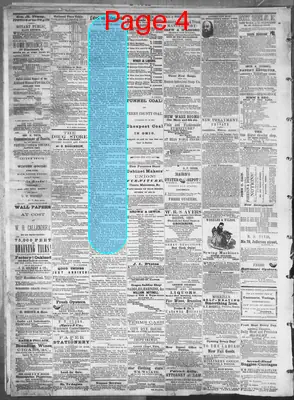
Dayton Daily Empire
Dayton, Montgomery County, Ohio
What is this article about?
In the U.S. House of Representatives on Dec. 27 during the 36th Congress, Mr. Moore proposed declaring Alex. H. Boteler Speaker, sparking debate. Mr. Smith of Virginia defended the Constitution and slavery provisions in a lengthy speech, amid humorous exchanges and failed adjournment motions over Christmas.
Clipping

OCR Quality
Full Text
Congress—XXXVIth Session
WASHINGTON, Dec. 27.
HOUSE.—Mr. Moore, of Ky., Mr. Smith, of Virginia, yielding the floor, offered a resolution, which was read for information, that Alex. H. Boteler be declared Speaker of the House of the Thirty-sixth Congress. Messrs. Bingham and Barksdale objected to the resolution as being out of order.
Mr. McClernand, of Illinois, moved to substitute the name of Mr. Davis of Ind.
Mr. Moore remarked that he introduced the resolution honestly, hoping that it would meet the approbation of a majority of the House. He trusted that all had earnestly endeavored since the first day of their meeting to effect an organization, and been governed by the same honesty, candor and frankness by which he himself was actuated.
Mr. Barksdale, of Mississippi, reminded Mr. Moore that the resolution had been objected to, and the gentleman, therefore, had no right to debate.
Mr. Smith, resuming, declared himself a sincere and loyal friend to the Constitution and the Union. He was an advocate for no new and inflammatory doctrines; he wanted no modern inventions: he desired to uphold the Constitution as framed by our fathers, and replied to the arguments of the Republicans, founded on the Declaration of Independence, that all men were created equal, by saying that instrument was formed by free men, not slaves. It was free men who proposed to sever the relations with England and form an independent government. In the articles of confederation free inhabitants are specifically mentioned, showing that slaves are not included.
Then followed the adoption of the Constitution. Negroes were no parties to the formation of that instrument. The Constitution expressly provides for the return of fugitive slaves.
Mr. Smith went on to allude to cases occurring under that clause. Washington himself attempted to reclaim a fugitive slave. He quoted the case of Prigg vs. the State of Pa., and gave the history of events from the adoption of the Constitution to the present day, showing that all aggressions on the subject of slavery from the North, and the agitation resulting therefrom was justly chargeable to them. Particular reference was made to the Louisiana purchase, the admission of Missouri, the efforts of Henry Clay on that occasion, and quoting the authority of Jefferson, Madison and Monroe on the Missouri restriction. Northern aggression did not originate in the love of the negro, but the desire for political power.
During his speech some one sent him a tumbler of egg-nogg, which he drank, saying: "Merry Christmas to all of you." (Laughter.)
Mr. Kilgore, of Ind., inquired whether it was in order for the gentleman to monopolize the drinking of egg-nogg, while the rest are doing without it?
Mr. Smith said that that was one of the constitutional privileges of his side of the House. (Laughter.)
Mr. Moore, of Ky.—"I move we adjourn, so as all may take the same kind." (Cries of "No, no; go on."
Mr. Smith—"I was willing to adjourn this morning myself, out of reverence for the day, but the party which regards the Sabbath as an innovation on popular liberty and repudiates it as a social arrangement, was not willing so manifest their respect for the birth-day of the Savior of the world. and hence refused to adjourn. I then, in a christian and reverential spirit, (laughter,) engaged in the labor of love, endeavoring to enlighten the darkened understanding of that side of the House; but yet, Sir, I am willing to give way for an adjournment." (Cries on the Republican side of "No, no; go on.")
Mr. Smith—"If it be the pleasure of the House to adjourn I will yield."
Mr. Burnett—"I move we adjourn. I care nothing personally about it, but think it due to the employees of this House. If there is a chance to elect a Speaker, I would be willing to vote."
The Republican side called for the yeas and nays on the motion to adjourn.
Mr. Hall, of Ohio, remarked that some distinguished man had said "all things must have an end," and he presumed Mr. Smith's speech would. (Laughter.) He would move that Mr. Smith be permitted to continue his remarks until they were finished, and that the House stand adjourned at their conclusion. (Excessive laughter.)
Mr. Smith, (rising indignantly,) said he did not see why gentlemen should wish to treat him in that way. He had yielded the floor day after day, and now, after he had indicated a wish from the beginning to gratify a number of gentlemen who wished to adjourn, there seemed to be an effort made to treat him with disrespect and force him to speak to empty benches. He knew not why he was so treated by friends as well as foes.
Mr. Briggs desired Mr. Smith to give some reasonable guarantee how much more time he proposed to occupy? If he would continue to entertain the House during the Holiday week, it would save the necessity for adjourning over. (Laughter.) The vote announced; yeas 75, nays 123. So the House refused to adjourn.
Mr. Hill moved that no vote be taken for Speaker until Mr. Smith concludes his remarks.
What sub-type of article is it?
What keywords are associated?
What entities or persons were involved?
Where did it happen?
Domestic News Details
Primary Location
Washington
Event Date
Dec. 27
Key Persons
Outcome
house refused to adjourn (yeas 75, nays 123); debate on speaker election and slavery continued.
Event Details
During the 36th Congress House session, Mr. Moore offered a resolution declaring Alex. H. Boteler Speaker, objected to by Bingham and Barksdale. McClernand moved to substitute Davis. Moore spoke honestly on organization efforts. Smith defended Constitution, argued against Republican views on equality and slavery, citing historical documents and cases. Speech interrupted by egg-nogg toast and humorous exchanges. Multiple adjournment motions failed amid laughter and Republican refusals.