Thank you for visiting SNEWPapers!
Sign up free
Story
May 20, 1829
The Massachusetts Spy, And Worcester County Advertiser
Worcester, Worcester County, Massachusetts
What is this article about?
Article debates theory that Lombardy poplar trees decay due to propagation from cuttings rather than seeds, cites earlier decay in New Jersey, notes similar issues in related trees, and solicits reader facts on cultivation attempts.
Clipping
OCR Quality
98%
Excellent
Full Text
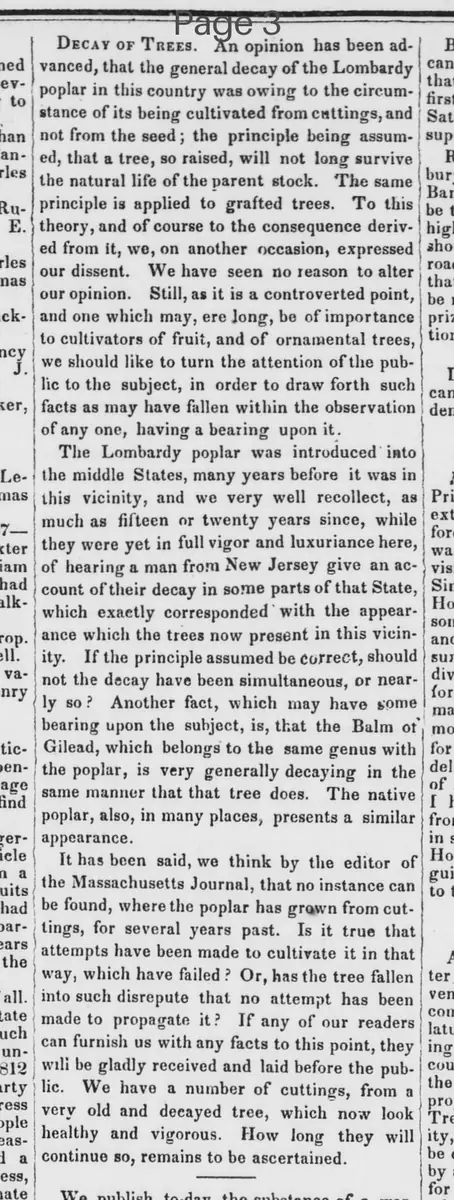
Decay of Trees. An opinion has been advanced, that the general decay of the Lombardy poplar in this country was owing to the circumstance of its being cultivated from cuttings, and not from the seed; the principle being assumed, that a tree, so raised, will not long survive the natural life of the parent stock. The same principle is applied to grafted trees. To this theory, and of course to the consequence derived from it, we, on another occasion, expressed our dissent. We have seen no reason to alter our opinion. Still, as it is a controverted point, and one which may, ere long, be of importance to cultivators of fruit, and of ornamental trees, we should like to turn the attention of the public to the subject, in order to draw forth such facts as may have fallen within the observation of any one, having a bearing upon it.
The Lombardy poplar was introduced into the middle States, many years before it was in this vicinity, and we very well recollect, as much as fifteen or twenty years since, while they were yet in full vigor and luxuriance here, of hearing a man from New Jersey give an account of their decay in some parts of that State, which exactly corresponded with the appearance which the trees now present in this vicinity. If the principle assumed be correct, should not the decay have been simultaneous, or nearly so? Another fact, which may have some bearing upon the subject, is, that the Balm of Gilead, which belongs to the same genus with the poplar, is very generally decaying in the same manner that that tree does. The native poplar, also, in many places, presents a similar appearance.
It has been said, we think by the editor of the Massachusetts Journal, that no instance can be found, where the poplar has grown from cuttings, for several years past. Is it true that attempts have been made to cultivate it in that way, which have failed? Or, has the tree fallen into such disrepute that no attempt has been made to propagate it? If any of our readers can furnish us with any facts to this point, they will be gladly received and laid before the public. We have a number of cuttings, from a very old and decayed tree, which now look healthy and vigorous. How long they will continue so, remains to be ascertained.
The Lombardy poplar was introduced into the middle States, many years before it was in this vicinity, and we very well recollect, as much as fifteen or twenty years since, while they were yet in full vigor and luxuriance here, of hearing a man from New Jersey give an account of their decay in some parts of that State, which exactly corresponded with the appearance which the trees now present in this vicinity. If the principle assumed be correct, should not the decay have been simultaneous, or nearly so? Another fact, which may have some bearing upon the subject, is, that the Balm of Gilead, which belongs to the same genus with the poplar, is very generally decaying in the same manner that that tree does. The native poplar, also, in many places, presents a similar appearance.
It has been said, we think by the editor of the Massachusetts Journal, that no instance can be found, where the poplar has grown from cuttings, for several years past. Is it true that attempts have been made to cultivate it in that way, which have failed? Or, has the tree fallen into such disrepute that no attempt has been made to propagate it? If any of our readers can furnish us with any facts to this point, they will be gladly received and laid before the public. We have a number of cuttings, from a very old and decayed tree, which now look healthy and vigorous. How long they will continue so, remains to be ascertained.
What sub-type of article is it?
Curiosity
What themes does it cover?
Nature
Misfortune
What keywords are associated?
Lombardy Poplar
Tree Decay
Cuttings Propagation
Balm Of Gilead
New Jersey
Tree Cultivation
Where did it happen?
Middle States, New Jersey, This Vicinity
Story Details
Location
Middle States, New Jersey, This Vicinity
Event Date
Fifteen Or Twenty Years Since
Story Details
Debate on whether Lombardy poplar decay results from cultivation via cuttings, dissenting from the theory, noting prior decay reports from New Jersey, similar decay in Balm of Gilead and native poplars, questioning recent propagation attempts, and seeking reader observations.