Thank you for visiting SNEWPapers!
Sign up free
Foreign News
February 24, 1854
Wilmington Journal
Wilmington, New Hanover County, North Carolina
What is this article about?
Satirical eye-witness account portraying Emperor Nicholas of Russia as an incompetent and delusional warrior during the war with Turkey, including anecdotes of mock battles, poor decisions, and his admiration for crusades amid absolutist ambitions.
Clipping
OCR Quality
98%
Excellent
Full Text
[From an Eye-Witness.]
The Emperor Nicholas as a Warrior:
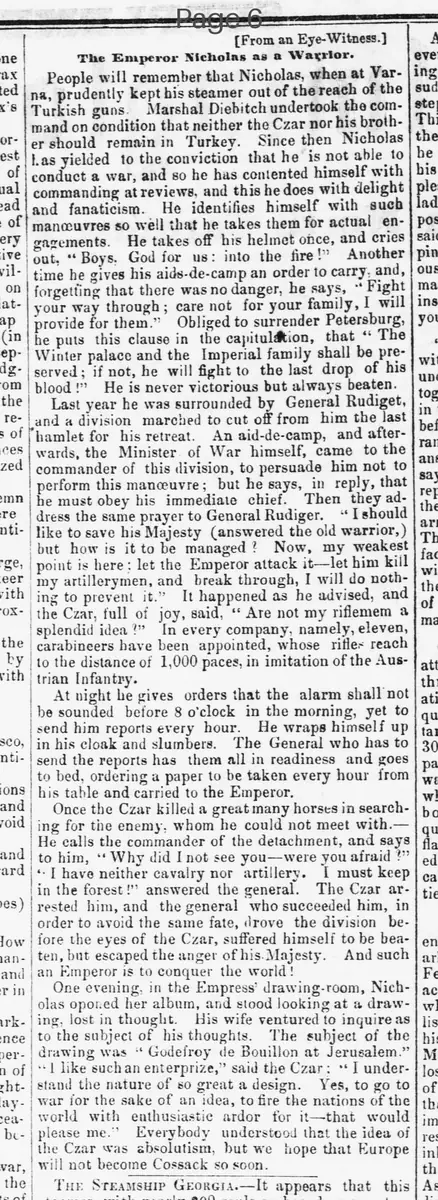
People will remember that Nicholas, when at Varna, prudently kept his steamer out of the reach of the Turkish guns. Marshal Diebitch undertook the command on condition that neither the Czar nor his brother should remain in Turkey. Since then Nicholas has yielded to the conviction that he is not able to conduct a war, and so he has contented himself with commanding at reviews, and this he does with delight and fanaticism. He identifies himself with such manoeuvres so well that he takes them for actual engagements. He takes off his helmet once, and cries out, "Boys, God for us: into the fire!" Another time he gives his aids-de-camp an order to carry, and, forgetting that there was no danger, he says, "Fight your way through; care not for your family, I will provide for them." Obliged to surrender Petersburg, he puts this clause in the capitulation, that "The Winter palace and the Imperial family shall be preserved; if not, he will fight to the last drop of his blood!" He is never victorious but always beaten.
Last year he was surrounded by General Rudiger, and a division marched to cut off from him the last hamlet for his retreat. An aid-de-camp, and afterwards, the Minister of War himself, came to the commander of this division, to persuade him not to perform this manoeuvre; but he says, in reply, that he must obey his immediate chief. Then they address the same prayer to General Rudiger. "I should like to save his Majesty (answered the old warrior,) but how is it to be managed? Now, my weakest point is here: let the Emperor attack it—let him kill my artillerymen, and break through, I will do nothing to prevent it." It happened as he advised, and the Czar, full of joy, said, "Are not my riflemen a splendid idea?" In every company, namely, eleven, carabineers have been appointed, whose rifle reaches to the distance of 1,000 paces, in imitation of the Austrian Infantry.
At night he gives orders that the alarm shall not be sounded before 8 o'clock in the morning, yet to send him reports every hour. He wraps himself up in his cloak and slumbers. The General who has to send the reports has them all in readiness and goes to bed, ordering a paper to be taken every hour from his table and carried to the Emperor.
Once the Czar killed a great many horses in searching for the enemy, whom he could not meet with. He calls the commander of the detachment, and says to him, "Why did I not see you—were you afraid?"
"I have neither cavalry nor artillery. I must keep in the forest!" answered the general. The Czar arrested him, and the general who succeeded him, in order to avoid the same fate, drove the division before the eyes of the Czar, suffered himself to be beaten, but escaped the anger of his Majesty. And such an Emperor is to conquer the world!
One evening, in the Empress' drawing-room, Nicholas opened her album, and stood looking at a drawing, lost in thought. His wife ventured to inquire as to the subject of his thoughts. The subject of the drawing was "Godefroy de Bouillon at Jerusalem."
"I like such an enterprise," said the Czar; "I understand the nature of so great a design. Yes, to go to war for the sake of an idea, to fire the nations of the world with enthusiastic ardor for it—that would please me." Everybody understood that the idea of the Czar was absolutism, but we hope that Europe will not become Cossack so soon.
The Emperor Nicholas as a Warrior:
People will remember that Nicholas, when at Varna, prudently kept his steamer out of the reach of the Turkish guns. Marshal Diebitch undertook the command on condition that neither the Czar nor his brother should remain in Turkey. Since then Nicholas has yielded to the conviction that he is not able to conduct a war, and so he has contented himself with commanding at reviews, and this he does with delight and fanaticism. He identifies himself with such manoeuvres so well that he takes them for actual engagements. He takes off his helmet once, and cries out, "Boys, God for us: into the fire!" Another time he gives his aids-de-camp an order to carry, and, forgetting that there was no danger, he says, "Fight your way through; care not for your family, I will provide for them." Obliged to surrender Petersburg, he puts this clause in the capitulation, that "The Winter palace and the Imperial family shall be preserved; if not, he will fight to the last drop of his blood!" He is never victorious but always beaten.
Last year he was surrounded by General Rudiger, and a division marched to cut off from him the last hamlet for his retreat. An aid-de-camp, and afterwards, the Minister of War himself, came to the commander of this division, to persuade him not to perform this manoeuvre; but he says, in reply, that he must obey his immediate chief. Then they address the same prayer to General Rudiger. "I should like to save his Majesty (answered the old warrior,) but how is it to be managed? Now, my weakest point is here: let the Emperor attack it—let him kill my artillerymen, and break through, I will do nothing to prevent it." It happened as he advised, and the Czar, full of joy, said, "Are not my riflemen a splendid idea?" In every company, namely, eleven, carabineers have been appointed, whose rifle reaches to the distance of 1,000 paces, in imitation of the Austrian Infantry.
At night he gives orders that the alarm shall not be sounded before 8 o'clock in the morning, yet to send him reports every hour. He wraps himself up in his cloak and slumbers. The General who has to send the reports has them all in readiness and goes to bed, ordering a paper to be taken every hour from his table and carried to the Emperor.
Once the Czar killed a great many horses in searching for the enemy, whom he could not meet with. He calls the commander of the detachment, and says to him, "Why did I not see you—were you afraid?"
"I have neither cavalry nor artillery. I must keep in the forest!" answered the general. The Czar arrested him, and the general who succeeded him, in order to avoid the same fate, drove the division before the eyes of the Czar, suffered himself to be beaten, but escaped the anger of his Majesty. And such an Emperor is to conquer the world!
One evening, in the Empress' drawing-room, Nicholas opened her album, and stood looking at a drawing, lost in thought. His wife ventured to inquire as to the subject of his thoughts. The subject of the drawing was "Godefroy de Bouillon at Jerusalem."
"I like such an enterprise," said the Czar; "I understand the nature of so great a design. Yes, to go to war for the sake of an idea, to fire the nations of the world with enthusiastic ardor for it—that would please me." Everybody understood that the idea of the Czar was absolutism, but we hope that Europe will not become Cossack so soon.
What sub-type of article is it?
War Report
Military Campaign
Royal Event
What keywords are associated?
Emperor Nicholas
Russian War
Military Incompetence
Varna
Turkish Guns
Mock Battles
Absolutism
What entities or persons were involved?
Emperor Nicholas
Marshal Diebitch
General Rudiger
Minister Of War
Empress
Where did it happen?
Varna
Foreign News Details
Primary Location
Varna
Key Persons
Emperor Nicholas
Marshal Diebitch
General Rudiger
Minister Of War
Empress
Outcome
he is never victorious but always beaten.
Event Details
Satirical anecdotes depict Nicholas avoiding combat at Varna, conducting mock reviews as real battles, staging defeats to appear victorious, poor night watch practices, arresting a general for hiding, and expressing admiration for crusades tied to absolutism.