Thank you for visiting SNEWPapers!
Sign up free
Literary
February 22, 1770
The Virginia Gazette
Richmond, Williamsburg, Richmond County, Virginia
What is this article about?
Description from the American Society for promoting useful knowledge of a self-powered machine using a water wheel made from oars and a topmast to pump water from leaking ships at sea, reducing crew labor.
Clipping
OCR Quality
95%
Excellent
Full Text
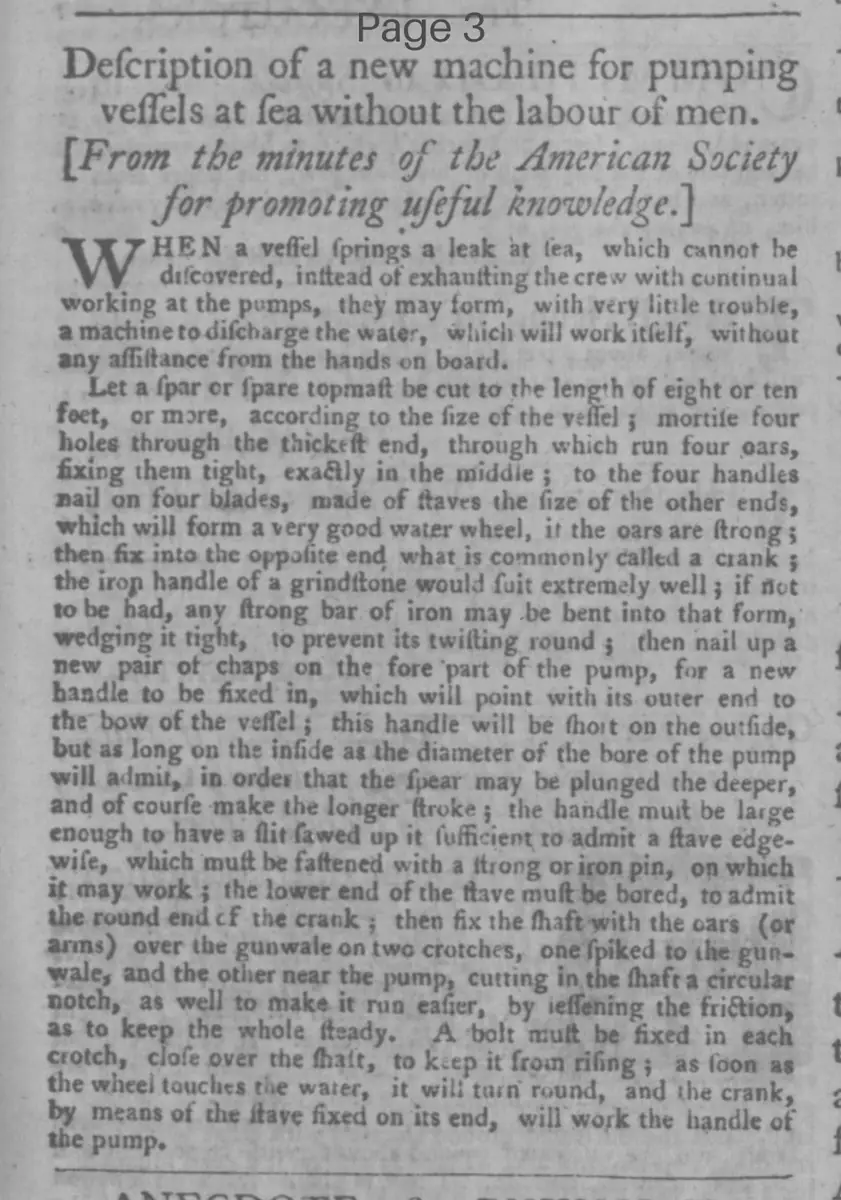
Description of a new machine for pumping vessels at sea without the labour of men.
[From the minutes of the American Society for promoting useful knowledge.]
When a vessel springs a leak at sea, which cannot be discovered, instead of exhausting the crew with continual working at the pumps, they may form, with very little trouble, a machine to discharge the water, which will work itself, without any assistance from the hands on board. Let a spare topmast be cut to the length of eight or ten feet, or more, according to the size of the vessel; mortise four holes through the thickest end, through which run four oars, fixing them tight, exactly in the middle; to the four handles nail on four blades, made of staves the size of the other ends, which will form a very good water wheel, if the oars are strong; then fix into the opposite end what is commonly called a crank; the iron handle of a grindstone would suit extremely well; if not to be had, any strong bar of iron may be bent into that form, wedging it tight, to prevent its twisting round; then nail up a new pair of chaps on the fore part of the pump, for a new handle to be fixed in, which will point with its outer end to the bow of the vessel; this handle will be short on the outside, but as long on the inside as the diameter of the bore of the pump will admit, in order that the spear may be plunged the deeper, and of course make the longer stroke; the handle must be large enough to have a slit sawed up it sufficient to admit a stave edgewise, which must be fastened with a strong iron pin, on which it may work; the lower end of the stave must be bored, to admit the round end of the crank; then fix the shaft with the oars (or arms) over the gunwale on two crotches, one fixed to the gunwale, and the other near the pump, cutting in the shaft a circular notch, as well to make it run easier, by lessening the friction, as to keep the whole steady. A bolt must be fixed in each crotch, close over the shaft, to keep it from rising; as soon as the wheel touches the water, it will turn round, and the crank, by means of the stave fixed on its end, will work the handle of the pump.
[From the minutes of the American Society for promoting useful knowledge.]
When a vessel springs a leak at sea, which cannot be discovered, instead of exhausting the crew with continual working at the pumps, they may form, with very little trouble, a machine to discharge the water, which will work itself, without any assistance from the hands on board. Let a spare topmast be cut to the length of eight or ten feet, or more, according to the size of the vessel; mortise four holes through the thickest end, through which run four oars, fixing them tight, exactly in the middle; to the four handles nail on four blades, made of staves the size of the other ends, which will form a very good water wheel, if the oars are strong; then fix into the opposite end what is commonly called a crank; the iron handle of a grindstone would suit extremely well; if not to be had, any strong bar of iron may be bent into that form, wedging it tight, to prevent its twisting round; then nail up a new pair of chaps on the fore part of the pump, for a new handle to be fixed in, which will point with its outer end to the bow of the vessel; this handle will be short on the outside, but as long on the inside as the diameter of the bore of the pump will admit, in order that the spear may be plunged the deeper, and of course make the longer stroke; the handle must be large enough to have a slit sawed up it sufficient to admit a stave edgewise, which must be fastened with a strong iron pin, on which it may work; the lower end of the stave must be bored, to admit the round end of the crank; then fix the shaft with the oars (or arms) over the gunwale on two crotches, one fixed to the gunwale, and the other near the pump, cutting in the shaft a circular notch, as well to make it run easier, by lessening the friction, as to keep the whole steady. A bolt must be fixed in each crotch, close over the shaft, to keep it from rising; as soon as the wheel touches the water, it will turn round, and the crank, by means of the stave fixed on its end, will work the handle of the pump.
What sub-type of article is it?
Essay
What keywords are associated?
Pumping Machine
Water Wheel
Vessel Leak
Nautical Invention
Self Powered Pump
Maritime Safety
What entities or persons were involved?
[From The Minutes Of The American Society For Promoting Useful Knowledge.]
Literary Details
Title
Description Of A New Machine For Pumping Vessels At Sea Without The Labour Of Men.
Author
[From The Minutes Of The American Society For Promoting Useful Knowledge.]
Form / Style
Technical Prose Description
Key Lines
When A Vessel Springs A Leak At Sea, Which Cannot Be Discovered, Instead Of Exhausting The Crew With Continual Working At The Pumps, They May Form, With Very Little Trouble, A Machine To Discharge The Water, Which Will Work Itself, Without Any Assistance From The Hands On Board.
Let A Spare Topmast Be Cut To The Length Of Eight Or Ten Feet, Or More, According To The Size Of The Vessel; Mortise Four Holes Through The Thickest End, Through Which Run Four Oars, Fixing Them Tight, Exactly In The Middle; To The Four Handles Nail On Four Blades, Made Of Staves The Size Of The Other Ends, Which Will Form A Very Good Water Wheel, If The Oars Are Strong;