Thank you for visiting SNEWPapers!
Sign up free
Alexandria Gazette & Daily Advertiser
Alexandria, Virginia
What is this article about?
Reports from August 12 detail the Neapolitan revolution: bloody conflict in Sicily over independence with over 2,000 casualties; mutiny in Naples suppressed with dozens killed; agitations in Sardinia and papal territories; Austrian court reacts with possible troop mobilizations.
Clipping
OCR Quality
Full Text
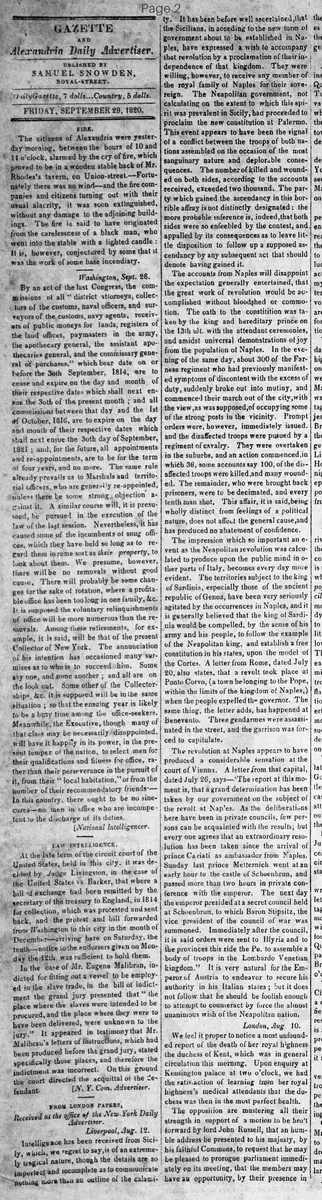
Received at the office of the New-York Daily Advertiser.
Liverpool, Aug. 12.
Intelligence has been received from Sicily, which, we regret to say, is of an extremely tragical nature, though the details are so imperfect and incomplete as to communicate nothing more than an outline of the calamity. It has been before well ascertained, that the Sicilians, in acceding to the new form of government about to be established in Naples, have expressed a wish to accompany that revolution by a proclamation of their independence of that kingdom. They were willing, however, to receive any member of the royal family of Naples for their sovereign. The Neapolitan government, not calculating on the extent to which this spirit was prevalent in Sicily, had proceeded to proclaim the new constitution at Palermo. This event appears to have been the signal of a conflict between the troops of both nations assembled on the occasion of the most sanguinary nature and deplorable consequences. The number of killed and wounded on both sides, according to the accounts received, exceeded two thousand. The party which gained the ascendancy in this horrible affray is not distinctly designated: the more probable inference is, indeed, that both sides were so enfeebled by the contest, and appalled by its consequences as to leave little disposition to follow up a supposed ascendancy by any subsequent act that should denote having gained it.
The accounts from Naples will disappoint the expectation generally entertained, that the great work of revolution would be accomplished without bloodshed or commotion. The oath to the constitution was taken by the king and hereditary prince on the 13th ult. with the attendant ceremonies, and amidst universal demonstrations of joy from the population of Naples. In the evening of the same day, about 300 of the Farne se regiment who had previously manifested symptoms of discontent with the excess of duty, suddenly broke out into mutiny, and commenced their march out of the city, with the view, as was supposed, of occupying some of the strong posts in the vicinity. Prompt orders were, however, immediately issued, and the disaffected troops were pursued by a regiment of cavalry. They were overtaken in the suburbs, and an action commenced, in which 36, some accounts say 100, of the disaffected troops were killed, and many wounded. The remainder, who were brought back prisoners, were to be decimated, and every tenth man shot. This affair, it is said, being wholly distinct from feelings of a political nature, does not affect the general cause, and has produced no abatement of confidence.
The impression which so important an event as the Neapolitan revolution was calculated to produce upon the public mind in other parts of Italy, becomes every day more evident. The territories subject to the king of Sardinia, especially those of the ancient republic of Genoa, have been very seriously agitated by the occurrences in Naples, and it is generally believed that the king of Sardinia would be compelled, by the sense of his army and his people, to follow the example of the Neapolitan king, and establish a free constitution in his states, upon the model of the Cortes. A letter from Rome, dated July 20, also states, that a revolt took place at Ponte Corvo, (a town belonging to the Pope, within the limits of the kingdom of Naples,) when the people expelled the governor. The same thing, the letter adds, has happened at Benevento. Three gendarmes were assassinated in the street, and the garrison was forced to capitulate.
The revolution at Naples appears to have produced a considerable sensation at the court of Vienna. A letter from that capital, dated July 26, says—'The report at this moment is, that a grand determination has been taken by our government on the subject of the revolt at Naples. As the deliberations here have been in private councils, few persons can be acquainted with the results; but every one agrees that an extraordinary resolution has been taken since the arrival of prince Cariati as ambassador from Naples. Sunday last prince Metternich went at an early hour to the castle of Schoenbrunn, and passed more than two hours in private conference with the emperor. The next day the emperor presided at a secret council held at Schoenbrunn, to which Baron Stipsitz, the vice president of the council of war was summoned. Immediately after the council, it is said orders were sent to Illyria and to the provinces this side the Po, to assemble a body of troops in the Lombardo Venetian kingdom.' It is very natural for the Emperor of Austria to endeavor to secure his authority in his Italian states; but it does not follow that he should be foolish enough to attempt to counteract by force the almost unanimous wish of the Neapolitan nation.
What sub-type of article is it?
What keywords are associated?
What entities or persons were involved?
Where did it happen?
Foreign News Details
Primary Location
Naples And Sicily
Event Date
As Reported August 12; Events From July 13 And July 20
Key Persons
Outcome
sicily: exceeded two thousand killed and wounded; naples mutiny: 36 to 100 killed, many wounded, prisoners to be decimated; revolts at ponte corvo and benevento: three gendarmes assassinated, garrison capitulated
Event Details
Sicilians sought independence from Naples amid new constitution, leading to bloody conflict in Palermo with over 2000 casualties and no clear victor. In Naples, king and prince swore to constitution on July 13, but 300 Farne se regiment mutinied, pursued and defeated with dozens killed. Agitation in Sardinia's territories, especially Genoa, likely forcing constitutional changes. Revolts in papal towns Ponte Corvo and Benevento expelled governors. Vienna court deliberates response, with Metternich and emperor in councils, orders to assemble troops in Italian provinces.