Thank you for visiting SNEWPapers!
Sign up free
Literary
January 23, 1852
Kenosha Telegraph
Kenosha, Kenosha County, Wisconsin
What is this article about?
In this satirical prose fiction, candidate Mr. R— manipulates newly naturalized Irish immigrant Patrick Murphy with flattery and drink to secure his vote against the 'privileged classes.' Murphy defies his employer to work at the polls, but R—'s party loses, leaving Murphy disillusioned.
Merged-components note: Continuation of the serialized literary story 'IN FOUR PARTS. BY T. S. ARTHUR.' across sequential reading orders on the same page.
Clipping
OCR Quality
95%
Excellent
Full Text
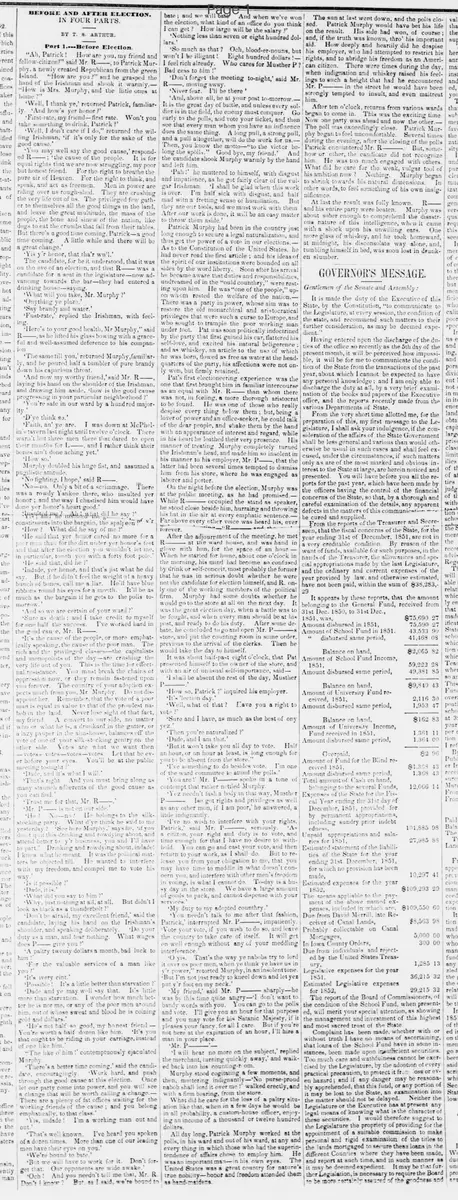
IN FOUR PARTS.
BY T. S. ARTHUR.
Part I.—Before Election.
"Ah, Patrick! How are you, my friend and fellow-citizen?" said Mr. R—, to Patrick Murphy, a newly created Republican from the green Island. "How are you?" and he grasped the hand of the Irishman and shook it warmly.
"How is Mrs. Murphy, and the little ones at home?"
"Well, I thank ye," returned Patrick, familiarly. "And how's yer honor?"
"First-rate, my friend—first rate. Won't you take something to drink, Patrick?"
"Well, I don't care if I do," returned the willing Irishman, "if it's only for the sake of the good cause."
"You may well say the good cause," responded R—; "the cause of the people. It is for equal rights that we are now struggling, my poor but honest friend. For the right to breathe the pure air of Heaven. For the right to think, and speak, and act as freemen. Men in power are riding over us rough-shod. They are crushing the very life out of us. The privileged few gather to themselves all the good things in the land, and leave the great multitude, the mass of the people, the bone and sinew of the nation, like dogs to eat the crumbs that fall from their tables. But there's a good time coming, Patrick—a good time coming. A little while and there will be a great change."
"Yis y'r honor, that there will."
The candidate, for be it understood, that it was on the eve of an election, and that R— was a candidate for a seat in the legislature—now advancing towards the bar—they had entered a drinking house—saying,
"What will you take, Mr. Murphy?"
"Anything ye plaze."
"Say brandy and water."
"Fust-rate," replied the Irishman, with feeling.
"Here's to your good health, Mr. Murphy," said R—, as he lifted his glass bowing with a graceful and well-assumed deference to his companion.
"The same till you," returned Murphy, familiarly, and he poured half a tumbler of pure brandy down his capacious throat.
"And now my worthy friend," said Mr. R—, laying his hand on the shoulder of the Irishman, and drawing him aside, "how is the good cause progressing in your particular neighborhood?"
"You're safe in our ward by a hundred majority."
"D'ye think so?"
"Faith, an' ye are. I was down at McPhelim's tavern last night until twelve o'clock. There wasn't but three men there that dared to open their mouths for L—, and I rather think their bones ain't done aching yet."
"How so?"
Murphy doubled his huge fist, and assumed a pugilistic attitude.
"No fighting, I hope," said R—.
"No—no. Only a bit of a scrimmage. There was a rowdy Yankee there, who insulted yer honor: and the way I chastised him would have done yer honor's heart good."
"Insulted me! And what did he say?"
"Insulted yer honor and his constituents into the bargain, the spalpeen!"
"How? What did he say of me?"
"He said that yer honor cared no more for a poor man than for the dirt under yer honor's feet, and that after the election you wouldn't let me, in particular, touch you with a forty foot pole."
"He said that, did he?"
"Indade, yer honor, and that's jist what he did say. But if he didn't feel the weight of a heavy bunch of bones, call me a liar. He'll have blue ribbons round his eyes for a month. It'll be as much as the bargain if he gets to the polls to-morrow."
"And so we are certain of your ward?"
"Sure as death: and I take credit to myself for one half the success. I've worked hard in the good cause. Mr. R—."
"It's the cause of the people, or more emphatically speaking, the cause of the poor man. The rich and the privileged classes—the capitalists and monopolists of the day—are crushing the very life out of you. This is the time for effectual resistance. You must break the chains of oppression now, or they remain fastened upon you forever. The country of your adoption expects much from you, Mr. Murphy. Do not disappoint her. Remember, that the vote of a poor man is equal in value to that of the proudest nabob in the land. Never lose sight of that fact, my friend. A convert to our side, no matter who or what he is, a drunkard in the gutter, or a lazy pauper in the alms-house, balances off the vote of one of your silk-stocking gentry on the other side. Votes are what we want then—votes—votes—votes—votes. Let that be ever before your eyes. You'll be at the public meeting to-night?"
"Indade, and it's what I will."
"That's right. And you must bring along as many staunch adherents of the good cause as you can find."
"Trust me for that, Mr. R—."
"Mr. P— is not on our side."
"He? No—he belongs to the silk-stocking party. What d'ye think he said to me yesterday? See here Murphy, says he, if you don't quit this drinking and rowdying about, and attend better to y'r business, you and I'll have to part." Drinking and rowdying about, indade: I knew what he meant. It was the political matters he objected to. He wanted to interfere with my freedom, and compel me to vote his way."
"Is it possible?"
"Indade, it is."
"What did you say to him?"
"Why, just nothing at all, at all. But didn't I look as black as a thunderbolt?"
"Don't be afraid, my excellent friend," said the candidate, laying his hand on the Irishman's shoulder, and speaking deliberately. "Do your duty as a man, and fear nothing."
"What wages does P— give you?"
"A paltry twenty dollars a month, bad luck to him!"
"For the valuable services of a man like you?"
"It's ivery cint."
"Possible! It's a little better than starvation?"
"Indade and ye may well say that. It's little more than starvation. I wonder how much better he is nor me, or any of the poor men around him, out of whose sweat and blood he is coining gold and dollars."
"He's not half so good, my honest friend—You're worth a half dozen like him. It's you that ought to be riding in your carriage, instead of one like him."
"The like o' him!" contemptuously ejaculated Murphy.
"There's a better time coming," said the candidate, encouragingly.
"Work hard, and push through the good cause at this election. Once let our party come into power, and you will see a change that will be worth calling a change.—There are a plenty of fat offices waiting for the working friends of the cause: and you belong emphatically, to that class."
"Yis, indade! I'm a working man out and out."
"That's well known. I've heard you spoken of a dozen times. More than one of our leading men have their eyes on you."
"We're bound to bate them."
"But we will have to work for it. Don't forget that. Our opponents are wide awake."
"Och! And you needn't tell me that. Mr. R—. Don't I know? But, as I said, we're bound to win.
And when we've won the election, what kind of an office do you think I can get? How large will be the salary?
"Nothing less than seven or eight hundred dollars."
"So much as that? Och, blood-an'-ouns, but won't I be illigant! Eight hundred dollars!—I feel rich already. Who cares for Musther P? Bad cess to him!"
"Don't forget the meeting to-night," said Mr. R—, moving away.
"Niver fear. I'll be there."
"And, above all, be at your post to-morrow.—It is the great day of battle, and unless every soldier is in the field, the enemy must conquer. Go early to the polls, and vote your ticket, and then see that every man whom you have an influence over does the same thing. A long pull, a strong pull, and a pull altogether, will do the work for us.—Then, you know the motto—'to the victor belong the spoils.' Good bye, my friend." And the candidate shook Murphy warmly by the hand and left him.
"Pah!" he muttered to himself, with disgust and impatience, as he got fairly clear of the vulgar Irishman. "I shall be glad when this work is over. I'm half sick with disgust, and half mad with a fretting sense of humiliation. But they are our tools, and we must work with them. After our work is done, it will be an easy matter to throw them aside."
Patrick Murphy had been in the country just long enough to secure a legal naturalization, and thus get the power of a vote in our elections.—As to the Constitution of the United States, he had never read the first article: and his ideas of the spirit of our institutions were bounded on all sides by the word liberty. Soon after his arrival he became aware that duties and responsibilities, undreamed of in the "ould counthry," were resting upon him. He was "one of the people," upon whom rested the welfare of the nation.—There was a party in power, whose aim was to restore the old monarchical and aristocratical privileges that were such a curse to Europe, and who sought to trample the poor working man under foot. Pat was soon politically indoctrinated by the party that first gained his ear, flattered his self-love, and excited his natural belligerence; and as whiskey, an article to the use of which he was born, flowed as free as water at the head-quarters of the party, his affections were not only won, but firmly retained.
Pat's first electioneering experience was the one that first brought him in familiar intercourse as an equal with Mr. R— than whom there was not, in feeling, a more thorough aristocrat to be found. He was one of those who really despise every thing below them; but, being a lover of power and an office-seeker, he could talk of the dear people, and shake them by the hand with an appearance of interest and regard, while in his heart he loathed their very presence. His manner of treating Murphy completely turned the Irishman's head, and made him so insolent in his manner to his employer, Mr. P—, that the latter had been several times tempted to dismiss him from his store, where he was engaged as laborer and porter.
On the night before the election, Murphy was at the public meeting, as he had promised.—While R— occupied the stand as speaker he stood close beside him, hurrahing and throwing his hat in the air at every emphatic sentence.—Far above every other voice was heard his, ever and forever.
"R— forever."
After the adjournment of the meeting, he met R— at the ward house, and was hand in glove with him, for the space of an hour—When he started for home, about one o'clock in the morning, his mind had become so confused by drink or self-conceit, most probably the former that he was in serious doubt whether he were not the candidate for election himself, and R— only one of the working members of the political firm. Murphy had some doubts whether he would go to the store at all on the next day. It was the great election day, when a battle was to be fought, and when every man should be at his post, and ready to do his duty. After some debate, he concluded to go and open Mr. P—'s store, and put the counting room in some order previous to the arrival of the clerks. Then he would take the day to himself.
It was about half-past eight o'clock, that Pat presented himself to the owner of the store, and with an air of unusual self-importance, said—
"I shall be absent the rest of the day, Musther P—."
"How so, Patrick?" inquired his employer.
"It's 'lection day."
"Well, what of that? Have you a right to vote?"
"Sure and I have, as much as the best of ony yez."
"Then you're naturalized?"
"Indade, and I am thot."
"But it won't take you all day to vote. Half an hour, or an hour at least, is long enough for you to be absent from the store."
"I've something to do besides vote. I'm one of the ward committee to attend the polls."
"You are!" Mr. P— spoke in a tone of contempt that rather nettled Murphy.
"Yez needn't fash a body in that way, Musther P—. I've got rights and privileges as well as any other man, if I am poor," he answered, a little indignantly.
"I've no wish to interfere with your rights, Patrick," said Mr. P—, seriously. "As a citizen, your right and duty is to vote, and time enough for that I have no desire to withhold. You can go and cast your vote, and then return to your work, as I shall do. But to release you from your obligation to me, that you may have time to meddle in what doesn't concern you, and interfere with other men's freedom in voting, is what I cannot do. To-day is a busy day in the store. We have a large amount of goods to pack, and cannot dispense with your services."
"My duty to my adopted counthry."
"You needn't talk to me after that fashion, Patrick," interrupted Mr. P—, impatiently. "Vote your vote, if you wish to do so, and leave the country to take care of itself. It will get on well enough without any of your meddling interference."
"Oh yis. That's the way ye nabobs try to lord it over us poor men, when ye think ye have us in y'r power," retorted Murphy, in an insolent tone. "But I'm not just ready to kneel down and let yez put y'r foot on my neck."
"My friend," said Mr. P— sharply—he was by this time quite angry—"I don't want to bandy words with you. You can go to the polls and vote. I'll give you an hour for that purpose and you may vote for his Satanic Majesty, if it pleases your fancy, for all I care. But if you're not here at the expiration of an hour, I'll hire a man in your place."
"Mr. P—."
"I will hear no more on the subject," replied the merchant, turning quickly away, and walked back into his counting-room.
Murphy stood cogitating a few moments, and then, muttering indignantly—"No purse-proud nabob shall lord it over me!" walked erectly, and with a firm bearing, from the store.
What did he care for the loss of a paltry situation like that, when in a few days he would be, in all probability, a custom-house officer, enjoying an income of a thousand or twelve hundred dollars.
All day long, Patrick Murphy worked at the polls, in his ward and out of his ward, at any and every thing in which those who had the superintendence of affairs chose to employ him. He was an important man—in his own eyes. The United States was a great country for nature's true nobility—honor and freedom attended them as hand-maidens.
The sun at last went down, and the polls closed. Patrick Murphy would have bet his life on the result. His side had won, of course; and, if the truth was known, thro' his important aid. How deeply and heartily did he despise his employer, who had attempted to restrict his rights, and to abridge his freedom as an American citizen. There were times during the day, when indignation and whiskey raised his feelings to such a height that had he encountered Mr. P— in the street he would have been strongly tempted to insult, and even maltreat him.
After ten o'clock, returns from various wards began to come in. This was the exciting time. Now one party was ahead and now the other.—The poll was exceedingly close. Patrick Murphy began to feel uncomfortable. Several times during the evening, after the closing of the polls Patrick encountered Mr. R—. But, somehow or other, the candidate did not recognize him. He was too much engaged with others. What did he care for the weak, vulgar tool of his ambition now? Nothing. Murphy began to shrink towards his natural dimensions. In other words, to feel something of his own insignificance.
At last the result was fully known. R— and his entire party were beaten. Murphy was about sober enough to comprehend the disastrous nature of this intelligence, when it came with a shock upon his unwilling ears. One more glass of whiskey, and he took his homeward, at midnight, his disconsolate way alone, and, tumbling himself in bed, was soon lost in drunken slumber.
BY T. S. ARTHUR.
Part I.—Before Election.
"Ah, Patrick! How are you, my friend and fellow-citizen?" said Mr. R—, to Patrick Murphy, a newly created Republican from the green Island. "How are you?" and he grasped the hand of the Irishman and shook it warmly.
"How is Mrs. Murphy, and the little ones at home?"
"Well, I thank ye," returned Patrick, familiarly. "And how's yer honor?"
"First-rate, my friend—first rate. Won't you take something to drink, Patrick?"
"Well, I don't care if I do," returned the willing Irishman, "if it's only for the sake of the good cause."
"You may well say the good cause," responded R—; "the cause of the people. It is for equal rights that we are now struggling, my poor but honest friend. For the right to breathe the pure air of Heaven. For the right to think, and speak, and act as freemen. Men in power are riding over us rough-shod. They are crushing the very life out of us. The privileged few gather to themselves all the good things in the land, and leave the great multitude, the mass of the people, the bone and sinew of the nation, like dogs to eat the crumbs that fall from their tables. But there's a good time coming, Patrick—a good time coming. A little while and there will be a great change."
"Yis y'r honor, that there will."
The candidate, for be it understood, that it was on the eve of an election, and that R— was a candidate for a seat in the legislature—now advancing towards the bar—they had entered a drinking house—saying,
"What will you take, Mr. Murphy?"
"Anything ye plaze."
"Say brandy and water."
"Fust-rate," replied the Irishman, with feeling.
"Here's to your good health, Mr. Murphy," said R—, as he lifted his glass bowing with a graceful and well-assumed deference to his companion.
"The same till you," returned Murphy, familiarly, and he poured half a tumbler of pure brandy down his capacious throat.
"And now my worthy friend," said Mr. R—, laying his hand on the shoulder of the Irishman, and drawing him aside, "how is the good cause progressing in your particular neighborhood?"
"You're safe in our ward by a hundred majority."
"D'ye think so?"
"Faith, an' ye are. I was down at McPhelim's tavern last night until twelve o'clock. There wasn't but three men there that dared to open their mouths for L—, and I rather think their bones ain't done aching yet."
"How so?"
Murphy doubled his huge fist, and assumed a pugilistic attitude.
"No fighting, I hope," said R—.
"No—no. Only a bit of a scrimmage. There was a rowdy Yankee there, who insulted yer honor: and the way I chastised him would have done yer honor's heart good."
"Insulted me! And what did he say?"
"Insulted yer honor and his constituents into the bargain, the spalpeen!"
"How? What did he say of me?"
"He said that yer honor cared no more for a poor man than for the dirt under yer honor's feet, and that after the election you wouldn't let me, in particular, touch you with a forty foot pole."
"He said that, did he?"
"Indade, yer honor, and that's jist what he did say. But if he didn't feel the weight of a heavy bunch of bones, call me a liar. He'll have blue ribbons round his eyes for a month. It'll be as much as the bargain if he gets to the polls to-morrow."
"And so we are certain of your ward?"
"Sure as death: and I take credit to myself for one half the success. I've worked hard in the good cause. Mr. R—."
"It's the cause of the people, or more emphatically speaking, the cause of the poor man. The rich and the privileged classes—the capitalists and monopolists of the day—are crushing the very life out of you. This is the time for effectual resistance. You must break the chains of oppression now, or they remain fastened upon you forever. The country of your adoption expects much from you, Mr. Murphy. Do not disappoint her. Remember, that the vote of a poor man is equal in value to that of the proudest nabob in the land. Never lose sight of that fact, my friend. A convert to our side, no matter who or what he is, a drunkard in the gutter, or a lazy pauper in the alms-house, balances off the vote of one of your silk-stocking gentry on the other side. Votes are what we want then—votes—votes—votes—votes. Let that be ever before your eyes. You'll be at the public meeting to-night?"
"Indade, and it's what I will."
"That's right. And you must bring along as many staunch adherents of the good cause as you can find."
"Trust me for that, Mr. R—."
"Mr. P— is not on our side."
"He? No—he belongs to the silk-stocking party. What d'ye think he said to me yesterday? See here Murphy, says he, if you don't quit this drinking and rowdying about, and attend better to y'r business, you and I'll have to part." Drinking and rowdying about, indade: I knew what he meant. It was the political matters he objected to. He wanted to interfere with my freedom, and compel me to vote his way."
"Is it possible?"
"Indade, it is."
"What did you say to him?"
"Why, just nothing at all, at all. But didn't I look as black as a thunderbolt?"
"Don't be afraid, my excellent friend," said the candidate, laying his hand on the Irishman's shoulder, and speaking deliberately. "Do your duty as a man, and fear nothing."
"What wages does P— give you?"
"A paltry twenty dollars a month, bad luck to him!"
"For the valuable services of a man like you?"
"It's ivery cint."
"Possible! It's a little better than starvation?"
"Indade and ye may well say that. It's little more than starvation. I wonder how much better he is nor me, or any of the poor men around him, out of whose sweat and blood he is coining gold and dollars."
"He's not half so good, my honest friend—You're worth a half dozen like him. It's you that ought to be riding in your carriage, instead of one like him."
"The like o' him!" contemptuously ejaculated Murphy.
"There's a better time coming," said the candidate, encouragingly.
"Work hard, and push through the good cause at this election. Once let our party come into power, and you will see a change that will be worth calling a change.—There are a plenty of fat offices waiting for the working friends of the cause: and you belong emphatically, to that class."
"Yis, indade! I'm a working man out and out."
"That's well known. I've heard you spoken of a dozen times. More than one of our leading men have their eyes on you."
"We're bound to bate them."
"But we will have to work for it. Don't forget that. Our opponents are wide awake."
"Och! And you needn't tell me that. Mr. R—. Don't I know? But, as I said, we're bound to win.
And when we've won the election, what kind of an office do you think I can get? How large will be the salary?
"Nothing less than seven or eight hundred dollars."
"So much as that? Och, blood-an'-ouns, but won't I be illigant! Eight hundred dollars!—I feel rich already. Who cares for Musther P? Bad cess to him!"
"Don't forget the meeting to-night," said Mr. R—, moving away.
"Niver fear. I'll be there."
"And, above all, be at your post to-morrow.—It is the great day of battle, and unless every soldier is in the field, the enemy must conquer. Go early to the polls, and vote your ticket, and then see that every man whom you have an influence over does the same thing. A long pull, a strong pull, and a pull altogether, will do the work for us.—Then, you know the motto—'to the victor belong the spoils.' Good bye, my friend." And the candidate shook Murphy warmly by the hand and left him.
"Pah!" he muttered to himself, with disgust and impatience, as he got fairly clear of the vulgar Irishman. "I shall be glad when this work is over. I'm half sick with disgust, and half mad with a fretting sense of humiliation. But they are our tools, and we must work with them. After our work is done, it will be an easy matter to throw them aside."
Patrick Murphy had been in the country just long enough to secure a legal naturalization, and thus get the power of a vote in our elections.—As to the Constitution of the United States, he had never read the first article: and his ideas of the spirit of our institutions were bounded on all sides by the word liberty. Soon after his arrival he became aware that duties and responsibilities, undreamed of in the "ould counthry," were resting upon him. He was "one of the people," upon whom rested the welfare of the nation.—There was a party in power, whose aim was to restore the old monarchical and aristocratical privileges that were such a curse to Europe, and who sought to trample the poor working man under foot. Pat was soon politically indoctrinated by the party that first gained his ear, flattered his self-love, and excited his natural belligerence; and as whiskey, an article to the use of which he was born, flowed as free as water at the head-quarters of the party, his affections were not only won, but firmly retained.
Pat's first electioneering experience was the one that first brought him in familiar intercourse as an equal with Mr. R— than whom there was not, in feeling, a more thorough aristocrat to be found. He was one of those who really despise every thing below them; but, being a lover of power and an office-seeker, he could talk of the dear people, and shake them by the hand with an appearance of interest and regard, while in his heart he loathed their very presence. His manner of treating Murphy completely turned the Irishman's head, and made him so insolent in his manner to his employer, Mr. P—, that the latter had been several times tempted to dismiss him from his store, where he was engaged as laborer and porter.
On the night before the election, Murphy was at the public meeting, as he had promised.—While R— occupied the stand as speaker he stood close beside him, hurrahing and throwing his hat in the air at every emphatic sentence.—Far above every other voice was heard his, ever and forever.
"R— forever."
After the adjournment of the meeting, he met R— at the ward house, and was hand in glove with him, for the space of an hour—When he started for home, about one o'clock in the morning, his mind had become so confused by drink or self-conceit, most probably the former that he was in serious doubt whether he were not the candidate for election himself, and R— only one of the working members of the political firm. Murphy had some doubts whether he would go to the store at all on the next day. It was the great election day, when a battle was to be fought, and when every man should be at his post, and ready to do his duty. After some debate, he concluded to go and open Mr. P—'s store, and put the counting room in some order previous to the arrival of the clerks. Then he would take the day to himself.
It was about half-past eight o'clock, that Pat presented himself to the owner of the store, and with an air of unusual self-importance, said—
"I shall be absent the rest of the day, Musther P—."
"How so, Patrick?" inquired his employer.
"It's 'lection day."
"Well, what of that? Have you a right to vote?"
"Sure and I have, as much as the best of ony yez."
"Then you're naturalized?"
"Indade, and I am thot."
"But it won't take you all day to vote. Half an hour, or an hour at least, is long enough for you to be absent from the store."
"I've something to do besides vote. I'm one of the ward committee to attend the polls."
"You are!" Mr. P— spoke in a tone of contempt that rather nettled Murphy.
"Yez needn't fash a body in that way, Musther P—. I've got rights and privileges as well as any other man, if I am poor," he answered, a little indignantly.
"I've no wish to interfere with your rights, Patrick," said Mr. P—, seriously. "As a citizen, your right and duty is to vote, and time enough for that I have no desire to withhold. You can go and cast your vote, and then return to your work, as I shall do. But to release you from your obligation to me, that you may have time to meddle in what doesn't concern you, and interfere with other men's freedom in voting, is what I cannot do. To-day is a busy day in the store. We have a large amount of goods to pack, and cannot dispense with your services."
"My duty to my adopted counthry."
"You needn't talk to me after that fashion, Patrick," interrupted Mr. P—, impatiently. "Vote your vote, if you wish to do so, and leave the country to take care of itself. It will get on well enough without any of your meddling interference."
"Oh yis. That's the way ye nabobs try to lord it over us poor men, when ye think ye have us in y'r power," retorted Murphy, in an insolent tone. "But I'm not just ready to kneel down and let yez put y'r foot on my neck."
"My friend," said Mr. P— sharply—he was by this time quite angry—"I don't want to bandy words with you. You can go to the polls and vote. I'll give you an hour for that purpose and you may vote for his Satanic Majesty, if it pleases your fancy, for all I care. But if you're not here at the expiration of an hour, I'll hire a man in your place."
"Mr. P—."
"I will hear no more on the subject," replied the merchant, turning quickly away, and walked back into his counting-room.
Murphy stood cogitating a few moments, and then, muttering indignantly—"No purse-proud nabob shall lord it over me!" walked erectly, and with a firm bearing, from the store.
What did he care for the loss of a paltry situation like that, when in a few days he would be, in all probability, a custom-house officer, enjoying an income of a thousand or twelve hundred dollars.
All day long, Patrick Murphy worked at the polls, in his ward and out of his ward, at any and every thing in which those who had the superintendence of affairs chose to employ him. He was an important man—in his own eyes. The United States was a great country for nature's true nobility—honor and freedom attended them as hand-maidens.
The sun at last went down, and the polls closed. Patrick Murphy would have bet his life on the result. His side had won, of course; and, if the truth was known, thro' his important aid. How deeply and heartily did he despise his employer, who had attempted to restrict his rights, and to abridge his freedom as an American citizen. There were times during the day, when indignation and whiskey raised his feelings to such a height that had he encountered Mr. P— in the street he would have been strongly tempted to insult, and even maltreat him.
After ten o'clock, returns from various wards began to come in. This was the exciting time. Now one party was ahead and now the other.—The poll was exceedingly close. Patrick Murphy began to feel uncomfortable. Several times during the evening, after the closing of the polls Patrick encountered Mr. R—. But, somehow or other, the candidate did not recognize him. He was too much engaged with others. What did he care for the weak, vulgar tool of his ambition now? Nothing. Murphy began to shrink towards his natural dimensions. In other words, to feel something of his own insignificance.
At last the result was fully known. R— and his entire party were beaten. Murphy was about sober enough to comprehend the disastrous nature of this intelligence, when it came with a shock upon his unwilling ears. One more glass of whiskey, and he took his homeward, at midnight, his disconsolate way alone, and, tumbling himself in bed, was soon lost in drunken slumber.
What sub-type of article is it?
Prose Fiction
Satire
Dialogue
What themes does it cover?
Political
Liberty Freedom
Social Manners
What keywords are associated?
Election
Politics
Irish Immigrant
Voter Manipulation
Class Divide
Satire
Democracy
Whiskey
Naturalization
What entities or persons were involved?
By T. S. Arthur.
Literary Details
Title
Part I.—Before Election
Author
By T. S. Arthur.
Subject
Electioneering And Manipulation Of Immigrant Voters
Form / Style
Satirical Narrative With Extensive Dialogue
Key Lines
"You May Well Say The Good Cause," Responded R—; "The Cause Of The People. It Is For Equal Rights That We Are Now Struggling, My Poor But Honest Friend."
"Pah!" He Muttered To Himself, With Disgust And Impatience, As He Got Fairly Clear Of The Vulgar Irishman. "I Shall Be Glad When This Work Is Over."
"No Purse Proud Nabob Shall Lord It Over Me!"