Thank you for visiting SNEWPapers!
Sign up free
Story
August 20, 1819
Richmond Enquirer
Richmond, Richmond County, Virginia
What is this article about?
Scientific observations of a comet visible in July 1819, first seen on July 3rd, with details on its path, appearance, orbital elements, and visibility from New Haven, Connecticut.
Clipping
OCR Quality
95%
Excellent
Full Text
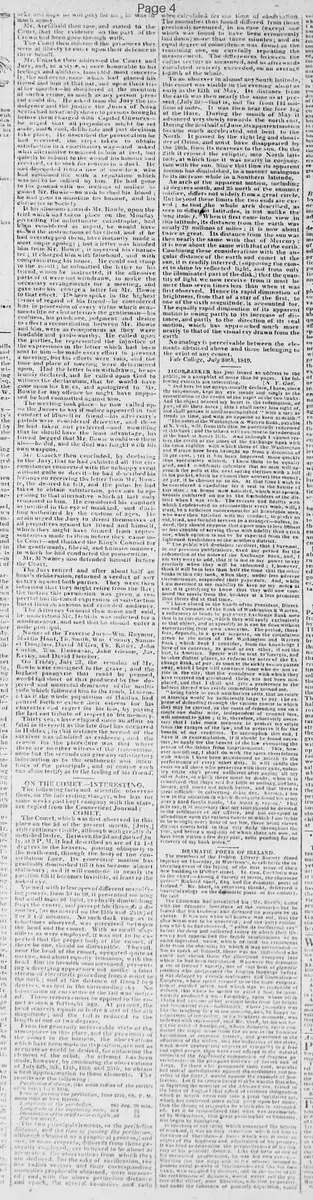
ON THE COMET—INTERESTING.
The following facts and scientific observations, on the interesting stranger, who has for some weeks past kept company with the stars, are copied from the Connecticut Journal:
COMET.
The Comet, which was first observed in this place on the 3d of the present month. [July.] still continues visible, although with greatly diminished lustre. Between the 3d and 20th of July, at 9 P. M. it had described an arc of 13 1-4 degrees in the heavens, passing obliquely to the north-east, through the body of the constellation Leo. Its geocentric motion has gradually diminished until it has become almost stationary; and it will continue in nearly its present position till it becomes invisible, at least to the naked eye.
Viewed with telescopes of different magnifying powers, from 30 to 90, it presented no thing but a circular mass of light, gradually diminishing from the centre, and perceptible through a diameter, (as measured on the 15th and 16th) of 2 or 2 1-2 minutes. No such dark ring as is sometimes observed, was perceived between the head and the comet. With as small magnifiers as were employed, it was not to be expected that the proper body of the comet, if there be one, should be discernible. The tail, near the head of the comet, appeared quite as narrow, and about equally luminous, with the head But its breadth soon increased, presenting a diverging appearance not unlike a faint stream of electricity proceeding from a point in the dark; and at the distance of from 7 to 9 degrees, was lost in the surrounding skies No undulation or curvature of the tail was noticed. These remarks must be applied to the comet as seen a fortnight ago. At present, the head scarcely equals in lustre a star of the 5th magnitude; and the tail is reduced to the length of one or two degrees.
From the generally unfavorable state of the atmosphere in this place, and the proximity of the comet to the horizon, the observations which have been made on its position, are not as accurate as could be desired, for obtaining the elements of the orbit. An attempt has been made, however, by combining the observations of July 6th, 9th, 13th, 16th and 25th, to obtain a rough approximation to these elements. The results are the following:
Perihelion distance, (the mean radius of the earth's orbit being 1) 0.6066
Time of passing the perihelion, June 27th, 8h. P. M. mean time at New Haven.
Longitude of the perihelion, 285 deg. 10 min.
Longitude of the ascending node, 272 deg. 32 min.
Inclination of the orbit to the ecliptic, 80 deg. 63 min. Motion direct.
The two principal elements, or the perihelion distance, and the time of passing the perihelion, although obtained by a graphical process, (and one, in some respects, different from those generally employed,) are believed to be about as accurate as the observations from which they are deduced. For the sake of verification, the five radius vectors and their corresponding anomalies graphically obtained, were measured: and, with the above perihelion distance and epoch, the several anomalies and radii were calculated for the time of observation. The anomalies thus found differed from those previously measured, in no case (except one which was found to have been erroneously laid down) more than three minutes: and an equal degree of coincidence was found in the remaining one, on carefully repeating the measurement. The differences between the radius vectors as measured, and as afterwards calculated scarcely exceeded, on an average -2s of the whole.
To an observer in almost any South Latitude, this comet was visible in the evening about as early as the 12th of May. Its distance from the earth was then nearly the same as at present.(July 30)—that is, not far from 14 millions of miles. It was then near the fore leg of the Hare. During the month of May it advanced very slowly towards the north east. During the first half of June, its apparent motion became much accelerated, and bent to the North. It passed by the right leg and shoulder of Orion, and must have disappeared by the 20th, from its nearness to the sun. On the 25th it crossed the ecliptic, into North latitude, at which time it was nearly in conjunction with the sun. Since that time its apparent motion has diminished, in a manner analogous to its increase while in a Southern latitude.
An arch of the apparent motion, including 10 degrees south, and 25 north of the summer solstice, differs not widely from a great circle. But beyond these limits the two ends are curved: so that the whole arch described, as seen in different latitudes, is not unlike the long italic f. When it first came into view in this latitude, its distance from the earth was nearly 79 millions of miles: it is now about twice as great. Its distance from the sun was then nearly the same with that of Mercury: it is now about the same with that of the earth. Combining these considerations with the angular distance of the earth and comet at the sun, it is readily inferred. (supposing the comet to shine by reflected light, and from only the illuminated part of the disk,) that the quantity of light we now receive from it must be more than seven times less than when it was first observed. Hence its rapid diminution of brightness, from that of a star of the first, to one of the sixth magnitude, is accounted for. The equally rapid diminution of its apparent motion is owing partly to its increase of distance, and partly to the direction of its real motion, which has approached much more nearly to that of the visual ray drawn from the earth.
No analogy is perceivable between the elements obtained above and those belonging to the orbit of any comet.
Yale College, July 30th, 1819.
The following facts and scientific observations, on the interesting stranger, who has for some weeks past kept company with the stars, are copied from the Connecticut Journal:
COMET.
The Comet, which was first observed in this place on the 3d of the present month. [July.] still continues visible, although with greatly diminished lustre. Between the 3d and 20th of July, at 9 P. M. it had described an arc of 13 1-4 degrees in the heavens, passing obliquely to the north-east, through the body of the constellation Leo. Its geocentric motion has gradually diminished until it has become almost stationary; and it will continue in nearly its present position till it becomes invisible, at least to the naked eye.
Viewed with telescopes of different magnifying powers, from 30 to 90, it presented no thing but a circular mass of light, gradually diminishing from the centre, and perceptible through a diameter, (as measured on the 15th and 16th) of 2 or 2 1-2 minutes. No such dark ring as is sometimes observed, was perceived between the head and the comet. With as small magnifiers as were employed, it was not to be expected that the proper body of the comet, if there be one, should be discernible. The tail, near the head of the comet, appeared quite as narrow, and about equally luminous, with the head But its breadth soon increased, presenting a diverging appearance not unlike a faint stream of electricity proceeding from a point in the dark; and at the distance of from 7 to 9 degrees, was lost in the surrounding skies No undulation or curvature of the tail was noticed. These remarks must be applied to the comet as seen a fortnight ago. At present, the head scarcely equals in lustre a star of the 5th magnitude; and the tail is reduced to the length of one or two degrees.
From the generally unfavorable state of the atmosphere in this place, and the proximity of the comet to the horizon, the observations which have been made on its position, are not as accurate as could be desired, for obtaining the elements of the orbit. An attempt has been made, however, by combining the observations of July 6th, 9th, 13th, 16th and 25th, to obtain a rough approximation to these elements. The results are the following:
Perihelion distance, (the mean radius of the earth's orbit being 1) 0.6066
Time of passing the perihelion, June 27th, 8h. P. M. mean time at New Haven.
Longitude of the perihelion, 285 deg. 10 min.
Longitude of the ascending node, 272 deg. 32 min.
Inclination of the orbit to the ecliptic, 80 deg. 63 min. Motion direct.
The two principal elements, or the perihelion distance, and the time of passing the perihelion, although obtained by a graphical process, (and one, in some respects, different from those generally employed,) are believed to be about as accurate as the observations from which they are deduced. For the sake of verification, the five radius vectors and their corresponding anomalies graphically obtained, were measured: and, with the above perihelion distance and epoch, the several anomalies and radii were calculated for the time of observation. The anomalies thus found differed from those previously measured, in no case (except one which was found to have been erroneously laid down) more than three minutes: and an equal degree of coincidence was found in the remaining one, on carefully repeating the measurement. The differences between the radius vectors as measured, and as afterwards calculated scarcely exceeded, on an average -2s of the whole.
To an observer in almost any South Latitude, this comet was visible in the evening about as early as the 12th of May. Its distance from the earth was then nearly the same as at present.(July 30)—that is, not far from 14 millions of miles. It was then near the fore leg of the Hare. During the month of May it advanced very slowly towards the north east. During the first half of June, its apparent motion became much accelerated, and bent to the North. It passed by the right leg and shoulder of Orion, and must have disappeared by the 20th, from its nearness to the sun. On the 25th it crossed the ecliptic, into North latitude, at which time it was nearly in conjunction with the sun. Since that time its apparent motion has diminished, in a manner analogous to its increase while in a Southern latitude.
An arch of the apparent motion, including 10 degrees south, and 25 north of the summer solstice, differs not widely from a great circle. But beyond these limits the two ends are curved: so that the whole arch described, as seen in different latitudes, is not unlike the long italic f. When it first came into view in this latitude, its distance from the earth was nearly 79 millions of miles: it is now about twice as great. Its distance from the sun was then nearly the same with that of Mercury: it is now about the same with that of the earth. Combining these considerations with the angular distance of the earth and comet at the sun, it is readily inferred. (supposing the comet to shine by reflected light, and from only the illuminated part of the disk,) that the quantity of light we now receive from it must be more than seven times less than when it was first observed. Hence its rapid diminution of brightness, from that of a star of the first, to one of the sixth magnitude, is accounted for. The equally rapid diminution of its apparent motion is owing partly to its increase of distance, and partly to the direction of its real motion, which has approached much more nearly to that of the visual ray drawn from the earth.
No analogy is perceivable between the elements obtained above and those belonging to the orbit of any comet.
Yale College, July 30th, 1819.
What sub-type of article is it?
Curiosity
Historical Event
What themes does it cover?
Nature
What keywords are associated?
Comet
Astronomical Observation
Yale College
Orbital Elements
1819 Sighting
Where did it happen?
New Haven, Connecticut
Story Details
Location
New Haven, Connecticut
Event Date
July 1819
Story Details
Detailed astronomical observations of a comet's visibility, path through constellations, appearance with telescope, orbital elements calculated from July observations, and explanations of its motion and brightness diminution.