Thank you for visiting SNEWPapers!
Sign up free
Literary
December 31, 1914
Ottumwa Tri Weekly Courier
Ottumwa, Wapello County, Iowa
What is this article about?
Tom Thrane, back from seven years in Alaska, reunites with his former love Anne Trayner at her modest home. She had refused his proposal due to her family's bankruptcy and hidden away, but now she's set to become a prima donna. They confess enduring love and plan to marry.
Clipping
OCR Quality
98%
Excellent
Full Text
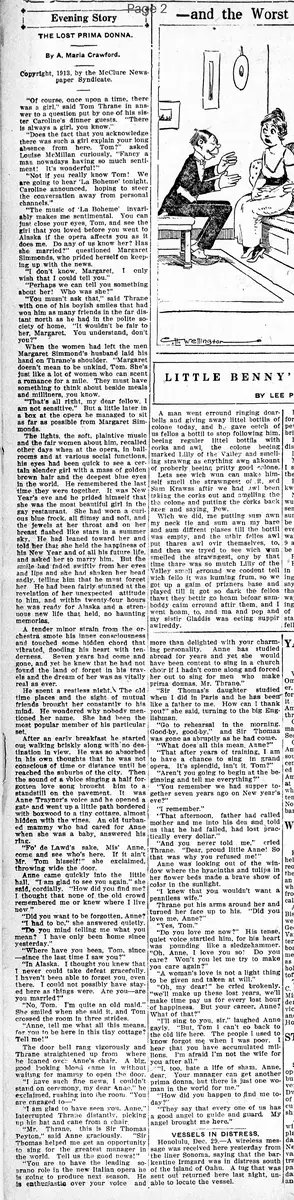
Evening Story
the lost prima donna.
By A. Marla Crawford.
Copyright, 1913, by the McClure Newspaper Syndicate.
"Of course, once upon a time, there was a girl," said Tom Thrane in answer to a question put by one of his sister Caroline's dinner guests.
"There is always a girl, you know."
"Does the fact that you acknowledge there was such a girl explain your long absence from here, Tom?" asked Louise McMillan curiously. "Fancy a man nowadays having so much sentiment! It's wonderful!"
"Not if you really know Tom! We are going to hear 'La Boheme' tonight," Caroline announced, hoping to steer the conversation away from personal channels.
"The music of 'La Boheme' invariably makes me sentimental. You can just close your eyes, Tom, and see the girl that you loved before you went to Alaska if the opera affects you as it does me. Do any of us know her? Has she married?" questioned Margaret Simmonds, who prided herself on keeping up with the news.
"I don't know, Margaret. I only wish that I could tell you."
"Perhaps we can tell you something about her! Who was she?"
"You mustn't ask that," said Thrane with one of his boyish smiles that had won him as many friends in the far distant north as he had in the polite society of home. "It wouldn't be fair to her, Margaret. You understand, don't you?"
When the women had left the men Margaret Simmonds' husband laid his hand on Thrane's shoulder. "Margaret doesn't mean to be unkind, Tom. She's just like a lot of women who can scent a romance for a mile. They must have something to think about beside meals and milliners, you know."
"That's all right, my dear fellow. I am not sensitive." But a little later in a box at the opera he managed to sit as far as possible from Margaret Simmonds.
The lights, the soft, plaintive music and the fair women about him, recalled other days when at the opera, in ballrooms and at various social functions, his eyes had been quick to see a certain slender girl with a mass of golden brown hair and the deepest blue eyes in the world. He remembered the last time they were together. It was New Year's eve and he prided himself that she was the most beautiful girl in the gay restaurant. She had worn a curious blue frock, all flimsy and soft, and the jewels at her throat and on her breast flashed like stars in a summer sky. He had leaned toward her and told her that she held the happiness of his New Year and of all his future life, and asked her to marry him. But the smile had faded swiftly from her eyes and lips and she had shaken her head sadly, telling him that he must forget her. He had been fairly stunned at the revelation of her unexpected attitude to him, and within twenty-four hours he was ready for Alaska and a strenuous new life that held no haunting memories.
A tender minor strain from the orchestra smote his inner consciousness and touched some hidden chord that vibrated, flooding his heart with tenderness. Seven years had come and gone, and yet he knew that he had not found the land of forget in his travels and the dream of her was as vitally real as ever.
He spent a restless night. The old time places and the sight of mutual friends brought her constantly to his mind. He wondered why nobody mentioned her name. She had been the most popular member of his particular set.
After an early breakfast he started out walking briskly along with no destination in view. He was so absorbed in his own thoughts that he was not conscious of time or distance until he reached the suburbs of the city. Then the sound of a voice singing a half forgotten love song brought him to a standstill on the pavement. It was Anne Trayner's voice and he opened a gate and went up a little path bordered with boxwood to a tiny cottage, almost hidden with the vines. An old turbaned mammy who had cared for Anne when she was a baby, answered his ring.
"Fo' de Lawd's sake, Mis' Anne, come and see who's here. If it ain't Mr. Tom hisself!" she exclaimed, throwing wide the door.
Anne came quickly into the little hall. "I am glad to see you again," she said, cordially. "How did you find me? I thought that none of the old crowd remembered me or knew where I live now."
"Did you want to be forgotten, Anne?"
"I had to be," she answered quietly.
"Do you mind telling me what you mean? I have only been home since yesterday."
"Where have you been, Tom, since the last time I saw you?"
"In Alaska. I thought you knew that I never could take defeat gracefully. I haven't been able to forget you, even there. I could not possibly have stayed here as things were. Are you—are you married?"
"No, Tom. I'm quite an old maid."
She smiled when she said it, and Tom crossed the room in three strides.
"Anne, tell me what all this means, for you to be here in this tiny cottage? Tell me!"
The door bell rang vigorously and Thrane straightened up from where he leaned over Anne's chair. A big, good looking blond came in without waiting for mammy to open the door.
"I have such fine news, I couldn't stand on ceremony, my dear Anne," he exclaimed, rushing into the room. "You are engaged to—"
"I am glad to have seen you, Anne," interrupted Thrane distantly, picking up his hat and cane from a chair.
"Mr. Thrane, this is Sir Thomas Peyton," said Anne graciously.
"Sir Thomas helped me get an opportunity to sing for the greatest manager in the world. Tell us the good news!"
"You are to have the leading soprano role in the new Italian opera he is going to produce next season. He is enthusiastic over your voice and more than delighted with your charming personality. Anne has studied abroad for years and yet she would have been content to sing in a church choir if I hadn't come along and forced her out to sing for men who make prima donnas, Mr. Thrane."
"Sir Thomas's daughter studied when I did in Paris and he has been like a father to me. How can I thank you?" she said, turning to the big Englishman.
"Go to rehearsal in the morning. Good-by, good-by," and Sir Thomas was gone as abruptly as he had come.
"What does all this mean, Anne?"
"That after years of training, I am to have a chance to sing in grand opera. It's splendid, isn't it, Tom?"
"Aren't you going to begin at the beginning and tell me everything?"
"You remember we had supper together seven years ago on New Year's eve?"
"I remember."
That afternoon, father had called mother and me into his den and told us that he had failed, had lost practically every dollar.
"And you never told me," cried Thrane. "Dear, proud little Anne! So that was why you refused me!"
Anne was looking out of the window where the hyacinths and tulips in her flower beds made a brave show of color in the sunlight.
"I knew that you wouldn't want a penniless wife."
Thrane put his arms around her and turned her face up to his. "Did you love me, Anne?"
"Yes, Tom."
"Do you love me now?"
His tense quiet voice startled him, for his heart was pounding like a sledgehammer.
"Oh, Anne, I love you so! Do you care? Won't you let me try to make you care again?"
"A woman's love is not a light thing to be given and taken at will."
"Oh, my dear!" he cried brokenly. "We'll make up these lost years, we'll make time pay us for every lost hour of happiness. But your career, Anne? What of that?"
"I'll sing to you, sir," laughed Anne gayly. "But, Tom, I can't go back to the old life here. The people I used to know forgot me when I was poor. I hear that you have accumulated millions. I'm afraid I'm not the wife for you after all."
"I, too, hate a life of sham, Anne, dear. Your manager can get another prima donna, but there is just one woman in the world for me."
"How did you happen to find me today?"
"They say that every one of us has a good angel to guide and guard. My angel brought me here."
the lost prima donna.
By A. Marla Crawford.
Copyright, 1913, by the McClure Newspaper Syndicate.
"Of course, once upon a time, there was a girl," said Tom Thrane in answer to a question put by one of his sister Caroline's dinner guests.
"There is always a girl, you know."
"Does the fact that you acknowledge there was such a girl explain your long absence from here, Tom?" asked Louise McMillan curiously. "Fancy a man nowadays having so much sentiment! It's wonderful!"
"Not if you really know Tom! We are going to hear 'La Boheme' tonight," Caroline announced, hoping to steer the conversation away from personal channels.
"The music of 'La Boheme' invariably makes me sentimental. You can just close your eyes, Tom, and see the girl that you loved before you went to Alaska if the opera affects you as it does me. Do any of us know her? Has she married?" questioned Margaret Simmonds, who prided herself on keeping up with the news.
"I don't know, Margaret. I only wish that I could tell you."
"Perhaps we can tell you something about her! Who was she?"
"You mustn't ask that," said Thrane with one of his boyish smiles that had won him as many friends in the far distant north as he had in the polite society of home. "It wouldn't be fair to her, Margaret. You understand, don't you?"
When the women had left the men Margaret Simmonds' husband laid his hand on Thrane's shoulder. "Margaret doesn't mean to be unkind, Tom. She's just like a lot of women who can scent a romance for a mile. They must have something to think about beside meals and milliners, you know."
"That's all right, my dear fellow. I am not sensitive." But a little later in a box at the opera he managed to sit as far as possible from Margaret Simmonds.
The lights, the soft, plaintive music and the fair women about him, recalled other days when at the opera, in ballrooms and at various social functions, his eyes had been quick to see a certain slender girl with a mass of golden brown hair and the deepest blue eyes in the world. He remembered the last time they were together. It was New Year's eve and he prided himself that she was the most beautiful girl in the gay restaurant. She had worn a curious blue frock, all flimsy and soft, and the jewels at her throat and on her breast flashed like stars in a summer sky. He had leaned toward her and told her that she held the happiness of his New Year and of all his future life, and asked her to marry him. But the smile had faded swiftly from her eyes and lips and she had shaken her head sadly, telling him that he must forget her. He had been fairly stunned at the revelation of her unexpected attitude to him, and within twenty-four hours he was ready for Alaska and a strenuous new life that held no haunting memories.
A tender minor strain from the orchestra smote his inner consciousness and touched some hidden chord that vibrated, flooding his heart with tenderness. Seven years had come and gone, and yet he knew that he had not found the land of forget in his travels and the dream of her was as vitally real as ever.
He spent a restless night. The old time places and the sight of mutual friends brought her constantly to his mind. He wondered why nobody mentioned her name. She had been the most popular member of his particular set.
After an early breakfast he started out walking briskly along with no destination in view. He was so absorbed in his own thoughts that he was not conscious of time or distance until he reached the suburbs of the city. Then the sound of a voice singing a half forgotten love song brought him to a standstill on the pavement. It was Anne Trayner's voice and he opened a gate and went up a little path bordered with boxwood to a tiny cottage, almost hidden with the vines. An old turbaned mammy who had cared for Anne when she was a baby, answered his ring.
"Fo' de Lawd's sake, Mis' Anne, come and see who's here. If it ain't Mr. Tom hisself!" she exclaimed, throwing wide the door.
Anne came quickly into the little hall. "I am glad to see you again," she said, cordially. "How did you find me? I thought that none of the old crowd remembered me or knew where I live now."
"Did you want to be forgotten, Anne?"
"I had to be," she answered quietly.
"Do you mind telling me what you mean? I have only been home since yesterday."
"Where have you been, Tom, since the last time I saw you?"
"In Alaska. I thought you knew that I never could take defeat gracefully. I haven't been able to forget you, even there. I could not possibly have stayed here as things were. Are you—are you married?"
"No, Tom. I'm quite an old maid."
She smiled when she said it, and Tom crossed the room in three strides.
"Anne, tell me what all this means, for you to be here in this tiny cottage? Tell me!"
The door bell rang vigorously and Thrane straightened up from where he leaned over Anne's chair. A big, good looking blond came in without waiting for mammy to open the door.
"I have such fine news, I couldn't stand on ceremony, my dear Anne," he exclaimed, rushing into the room. "You are engaged to—"
"I am glad to have seen you, Anne," interrupted Thrane distantly, picking up his hat and cane from a chair.
"Mr. Thrane, this is Sir Thomas Peyton," said Anne graciously.
"Sir Thomas helped me get an opportunity to sing for the greatest manager in the world. Tell us the good news!"
"You are to have the leading soprano role in the new Italian opera he is going to produce next season. He is enthusiastic over your voice and more than delighted with your charming personality. Anne has studied abroad for years and yet she would have been content to sing in a church choir if I hadn't come along and forced her out to sing for men who make prima donnas, Mr. Thrane."
"Sir Thomas's daughter studied when I did in Paris and he has been like a father to me. How can I thank you?" she said, turning to the big Englishman.
"Go to rehearsal in the morning. Good-by, good-by," and Sir Thomas was gone as abruptly as he had come.
"What does all this mean, Anne?"
"That after years of training, I am to have a chance to sing in grand opera. It's splendid, isn't it, Tom?"
"Aren't you going to begin at the beginning and tell me everything?"
"You remember we had supper together seven years ago on New Year's eve?"
"I remember."
That afternoon, father had called mother and me into his den and told us that he had failed, had lost practically every dollar.
"And you never told me," cried Thrane. "Dear, proud little Anne! So that was why you refused me!"
Anne was looking out of the window where the hyacinths and tulips in her flower beds made a brave show of color in the sunlight.
"I knew that you wouldn't want a penniless wife."
Thrane put his arms around her and turned her face up to his. "Did you love me, Anne?"
"Yes, Tom."
"Do you love me now?"
His tense quiet voice startled him, for his heart was pounding like a sledgehammer.
"Oh, Anne, I love you so! Do you care? Won't you let me try to make you care again?"
"A woman's love is not a light thing to be given and taken at will."
"Oh, my dear!" he cried brokenly. "We'll make up these lost years, we'll make time pay us for every lost hour of happiness. But your career, Anne? What of that?"
"I'll sing to you, sir," laughed Anne gayly. "But, Tom, I can't go back to the old life here. The people I used to know forgot me when I was poor. I hear that you have accumulated millions. I'm afraid I'm not the wife for you after all."
"I, too, hate a life of sham, Anne, dear. Your manager can get another prima donna, but there is just one woman in the world for me."
"How did you happen to find me today?"
"They say that every one of us has a good angel to guide and guard. My angel brought me here."
What sub-type of article is it?
Prose Fiction
What themes does it cover?
Love Romance
Social Manners
What keywords are associated?
Romantic Reunion
Lost Love
Prima Donna
Social Exile
Financial Ruin
What entities or persons were involved?
By A. Marla Crawford.
Literary Details
Title
Evening Story The Lost Prima Donna.
Author
By A. Marla Crawford.
Key Lines
"Of Course, Once Upon A Time, There Was A Girl," Said Tom Thrane In Answer To A Question Put By One Of His Sister Caroline's Dinner Guests.
He Had Leaned Toward Her And Told Her That She Held The Happiness Of His New Year And Of All His Future Life, And Asked Her To Marry Him. But The Smile Had Faded Swiftly From Her Eyes And Lips And She Had Shaken Her Head Sadly, Telling Him That He Must Forget Her.
"I Knew That You Wouldn't Want A Penniless Wife."
"A Woman's Love Is Not A Light Thing To Be Given And Taken At Will."
"They Say That Every One Of Us Has A Good Angel To Guide And Guard. My Angel Brought Me Here."