Thank you for visiting SNEWPapers!
Sign up free
Alexandria Daily Advertiser
Alexandria, Virginia
What is this article about?
Reflections from the London Morning Chronicle criticize British government's blind approach to the war with France under Bonaparte, arguing it has strengthened France militarily despite civil wars. Calls for extraordinary military exertions, a proper army, and recognition of threats from France controlling Flanders and Holland.
Clipping
OCR Quality
Full Text
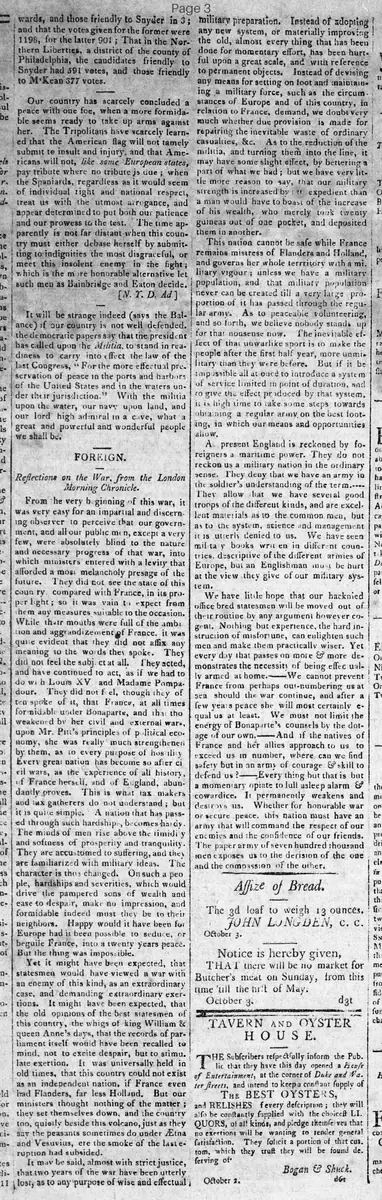
Reflections on the War, from the London Morning Chronicle.
From the very beginning of this war, it was very easy for an impartial and discerning observer to perceive that our government, and all our public men, except a very few, were absolutely blind to the nature and necessary progress of that war, into which ministers entered with a levity that afforded a most melancholy presage of the future. They did not see the state of this country, compared with France, in its proper light; so it was vain to expect from them any measures suitable to the occasion. While their mouths were full of the ambition and aggrandizement of France, it was quite evident that they did not affix any meaning to the words they spoke. They did not feel the subject at all. They acted, and have continued to act, as if we had to do with Louis XV and Madame Pompadour. They did not feel, though they often spoke of it, that France, at all times formidable under Bonaparte, and that though weakened by her civil and external wars, upon Mr. Pitt's principles of political economy, she was really much strengthened by them, as to every purpose of hostility. Every great nation has become so after civil wars, as the experience of all history, of France herself, and of England, abundantly proves. This is what tax makers and tax gatherers do not understand; but it is quite simple. A nation that has passed through such hardships, becomes hardy. The minds of men rise above the timidity and softness of prosperity and tranquillity. They are accustomed to suffering, and they are familiarized with military ideas. The character is thus changed. On such a people, hardships and severities, which would drive the pampered sons of wealth and ease to despair, make no impression, and formidable indeed must they be to their neighbors. Happy would it have been for Europe had it been possible to seduce, or beguile France, into a twenty years peace. But the thing was impossible.
Yet it might have been expected, that statesmen would have viewed a war with an enemy of this kind, as an extraordinary case, and demanding extraordinary exertions. It might have been expected, that the old opinions of the best statesmen of this country, the whigs of king William & queen Anne's days, that the records of parliament itself would have been recalled to mind, not to excite despair, but to stimulate exertion. It was universally held in old times, that this country could not exist as an independent nation, if France even had Flanders, far less Holland. But our ministers thought nothing of the matter; they set themselves down, and the country too, quietly beside this volcano, just as they say the peasants sometimes do under Etna and Vesuvius, ere the smoke of the last eruption had subsided.
It may be said, almost with strict justice, that two years of the war have been utterly lost, as to any purpose of wise and effectual military preparation. Instead of adopting any new system, or materially improving the old, almost every thing that has been done for momentary effort, has been hurtful upon a great scale, and with reference to permanent objects. Instead of devising any means for setting on foot and maintaining a military force, such as the circumstances of Europe and of this country, in relation to France, demand, we doubt very much whether due provision is made for repairing the inevitable waste of ordinary casualties, &c. As to the reduction of the militia, and turning them into the line, it may have some slight effect, by bartering a part of what we had; but we have very little more reason to say, that our military strength is increased by this expedient than a man would have to boast of the increase of his wealth, who merely took twenty guineas out of one pocket, and deposited them in another.
This nation cannot be safe while France remains mistress of Flanders and Holland, and governs her whole territory with a military vigour; unless we have a military population, and that military population never can be created till a very large proportion of it has passed through the regular army. As to peaceable volunteering, and so forth, we believe nobody stands up for that nonsense now. The inevitable effect of that unwarlike sport is to make the people after the first half year, more unmilitary than they were before. But if it be impossible all at once to introduce a system of service limited in point of duration, and to give the effect produced by that system, it is high time to take some steps towards obtaining a regular army on the best footing, in which our means and opportunities allow.
At present England is reckoned by foreigners a maritime power. They do not reckon us a military nation in the ordinary sense. They deny that we have an army in the soldier's understanding of the term. They allow but we have several good troops of the different kinds, and are excellent materials as to the common men, but as to the system, science and management it is utterly denied to us. We have seen military books written in different countries, descriptive of the different armies of Europe, but an Englishman must be hurt at the view they give of our military system.
We have little hope that our hackneyed office bred statesmen will be moved out of their routine by any argument however cogent. Nothing but experience, the hard instruction of misfortune, can enlighten such men and make them practically wiser. Yet every day that passes on more & more demonstrates the necessity of being effectually armed at home. We cannot prevent France from perhaps out-numbering us at sea should the war continue, and after a few years peace she will most certainly equal us at least. We must not limit the energy of Bonaparte's counsels by the dotage of our own. And if the natives of France and her allies approach to us to exceed us in number, where can we find safety but in an army of courage & skill to defend us? Every thing but that is but a momentary opiate to lull asleep alarms & cowardice. It permanently weakens and destroys us. Whether for honorable war or secure peace, this nation must have an army that will command the respect of our enemies and the confidence of our friends. The paper army of seven hundred thousand men exposes us to the derision of the one and the compassion of the other.
What sub-type of article is it?
What keywords are associated?
What entities or persons were involved?
Where did it happen?
Foreign News Details
Primary Location
France
Key Persons
Event Details
Reflections criticize British government's levity and blindness to the war's nature against a hardened France under Bonaparte, strengthened by civil wars. Argues two years lost in military preparation; urges creation of a proper military population and regular army to counter France's control of Flanders and Holland, dismissing volunteering as ineffective. Warns of France's naval and land threats, calling for an army to ensure safety.