Thank you for visiting SNEWPapers!
Sign up free
Story
December 4, 1874
Port Tobacco Times, And Charles County Advertiser
Port Tobacco, Charles County, Maryland
What is this article about?
An editorial critiques William E. Gladstone's pamphlet 'The Decrees of the Vatican,' which argues that papal infallibility promotes disloyalty to governments. The response defends Catholic loyalty, advocates religious freedom, and accuses Gladstone of stirring Protestant prejudices for political gain.
Clipping
OCR Quality
95%
Excellent
Full Text
The Decrees of the Vatican.
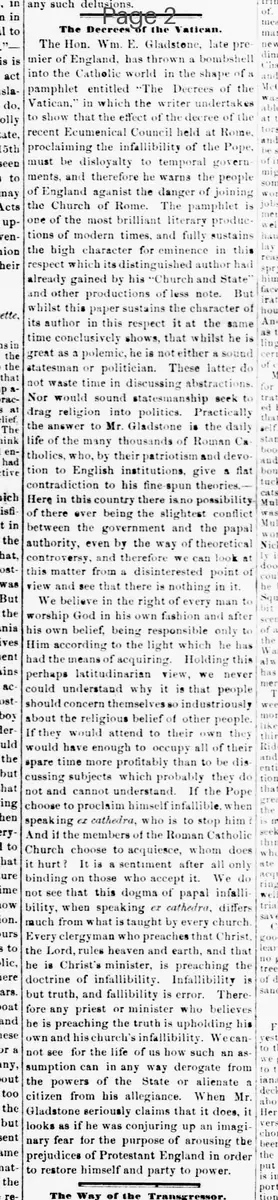
The Hon. Wm. E. Gladstone, late premier of England. has thrown a bombshell into the Catholic world in the shape of a pamphlet entitled "The Decrees of the Vatican." in which the writer undertakes to show that the effect of the decree of the recent Ecumenical Council held at Rome, proclaiming the infallibility of the Pope, must be disloyalty to temporal governments, and therefore he warns the people of England against the danger of joining the Church of Rome. The pamphlet is one of the most brilliant literary productions of modern times, and fully sustains the high character for eminence in this respect which its distinguished author had already gained by his "Church and State" and other productions of less note. But whilst this paper sustains the character of its author in this respect it at the same time conclusively shows, that whilst he is great as a polemic, he is not either a sound statesman or politician. These latter do not waste time in discussing abstractions Nor would sound statesmanship seek to drag religion into politics. Practically the answer to Mr. Gladstone is the daily life of the many thousands of Roman Catholics, who, by their patriotism and devotion to English institutions, give a flat contradiction to his fine-spun theories. Here in this country there is no possibility of there ever being the slightest conflict between the government and the papal authority, even by the way of theoretical controversy, and therefore we can look at this matter from a disinterested point of view and see that there is nothing in it. We believe in the right of every man to worship God in his own fashion and after his own belief. being responsible only to Him according to the light which he has had the means of acquiring. Holding this perhaps latitudinarian view, we never could understand why it is that people should concern themselves so industriously about the religious belief of other people. If they would attend to their own they would have enough to occupy all of their spare time more profitably than to be discussing subjects which probably they do not and cannot understand. If the Pope choose to proclaim himself infallible. when speaking ex cathedra, who is to stop him ? And if the members of the Roman Catholic Church choose to acquiesce, whom does it hurt? It is a sentiment after all only binding on those who accept it. We do not see that this dogma of papal infallibility, when speaking ex cathedra, differs much from what is taught by every church Every clergyman who preaches that Christ. the Lord, rules heaven and earth, and that he is Christ's minister, is preaching the doctrine of infallibility. Infallibility is but truth, and fallibility is error. Therefore any priest or minister who believes he is preaching the truth is upholding his own and his church's infallibility. We cannot see for the life of us how such an assumption can in any way derogate from the powers of the State or alienate a citizen from his allegiance. When Mr. Gladstone seriously claims that it does, it looks as if he was conjuring up an imaginary fear for the purpose of arousing the prejudices of Protestant England in order to restore himself and party to power.
The Hon. Wm. E. Gladstone, late premier of England. has thrown a bombshell into the Catholic world in the shape of a pamphlet entitled "The Decrees of the Vatican." in which the writer undertakes to show that the effect of the decree of the recent Ecumenical Council held at Rome, proclaiming the infallibility of the Pope, must be disloyalty to temporal governments, and therefore he warns the people of England against the danger of joining the Church of Rome. The pamphlet is one of the most brilliant literary productions of modern times, and fully sustains the high character for eminence in this respect which its distinguished author had already gained by his "Church and State" and other productions of less note. But whilst this paper sustains the character of its author in this respect it at the same time conclusively shows, that whilst he is great as a polemic, he is not either a sound statesman or politician. These latter do not waste time in discussing abstractions Nor would sound statesmanship seek to drag religion into politics. Practically the answer to Mr. Gladstone is the daily life of the many thousands of Roman Catholics, who, by their patriotism and devotion to English institutions, give a flat contradiction to his fine-spun theories. Here in this country there is no possibility of there ever being the slightest conflict between the government and the papal authority, even by the way of theoretical controversy, and therefore we can look at this matter from a disinterested point of view and see that there is nothing in it. We believe in the right of every man to worship God in his own fashion and after his own belief. being responsible only to Him according to the light which he has had the means of acquiring. Holding this perhaps latitudinarian view, we never could understand why it is that people should concern themselves so industriously about the religious belief of other people. If they would attend to their own they would have enough to occupy all of their spare time more profitably than to be discussing subjects which probably they do not and cannot understand. If the Pope choose to proclaim himself infallible. when speaking ex cathedra, who is to stop him ? And if the members of the Roman Catholic Church choose to acquiesce, whom does it hurt? It is a sentiment after all only binding on those who accept it. We do not see that this dogma of papal infallibility, when speaking ex cathedra, differs much from what is taught by every church Every clergyman who preaches that Christ. the Lord, rules heaven and earth, and that he is Christ's minister, is preaching the doctrine of infallibility. Infallibility is but truth, and fallibility is error. Therefore any priest or minister who believes he is preaching the truth is upholding his own and his church's infallibility. We cannot see for the life of us how such an assumption can in any way derogate from the powers of the State or alienate a citizen from his allegiance. When Mr. Gladstone seriously claims that it does, it looks as if he was conjuring up an imaginary fear for the purpose of arousing the prejudices of Protestant England in order to restore himself and party to power.
What sub-type of article is it?
Historical Event
Biography
What themes does it cover?
Moral Virtue
Justice
Social Manners
What keywords are associated?
Papal Infallibility
Vatican Decrees
Gladstone Pamphlet
Religious Freedom
Catholic Loyalty
Church And State
What entities or persons were involved?
Wm. E. Gladstone
Pope
Where did it happen?
England, Rome
Story Details
Key Persons
Wm. E. Gladstone
Pope
Location
England, Rome
Event Date
Recent Ecumenical Council
Story Details
Gladstone's pamphlet argues papal infallibility leads to disloyalty; editorial praises its literary merit but criticizes it as poor statesmanship, defends Catholic patriotism, and promotes religious tolerance.