Thank you for visiting SNEWPapers!
Sign up free
Story
July 23, 1912
The Evening Times
Grand Forks, Grand Forks County, North Dakota
What is this article about?
Profile of Jim Fike, Kansas Wheat King, who risks fortunes on weather-dependent wheat farming. In 1912, after past losses, perfect rains and snow lead to a $90,000 windfall on 10,000 acres, highlighting his lone-hand battle against nature.
Clipping
OCR Quality
98%
Excellent
Full Text
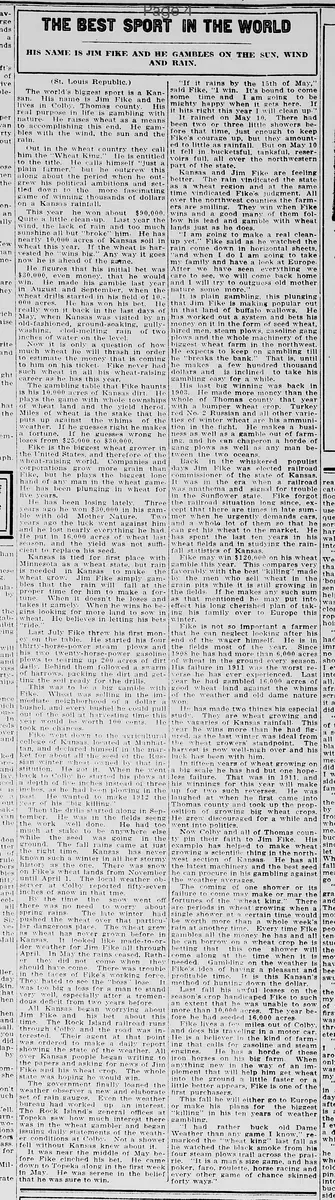
THE BEST SPORT IN THE WORLD.
HIS NAME IS JIM FIKE AND HE GAMBLES ON THE SUN, WIND AND RAIN.
(St. Louis Republic.)
The world's biggest sport is a Kansasan. His name is Jim Fike and he lives in Colby, Thomas county. His real purpose in life is gambling with nature. He raises wheat as a means to accomplishing this end. He gambles with the wind, the sun and the rain.
Out in the wheat country they call him the "Wheat King." He is entitled to the title. He calls himself "just a plain farmer," but he outgrew this along about the period when he outgrew his political ambitions and settled down to the more fascinating game of winning thousands of dollars on a Kansas rainfall.
This year he won about $90,000. Quite a little clean-up. Last year the wind, the lack of rain and too much sunshine all but "broke" him. He has nearly 10,000 acres of Kansas soil in wheat this year. If the wheat is harvested he "wins big." Any way it goes now he is ahead of the game.
He figures that his initial bet was $30,000, even money, that he would win. He made his gamble last year in August and September, when the wheat drills started in his field of 10,000 acres. He has won his bet. He really won it back in the last days of May, when Kansas was visited by an old-fashioned, ground-soaking, gully-washing, clod-melting rain of two inches of water on the level.
Now it is only a question of how much wheat he will thrash in order to estimate the money that is coming to him on his ticket. Fike never had such wheat in all his wheat-raising career as he has this year.
The gambling table that Fike haunts is his 10,000 acres of Kansas dirt. He plays the game with whole townships of wheat land and the yield thereof. Miles of wheat is the stake that he puts up against the whims of the weather. If he guesses right he makes a fortune. If he guesses wrong he loses from $25,000 to $30,000.
Fike is the biggest wheat grower in the United States, and therefore of the wheat-raising world. Companies and corporations grow more grain than Fike, but he plays the biggest lone hand of any man in the wheat game. He has been plunging in wheat for five years.
He has been losing lately. Three years ago he won $30,000 in his gamble with old Mother Nature. Two years ago the luck went against him and he lost nearly everything he had. He put in 16,000 acres of wheat last season, and the yield was not sufficient to replace his seed.
Kansas is tied for first place with Minnesota as a wheat state, but rain is needed in Kansas to make the wheat grow. Jim Fike simply gambles that the rain will fall at the proper time for him to make a fortune. When it doesn't he loses and takes it gamely. When he wins he begins looking for more land to sow in wheat. He believes in letting his bets "ride."
Last July Fike threw his first money on the table. He started his four thirty-horse-power steam plows and his two twenty-horse-power gasoline plows to tearing up 200 acres of dirt daily. Behind them followed a swarm of harrows, packing the dirt and getting the soil ready for the drills.
This was to be a big gamble with Fike. Wheat was selling in the immediate neighborhood of a dollar a bushel, and every bushel he could pull out of the soil at harvesting time this year would be worth 100 cents. He took no chances.
Fike went down to the agricultural college of Kansas, located at Manhattan, and declared himself in the market for about all the seed of the Russian winter wheat owned by that institution. He got it. When he went back to Colby he started his plows at a depth of five inches instead of three inches, as he had been plowing in the past. He wanted to make 1912 the year of his "big killing."
Then the drills started along in September. He was in the fields seeing the work well done. He had too much at stake to be anywhere else while the seed was going in the ground. The fall rains came at just the right time.
Kansas has never known such a winter in all her stormy history as the one. There was snow on Fike's wheat lands from November until April 1. The local weather observer at Colby reported fifty-seven inches of snow in that time.
By the time the snow went off there was no need to worry about spring rains. The late winter had pushed the wheat over that particular dangerous place. The wheat grew as wheat has never grown before in Kansas. It looked like made-to-order weather for Jim Fike all through April. In May the rains ceased. Rather they did not come when they should have come. There was trouble in the faces of Fike's working force. They hated to see the "boss" lose. It was too big a loss for a man to stand very well, especially after a tremendous deficit from two years before.
All Kansas began worrying about Jim Fike and his bet about this time. The Rock Island railroad runs through Colby and the road was interested. Their agent at that point was ordered to make a daily report showing the state of the weather. All over Kansas people began writing to the papers and asking for news of Jim Fike and his wheat crop. The whole state was hoping he would win.
The government finally loaned the weather observer a new and elaborate set of rain gauges. Even the weather bureau had worked up an interest. The Rock Island's general offices at Topeka saw how much interest there was in the wheat gambler and began issuing daily statements of the weather conditions at Colby. Not a shower fell without Kansas knew about it.
It was near the middle of May before Fike cinched his bet. He came down to Topeka along in the first week in May. He was serene in the belief that he was sure to win.
"If it rains by the 15th of May," said Fike, "I win. It's bound to come some time and I am going to be mighty happy when it gets here. If it hits right this year I will clean up."
It rained on May 10. There had been two or three little showers before that time, just enough to keep Fike's courage up, but they amounted to little as rainfall. But on May 10 it fell in bucketsful, tanksful, reservoirs full, all over the northwestern part of the state.
Kansas and Jim Fike are feeling better. The rain vindicated the state as a wheat region and at the same time vindicated Fike's judgment. All over the northwest counties the farmers are smiling. They win when Fike wins and a good many of them follow his lead and gamble with wheat lands just as he does.
"I am going to make a real clean-up yet," Fike said as he watched the rain come down in horizontal sheets, "and when I do I am going to take my family and have a look at Europe. After we have seen everything we care to see, we will come back home and I will try to outguess old mother nature some more."
It is plain gambling, this plunging that Jim Fike is making popular out in that land of buffalo wallows. He has worked out a system and bets his money on it in the form of seed wheat, hired men, steam plows, gasoline gang plows and the whole machinery of the biggest wheat farm in the northwest. He expects to keep on gambling till he "breaks the bank." That is, until he makes a few hundred thousand dollars and is inclined to take his gambling easy for a while.
His last big winning was back in 1909. He made more money than the whole of Thomas county that year with a bumper wheat crop. Turkey red No. 2 Russian and all other varieties of winter wheat are his ammunition in the fight. He makes a business as well as a gamble out of farming, and he can chaperon a horde of gang plows as well as any man between the two oceans.
Back in the whiskered populist days Jim Fike was elected railroad commissioner of the state of Kansas. It was in the era when a railroad was anathema and signal for trouble in the Sunflower state. Fike forgot the railroad situation long since, except that there are times in late summer when he urgently demands cars, and a whole lot of them so that he can get his wheat to the market. He has spent the last ten years in his wheat fields and in studying the rainfall statistics of Kansas.
Fike may win $120,000 on his wheat gamble this year. This compares very favorably with the best "killing" made by the men who sell wheat in the grain pits while it is still growing in the fields. If he makes any such sum as that mentioned he may put into effect his long cherished plan of taking his family over to Europe this winter.
Fike is not so important a farmer that he can neglect looking after his end of the wager himself. He is in the fields most of the year. Since 1908 he has had more than 6,000 acres of wheat in the ground every season.
His failure in 1911 was the worst reverse he has ever experienced. Last year he had gambled 16,000 acres of good wheat land against the whims of the weather and old dame nature won.
He has made two things his especial study. They are wheat growing and the vagaries of Kansas rainfall. This year he wins more than he had figured, as the last winter was ideal from the wheat growers' standpoint. The harvest is now well-nigh over and his luck has been with him.
In fifteen years of wheat growing on a big scale he has had but one hopeless failure. That was in 1911, and his winnings for this year will make up for two such reverses. He was laughed at when he first came into Thomas county and took up the proposition of growing big wheat crops. He grew discouraged for a while and went into politics.
Now Colby and all of Thomas county pin their faith to Jim Fike. His example has helped to make wheat growing a scientific thing in the northwest section of Kansas. He has all the latest machinery and the best seed he can procure in his gambling against the weather averages.
The coming of one shower or its failure to come may make or mar the fortunes of the "wheat king." There are periods in wheat growing when a single shower at a certain time would be worth more than a whole week's rain at another time.
Every time Fike gambles all the money he has and all he can borrow on a wheat crop he is betting that this one shower will come along at the time when it is needed. Gambling on the weather is Fike's idea of having a pleasant and profitable time. It is this Kansan's method of hunting down the dollar.
Last fall his awful losses on the season's crop handicapped Fike to such an extent that he was unable to sow more than 10,000 acres. The year before he had seeded 16,000 acres.
Fike lives a few miles out of Colby, and does his traveling in a motor car. He is a believer in the kind of farming that calls for gasoline and steam engines. He has a horde of these iron horses on his big farm.
When anything new in the way of an implement that will help him get wheat into the ground a little faster or a little better appears, Fike is one of the first purchasers.
This fall he will either go to Europe or make his plans for the biggest "killing" in his ten years of weather gambling.
"I had rather buck old Dame Weather than any game I know," remarked the "wheat king" last fall as he watched the black smoke from his four steam plows trail across the prairie. "It is a man's size game, and has poker, faro, roulette, horse racing and every other game of chance skinned forty ways."
HIS NAME IS JIM FIKE AND HE GAMBLES ON THE SUN, WIND AND RAIN.
(St. Louis Republic.)
The world's biggest sport is a Kansasan. His name is Jim Fike and he lives in Colby, Thomas county. His real purpose in life is gambling with nature. He raises wheat as a means to accomplishing this end. He gambles with the wind, the sun and the rain.
Out in the wheat country they call him the "Wheat King." He is entitled to the title. He calls himself "just a plain farmer," but he outgrew this along about the period when he outgrew his political ambitions and settled down to the more fascinating game of winning thousands of dollars on a Kansas rainfall.
This year he won about $90,000. Quite a little clean-up. Last year the wind, the lack of rain and too much sunshine all but "broke" him. He has nearly 10,000 acres of Kansas soil in wheat this year. If the wheat is harvested he "wins big." Any way it goes now he is ahead of the game.
He figures that his initial bet was $30,000, even money, that he would win. He made his gamble last year in August and September, when the wheat drills started in his field of 10,000 acres. He has won his bet. He really won it back in the last days of May, when Kansas was visited by an old-fashioned, ground-soaking, gully-washing, clod-melting rain of two inches of water on the level.
Now it is only a question of how much wheat he will thrash in order to estimate the money that is coming to him on his ticket. Fike never had such wheat in all his wheat-raising career as he has this year.
The gambling table that Fike haunts is his 10,000 acres of Kansas dirt. He plays the game with whole townships of wheat land and the yield thereof. Miles of wheat is the stake that he puts up against the whims of the weather. If he guesses right he makes a fortune. If he guesses wrong he loses from $25,000 to $30,000.
Fike is the biggest wheat grower in the United States, and therefore of the wheat-raising world. Companies and corporations grow more grain than Fike, but he plays the biggest lone hand of any man in the wheat game. He has been plunging in wheat for five years.
He has been losing lately. Three years ago he won $30,000 in his gamble with old Mother Nature. Two years ago the luck went against him and he lost nearly everything he had. He put in 16,000 acres of wheat last season, and the yield was not sufficient to replace his seed.
Kansas is tied for first place with Minnesota as a wheat state, but rain is needed in Kansas to make the wheat grow. Jim Fike simply gambles that the rain will fall at the proper time for him to make a fortune. When it doesn't he loses and takes it gamely. When he wins he begins looking for more land to sow in wheat. He believes in letting his bets "ride."
Last July Fike threw his first money on the table. He started his four thirty-horse-power steam plows and his two twenty-horse-power gasoline plows to tearing up 200 acres of dirt daily. Behind them followed a swarm of harrows, packing the dirt and getting the soil ready for the drills.
This was to be a big gamble with Fike. Wheat was selling in the immediate neighborhood of a dollar a bushel, and every bushel he could pull out of the soil at harvesting time this year would be worth 100 cents. He took no chances.
Fike went down to the agricultural college of Kansas, located at Manhattan, and declared himself in the market for about all the seed of the Russian winter wheat owned by that institution. He got it. When he went back to Colby he started his plows at a depth of five inches instead of three inches, as he had been plowing in the past. He wanted to make 1912 the year of his "big killing."
Then the drills started along in September. He was in the fields seeing the work well done. He had too much at stake to be anywhere else while the seed was going in the ground. The fall rains came at just the right time.
Kansas has never known such a winter in all her stormy history as the one. There was snow on Fike's wheat lands from November until April 1. The local weather observer at Colby reported fifty-seven inches of snow in that time.
By the time the snow went off there was no need to worry about spring rains. The late winter had pushed the wheat over that particular dangerous place. The wheat grew as wheat has never grown before in Kansas. It looked like made-to-order weather for Jim Fike all through April. In May the rains ceased. Rather they did not come when they should have come. There was trouble in the faces of Fike's working force. They hated to see the "boss" lose. It was too big a loss for a man to stand very well, especially after a tremendous deficit from two years before.
All Kansas began worrying about Jim Fike and his bet about this time. The Rock Island railroad runs through Colby and the road was interested. Their agent at that point was ordered to make a daily report showing the state of the weather. All over Kansas people began writing to the papers and asking for news of Jim Fike and his wheat crop. The whole state was hoping he would win.
The government finally loaned the weather observer a new and elaborate set of rain gauges. Even the weather bureau had worked up an interest. The Rock Island's general offices at Topeka saw how much interest there was in the wheat gambler and began issuing daily statements of the weather conditions at Colby. Not a shower fell without Kansas knew about it.
It was near the middle of May before Fike cinched his bet. He came down to Topeka along in the first week in May. He was serene in the belief that he was sure to win.
"If it rains by the 15th of May," said Fike, "I win. It's bound to come some time and I am going to be mighty happy when it gets here. If it hits right this year I will clean up."
It rained on May 10. There had been two or three little showers before that time, just enough to keep Fike's courage up, but they amounted to little as rainfall. But on May 10 it fell in bucketsful, tanksful, reservoirs full, all over the northwestern part of the state.
Kansas and Jim Fike are feeling better. The rain vindicated the state as a wheat region and at the same time vindicated Fike's judgment. All over the northwest counties the farmers are smiling. They win when Fike wins and a good many of them follow his lead and gamble with wheat lands just as he does.
"I am going to make a real clean-up yet," Fike said as he watched the rain come down in horizontal sheets, "and when I do I am going to take my family and have a look at Europe. After we have seen everything we care to see, we will come back home and I will try to outguess old mother nature some more."
It is plain gambling, this plunging that Jim Fike is making popular out in that land of buffalo wallows. He has worked out a system and bets his money on it in the form of seed wheat, hired men, steam plows, gasoline gang plows and the whole machinery of the biggest wheat farm in the northwest. He expects to keep on gambling till he "breaks the bank." That is, until he makes a few hundred thousand dollars and is inclined to take his gambling easy for a while.
His last big winning was back in 1909. He made more money than the whole of Thomas county that year with a bumper wheat crop. Turkey red No. 2 Russian and all other varieties of winter wheat are his ammunition in the fight. He makes a business as well as a gamble out of farming, and he can chaperon a horde of gang plows as well as any man between the two oceans.
Back in the whiskered populist days Jim Fike was elected railroad commissioner of the state of Kansas. It was in the era when a railroad was anathema and signal for trouble in the Sunflower state. Fike forgot the railroad situation long since, except that there are times in late summer when he urgently demands cars, and a whole lot of them so that he can get his wheat to the market. He has spent the last ten years in his wheat fields and in studying the rainfall statistics of Kansas.
Fike may win $120,000 on his wheat gamble this year. This compares very favorably with the best "killing" made by the men who sell wheat in the grain pits while it is still growing in the fields. If he makes any such sum as that mentioned he may put into effect his long cherished plan of taking his family over to Europe this winter.
Fike is not so important a farmer that he can neglect looking after his end of the wager himself. He is in the fields most of the year. Since 1908 he has had more than 6,000 acres of wheat in the ground every season.
His failure in 1911 was the worst reverse he has ever experienced. Last year he had gambled 16,000 acres of good wheat land against the whims of the weather and old dame nature won.
He has made two things his especial study. They are wheat growing and the vagaries of Kansas rainfall. This year he wins more than he had figured, as the last winter was ideal from the wheat growers' standpoint. The harvest is now well-nigh over and his luck has been with him.
In fifteen years of wheat growing on a big scale he has had but one hopeless failure. That was in 1911, and his winnings for this year will make up for two such reverses. He was laughed at when he first came into Thomas county and took up the proposition of growing big wheat crops. He grew discouraged for a while and went into politics.
Now Colby and all of Thomas county pin their faith to Jim Fike. His example has helped to make wheat growing a scientific thing in the northwest section of Kansas. He has all the latest machinery and the best seed he can procure in his gambling against the weather averages.
The coming of one shower or its failure to come may make or mar the fortunes of the "wheat king." There are periods in wheat growing when a single shower at a certain time would be worth more than a whole week's rain at another time.
Every time Fike gambles all the money he has and all he can borrow on a wheat crop he is betting that this one shower will come along at the time when it is needed. Gambling on the weather is Fike's idea of having a pleasant and profitable time. It is this Kansan's method of hunting down the dollar.
Last fall his awful losses on the season's crop handicapped Fike to such an extent that he was unable to sow more than 10,000 acres. The year before he had seeded 16,000 acres.
Fike lives a few miles out of Colby, and does his traveling in a motor car. He is a believer in the kind of farming that calls for gasoline and steam engines. He has a horde of these iron horses on his big farm.
When anything new in the way of an implement that will help him get wheat into the ground a little faster or a little better appears, Fike is one of the first purchasers.
This fall he will either go to Europe or make his plans for the biggest "killing" in his ten years of weather gambling.
"I had rather buck old Dame Weather than any game I know," remarked the "wheat king" last fall as he watched the black smoke from his four steam plows trail across the prairie. "It is a man's size game, and has poker, faro, roulette, horse racing and every other game of chance skinned forty ways."
What sub-type of article is it?
Biography
Personal Triumph
What themes does it cover?
Triumph
Fortune Reversal
Survival
What keywords are associated?
Wheat King
Jim Fike
Kansas Wheat
Weather Gambling
Crop Success
Farming Risk
What entities or persons were involved?
Jim Fike
Where did it happen?
Colby, Thomas County, Kansas
Story Details
Key Persons
Jim Fike
Location
Colby, Thomas County, Kansas
Event Date
1912
Story Details
Jim Fike, known as the Wheat King, gambles on Kansas weather by planting 10,000 acres of wheat. After losses in prior years, ideal winter snow and May rains in 1912 ensure a bumper crop, yielding about $90,000 profit and vindicating his high-stakes farming strategy.