Thank you for visiting SNEWPapers!
Sign up free
Editorial
April 26, 1871
The Daily State Journal
Richmond, Alexandria, Virginia
What is this article about?
The editorial vehemently denounces the outgoing Richmond city council for financial mismanagement, exacerbating social divisions, increasing debt by over $668,000, imposing heavy taxes, and leaving a $456,799 deficit for 1871, warning of potential revolution without reform.
Clipping
OCR Quality
95%
Excellent
Full Text
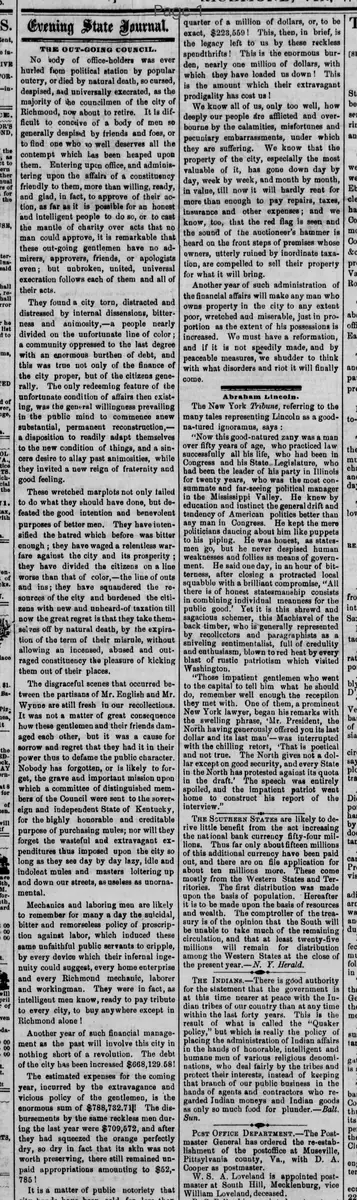
THE OUT-GOING COUNCIL
No body of office-holders was ever hurled from political station by popular outcry, or died by natural death, so cursed, despised, and universally execrated, as the majority of the councilmen of the city of Richmond, now about to retire. It is difficult to conceive of a body of men so generally despised by friends and foes, or to find one who so well deserves all the contempt which has been heaped upon them. Entering upon office, and administering upon the affairs of a constituency friendly to them, more than willing, ready, and glad, in fact, to approve of their action, as far as it is possible for an honest and intelligent people to do so, or to cast the mantle of charity over acts that no man could approve, it is remarkable that these out-going gentlemen have no admirers, approvers, friends, or apologists even; but unbroken, united, universal execration follows each of them and all of their acts.
They found a city torn, distracted and distressed by internal dissensions, bitterness and animosity,-a people nearly divided on the unfortunate line of color: a community oppressed to the last degree with an enormous burthen of debt, and this was true not only of the finance of the city proper, but of the citizens generally. The only redeeming feature of the unfortunate condition of affairs then existing, was the general willingness prevailing in the public mind to commence anew substantial, permanent reconstruction,- a disposition to readily adapt themselves to the new condition of things, and a sincere desire to allay past animosities, while they invited a new reign of fraternity and good feeling.
These wretched marplots not only failed to do what they should have done, but defeated the good intention and benevolent purposes of better men. They have intensified the hatred which before was bitter enough; they have waged a relentless warfare against the city and its prosperity; they have divided the citizens on a line worse than that of color.-the line of outs and ins; they have squandered the resources of the city and burdened the citizens with new and unheard-of taxation till now the great regret is that they take themselves off by natural death, by the expiration of the term of their misrule, without allowing an incensed, abused and outraged constituency the pleasure of kicking them out of their places.
The disgraceful scenes that occurred between the partisans of Mr. English and Mr. Wynne are still fresh in our recollections. It was not a matter of great consequence how these gentlemen and their friends damaged each other, but it was a cause for sorrow and regret that they had it in their power thus to defame the public character.
Nobody has forgotten, or is likely to forget, the grave and important mission upon which a committee of distinguished members of the Council were sent to the sovereign and Independent State of Kentucky, for the highly honorable and creditable purpose of purchasing mules; nor will they forget the wasteful and extravagant expenditures thus imposed upon the city so long as they see day by day lazy, idle and indolent mules and masters loltering up and down our streets, as useless as unornamental.
Mechanics and laboring men are likely to remember for many a day the suicidal, bitter and remorseless policy of proscription against labor, which induced these same unfaithful public servants to cripple, by every device which their infernal ingenuity could suggest, every home enterprise and every Richmond mechanic, laborer and workingman. They were in fact, as intelligent men know, ready to pay tribute to every city, to buy anywhere except in Richmond alone!
Another year of such financial management as the past will involve this city in nothing short of a revolution. The debt of the city has been increased $668,129.58! The estimated expenses for the coming year, incurred by the extravagance and vicious policy of the gentlemen, is the enormous sum of $788,732.71! The disbursements by the same reckless men during the last year were $709,572, and after they had squeezed the orange perfectly dry, so dry in fact that its skin was not worth preserving, there still remained unpaid appropriations amounting to $52,785!
It is a matter of public notoriety that city bonds have been sold for less than three-quarters of their value; that these men have so debauched the public credit that no prudent man would loan upon it, except at enormous rates of usurious interest, nor without the deposit of immense amounts of city securities for comparatively small loans, and then only for a short time, with "interest off." Still after exhausting all these extraordinary means of obtaining money they have bequeathed, with their dying breath, to their unfortunate successors, a deficiency to the enormous amount of $456,799.22, nearly half a million, to be raised by taxation during the year 1871!
They did not even have the manliness to exhibit the true condition of their accounts, nor the real enormity of their extravagance; for, while they report the expenses of the city government at $709,572, there is actually an item of "extraordinary expense" amounting to nearly a quarter of a million of dollars, or, to be exact, $223,559! This, then, in brief, is the legacy left to us by these reckless spendthrifts! This is the enormous burden, nearly one million of dollars, with which they have loaded us down! This is the amount which their extravagant prodigality has cost us!
We know all of us, only too well, how deeply our people are afflicted and overborne by the calamities, misfortunes and pecuniary embarrassments, under which they are suffering. We know that the property of the city, especially the most valuable of it, has gone down day by day, week by week, and month by month, in value, till now it will hardly rent for more than enough to pay repairs, taxes, insurance and other expenses; and we know, too, that the red flag is seen and the sound of the auctioneer's hammer is heard on the front steps of premises whose owners, utterly ruined by inordinate taxation, are compelled to sell their property for what it will bring.
Another year of such administration of the financial affairs will make any man who owns property in the city to any extent poor, wretched and miserable, just in proportion as the extent of his possessions is increased. We must have a reformation, and if it is not speedily made, and by peaceable measures, we shudder to think with what disorders and riot it will finally come.
No body of office-holders was ever hurled from political station by popular outcry, or died by natural death, so cursed, despised, and universally execrated, as the majority of the councilmen of the city of Richmond, now about to retire. It is difficult to conceive of a body of men so generally despised by friends and foes, or to find one who so well deserves all the contempt which has been heaped upon them. Entering upon office, and administering upon the affairs of a constituency friendly to them, more than willing, ready, and glad, in fact, to approve of their action, as far as it is possible for an honest and intelligent people to do so, or to cast the mantle of charity over acts that no man could approve, it is remarkable that these out-going gentlemen have no admirers, approvers, friends, or apologists even; but unbroken, united, universal execration follows each of them and all of their acts.
They found a city torn, distracted and distressed by internal dissensions, bitterness and animosity,-a people nearly divided on the unfortunate line of color: a community oppressed to the last degree with an enormous burthen of debt, and this was true not only of the finance of the city proper, but of the citizens generally. The only redeeming feature of the unfortunate condition of affairs then existing, was the general willingness prevailing in the public mind to commence anew substantial, permanent reconstruction,- a disposition to readily adapt themselves to the new condition of things, and a sincere desire to allay past animosities, while they invited a new reign of fraternity and good feeling.
These wretched marplots not only failed to do what they should have done, but defeated the good intention and benevolent purposes of better men. They have intensified the hatred which before was bitter enough; they have waged a relentless warfare against the city and its prosperity; they have divided the citizens on a line worse than that of color.-the line of outs and ins; they have squandered the resources of the city and burdened the citizens with new and unheard-of taxation till now the great regret is that they take themselves off by natural death, by the expiration of the term of their misrule, without allowing an incensed, abused and outraged constituency the pleasure of kicking them out of their places.
The disgraceful scenes that occurred between the partisans of Mr. English and Mr. Wynne are still fresh in our recollections. It was not a matter of great consequence how these gentlemen and their friends damaged each other, but it was a cause for sorrow and regret that they had it in their power thus to defame the public character.
Nobody has forgotten, or is likely to forget, the grave and important mission upon which a committee of distinguished members of the Council were sent to the sovereign and Independent State of Kentucky, for the highly honorable and creditable purpose of purchasing mules; nor will they forget the wasteful and extravagant expenditures thus imposed upon the city so long as they see day by day lazy, idle and indolent mules and masters loltering up and down our streets, as useless as unornamental.
Mechanics and laboring men are likely to remember for many a day the suicidal, bitter and remorseless policy of proscription against labor, which induced these same unfaithful public servants to cripple, by every device which their infernal ingenuity could suggest, every home enterprise and every Richmond mechanic, laborer and workingman. They were in fact, as intelligent men know, ready to pay tribute to every city, to buy anywhere except in Richmond alone!
Another year of such financial management as the past will involve this city in nothing short of a revolution. The debt of the city has been increased $668,129.58! The estimated expenses for the coming year, incurred by the extravagance and vicious policy of the gentlemen, is the enormous sum of $788,732.71! The disbursements by the same reckless men during the last year were $709,572, and after they had squeezed the orange perfectly dry, so dry in fact that its skin was not worth preserving, there still remained unpaid appropriations amounting to $52,785!
It is a matter of public notoriety that city bonds have been sold for less than three-quarters of their value; that these men have so debauched the public credit that no prudent man would loan upon it, except at enormous rates of usurious interest, nor without the deposit of immense amounts of city securities for comparatively small loans, and then only for a short time, with "interest off." Still after exhausting all these extraordinary means of obtaining money they have bequeathed, with their dying breath, to their unfortunate successors, a deficiency to the enormous amount of $456,799.22, nearly half a million, to be raised by taxation during the year 1871!
They did not even have the manliness to exhibit the true condition of their accounts, nor the real enormity of their extravagance; for, while they report the expenses of the city government at $709,572, there is actually an item of "extraordinary expense" amounting to nearly a quarter of a million of dollars, or, to be exact, $223,559! This, then, in brief, is the legacy left to us by these reckless spendthrifts! This is the enormous burden, nearly one million of dollars, with which they have loaded us down! This is the amount which their extravagant prodigality has cost us!
We know all of us, only too well, how deeply our people are afflicted and overborne by the calamities, misfortunes and pecuniary embarrassments, under which they are suffering. We know that the property of the city, especially the most valuable of it, has gone down day by day, week by week, and month by month, in value, till now it will hardly rent for more than enough to pay repairs, taxes, insurance and other expenses; and we know, too, that the red flag is seen and the sound of the auctioneer's hammer is heard on the front steps of premises whose owners, utterly ruined by inordinate taxation, are compelled to sell their property for what it will bring.
Another year of such administration of the financial affairs will make any man who owns property in the city to any extent poor, wretched and miserable, just in proportion as the extent of his possessions is increased. We must have a reformation, and if it is not speedily made, and by peaceable measures, we shudder to think with what disorders and riot it will finally come.
What sub-type of article is it?
Partisan Politics
Economic Policy
Taxation
What keywords are associated?
Richmond Council
Financial Mismanagement
Excessive Taxation
City Debt
Political Division
Economic Ruin
Reconstruction Failure
What entities or persons were involved?
Richmond City Council
Mr. English
Mr. Wynne
State Of Kentucky
Editorial Details
Primary Topic
Critique Of Outgoing Richmond City Council's Financial And Political Mismanagement
Stance / Tone
Strongly Condemnatory And Warning Of Revolution
Key Figures
Richmond City Council
Mr. English
Mr. Wynne
State Of Kentucky
Key Arguments
Universal Contempt For The Outgoing Councilmen
Failed To Unite A Divided City And Intensified Hatreds
Squandered City Resources And Imposed Excessive Taxation
Increased City Debt By $668,129.58
Left A $456,799.22 Deficit For 1871
Wasteful Expenditures Including Mule Purchase Mission To Kentucky
Proscribed Local Labor And Favored Out Of City Purchases
Debauched Public Credit By Selling Bonds Below Value
Hidden True Expenses Including $223,559 In Extraordinary Costs
Predicted Revolution Without Financial Reform