Thank you for visiting SNEWPapers!
Sign up free
Literary
March 9, 1915
The Tacoma Times
Tacoma, Pierce County, Washington
What is this article about?
In this excerpt from Jack London's 'The Sea-Wolf,' the injured Captain Wolf Larsen returns aboard suspiciously, checks the sleeping crew in the forecastle for signs of mutiny, and faces an attack by several sailors led by Leach and Johnson. He fights fiercely and escapes up the ladder despite being outnumbered.
Clipping
OCR Quality
95%
Excellent
Full Text
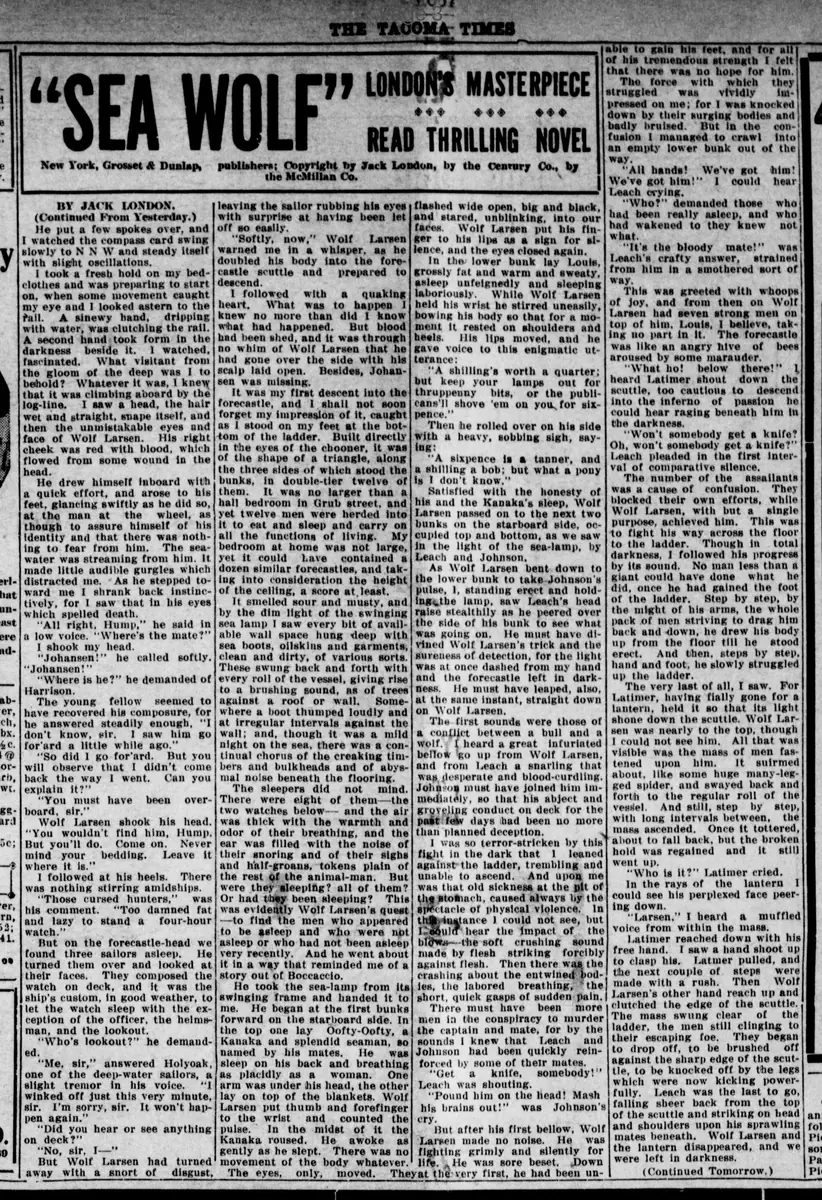
SEA-WOLF
THE TACOMA TIMES
LONDON'S MOST READ THRILLING
BY JACK LONDON.
(Continued From Yesterday.)
He put a few spokes over, and I watched the compass card swing slowly to N N W and steady itself with slight oscillations.
I took a fresh hold on my bed-clothes and was preparing to start on, when some movement caught my eye and I looked astern to the rail. A sinewy hand, dripping with water, was clutching the rail. A second hand took form in the darkness beside it. I watched, fascinated. What visitant from the gloom of the deep was I to behold? Whatever it was, I knew that it was climbing aboard by the log-line. I saw a head, the hair wet and straight, snap itself, and then the unmistakable eyes and face of Wolf Larsen. His right cheek was red with blood, which flowed from some wound in the head.
He drew himself inboard with a quick effort, and arose to his feet, glancing swiftly as he did so, at the man at the wheel, as though to assure himself of his identity and that there was nothing to fear from him. The sea-water was streaming from him. It made little audible gurgles which distracted me. As he stepped toward me I shrank back instinctively, for I saw that in his eyes which spelled death,
"All right, Hump," he said in a low voice. "Where's the mate?"
I shook my head.
"Johansen!" he called softly. "Johansen!"
"Where is he?" he demanded of Harrison.
The young fellow seemed to have recovered his composure, for he answered steadily enough, "I don't know, sir. I saw him go for'ard a little while ago."
"So did I go for'ard. But you will observe that I didn't come back the way I went. Can you explain it?"
"You must have been over-board, sir."
Wolf Larsen shook his head.
"You wouldn't find him, Hump. But you'll do. Come on. Never mind your bedding. Leave it where it is."
I followed at his heels. There was nothing stirring amidships.
"Those cursed hunters," was his comment. "Too damned fat and lazy to stand a four-hour watch."
But on the forecastle-head we found three sailors asleep. He turned them over and looked at their faces. They composed the watch on deck, and it was the ship's custom, in good weather, to let the watch sleep with the exception of the officer, the helmsman, and the lookout,
"Who's lookout?" he demanded.
"Me, sir," answered Holyoak, one of the deep-water sailors, a slight tremor in his voice.
"I winked off just this very minute, sir. I'm sorry, sir. It won't happen again."
"Did you hear or see anything on deck?"
"No, sir, I-"
But Wolf Larsen had turned away with a snort of disgust, leaving the sailor rubbing his eyes with surprise at having been let off so easily.
"Softly, now," Wolf Larsen warned me in a whisper, as he doubled his body into the forecastle scuttle and prepared to descend.
I followed with a quaking heart.
What was to happen I knew no more than did I know what had happened. But blood had been shed, and it was through no whim of Wolf Larsen that he had gone over the side with his scalp laid open. Besides, Johansen was missing.
It was my first descent into the forecastle, and I shall not soon forget my impression of it, caught as I stood on my feet at the bottom of the ladder. Built directly in the eaves of the schooner, it was of the shape of a triangle, along the three sides of which stood the bunks, in double-tier twelve of them. It was no larger than a hall bedroom in Grub street, and yet twelve men were herded into it to eat and sleep and carry on all the functions of living. My bedroom at home was not large, yet it could have contained a dozen similar forecastles, and taking into consideration the height of the ceiling, a score at least.
It smelled sour and musty, and by the dim light of the swinging sea lamp I saw every bit of available wall space hung deep with sea boots, oilskins and garments, clean and dirty, of various sorts. These swung back and forth with every roll of the vessel, giving rise to a brushing sound, as of trees against a roof or wall. Somewhere a boot thumped loudly and at irregular intervals against the wall; and, though it was a mild night on the sea, there was a continual chorus of the creaking timbers and bulkheads and of abysmal noise beneath the flooring.
The sleepers did not mind. There were eight of them-the two watches below--- and the air was thick with the warmth and odor of their breathing, and the ear was filled with the noise of their snoring and of their sighs and half-groans, tokens plain of the rest of the animal-man. But were they sleeping? all of them? Or had they been sleeping? This was evidently Wolf Larsen's quest -to find the men who appeared to be asleep and who were not asleep or who had not been asleep very recently. And he went about it in a way that reminded me of a story out of Boccaccio.
He took the sea-lamp from its swinging frame and handed it to me. He began at the first bunks forward on the starboard side. In the top one lay Oofty-Oofty, a Kanaka and splendid seaman, so named by his mates. He was sleep on his back and breathing as placidly as a woman. One arm was under his head, the other lay on top of the blankets. Wolf Larsen put thumb and forefinger to the wrist and counted the pulse. In the midst of it the Kanaka roused. He awoke as gently as he slept. There was no movement of the body whatever. The eyes, only, moved, flashed wide open, big and black, and stared, unblinking, into our faces. Wolf Larsen put his finger to his lips as a sign for silence, and the eyes closed again.
In the lower bunk lay Louis, grossly fat and warm and sweaty, asleep unfeignedly and sleeping laboriously. While Wolf Larsen held his wrist he stirred uneasily, bowing his body so that for a moment it rested on shoulders and heels. His lips moved, and he gave voice to this enigmatic utterance:
"A shilling's worth a quarter; but keep your lamps out for thruppenny bits, or the publicans'li shove 'em on you for six-pence."
Then he rolled over on his side with a heavy, sobbing sigh, saying:
"A sixpence is a tanner, and a shilling a bob; but what a pony is I don't know."
Satisfied with the honesty of his and the Kanaka's sleep, Wolf Larsen passed on to the next two bunks on the starboard side, occupied top and bottom, as we saw in the light of the sea-lamp, by Leach and Johnson.
As Wolf Larsen bent down to the lower bunk to take Johnson's pulse, I, standing erect and holding the lamp, saw Leach's head raise stealthily as he peered over the side of his bunk to see what was going on. He must have divined Wolf Larsen's trick and the sureness of detection, for the light was at once dashed from my hand and the forecastle left in darkness. He must have leaped, also, at the same instant, straight down on Wolf Larsen.
The first sounds were those of a conflict between a bull and a wolf. I heard a great infuriated bellow go up from Wolf Larsen, and from Leach a snarling that was desperate and blood-curdling. Johnson must have joined him immediately, so that his abject and groveling conduct on deck for the past few days had been no more than planned deception.
I was so terror-stricken by this fight in the dark that I leaned against the ladder, trembling and unable to ascend. And upon me was that old sickness at the pit of the stomach, caused always by the spectacle of physical violence. In this instance I could not see, but I could hear the impact of the blows-the soft crushing sound made by flesh striking forcibly against flesh. Then there was the crashing about the entwined bodies, the labored breathing, the short, quick gasps of sudden pain.
There must have been more men in the conspiracy to murder the captain and mate, for by the sounds I knew that Leach and Johnson had been quickly reinforced by some of their mates.
"Get a knife, somebody!" Leach was shouting.
"Pound him on the head! Mash his brains out!" was Johnson's cry.
But after his first bellow, Wolf Larsen made no noise. He was fighting grimly and silently for life. He was sore beset. Down at the very first, he had been unarmed and taken by surprise. Besides, there were seven strong men against him, Louis, I believe, taking no part in it.
The force with which they struggled was vividly impressed on me; for I was knocked down by their surging bodies and badly bruised. But in the confusion I managed to crawl into an empty lower bunk out of the way.
"All hands! We've got him! We've got him!" I could hear Leach crying.
"Who?" demanded those who had been really asleep, and who had wakened to they knew not what.
"It's the bloody mate!" was Leach's crafty answer, strained from him in a smothered sort of way.
This was greeted with whoops of joy, and from then on Wolf Larsen had seven strong men on top of him, Louis, I believe, taking no part in it. The forecastle was like an angry hive of bees aroused by some marauder.
"What ho! below there!" I heard Latimer shout down the scuttle, too cautious to descend into the inferno of passion he could hear raging beneath him in the darkness.
"Won't somebody get a knife? Oh, won't somebody get a knife?" Leach pleaded in the first interval of comparative silence.
The number of the assailants was a cause of confusion. They blocked their own efforts, while Wolf Larsen, with but a single purpose, achieved it. This was to fight his way across the floor to the ladder. Though in total darkness, I followed his progress by its sound. No man less than a giant could have done what he did, once he had gained the foot of the ladder. Step by step, by the might of his arms, the whole pack of men striving to drag him back and down, he drew his body up from the floor till he stood erect. And then, step by step, hand and foot, he slowly struggled up the ladder.
The very last of all, I saw. For Latimer, having finally gone for a lantern, held it so that its light shone down the scuttle. Wolf Larsen was nearly to the top, though I could not see him. All that was visible was the mass of men fastened upon him. It squirmed about, like some huge many-legged spider, and swayed back and forth to the regular roll of the vessel. And still, step by step, with long intervals between, the mass ascended. Once it tottered, about to fall back, but the broken hold was regained and it still went up.
"Who is it?" Latimer cried.
In the rays of the lantern I could see his perplexed face peering down.
"Larsen," I heard a muffled voice from within the mass.
Latimer reached down with his free hand. I saw a hand shoot up to clasp his. Latimer pulled, and the next couple of steps were made with a rush. Then Wolf Larsen's other hand reached up and clutched the edge of the scuttle. The mass swung clear of the ladder, the men still clinging to their escaping foe. They began to drop off, to be brushed off against the sharp edge of the scuttle, to be knocked off by the legs which were now kicking powerfully. Leach was the last to go, falling sheer back from the top of the scuttle and striking on head and shoulders upon his sprawling mates beneath. Wolf Larsen and the lantern disappeared, and we were left in darkness.
(Continued Tomorrow.)
THE TACOMA TIMES
LONDON'S MOST READ THRILLING
BY JACK LONDON.
(Continued From Yesterday.)
He put a few spokes over, and I watched the compass card swing slowly to N N W and steady itself with slight oscillations.
I took a fresh hold on my bed-clothes and was preparing to start on, when some movement caught my eye and I looked astern to the rail. A sinewy hand, dripping with water, was clutching the rail. A second hand took form in the darkness beside it. I watched, fascinated. What visitant from the gloom of the deep was I to behold? Whatever it was, I knew that it was climbing aboard by the log-line. I saw a head, the hair wet and straight, snap itself, and then the unmistakable eyes and face of Wolf Larsen. His right cheek was red with blood, which flowed from some wound in the head.
He drew himself inboard with a quick effort, and arose to his feet, glancing swiftly as he did so, at the man at the wheel, as though to assure himself of his identity and that there was nothing to fear from him. The sea-water was streaming from him. It made little audible gurgles which distracted me. As he stepped toward me I shrank back instinctively, for I saw that in his eyes which spelled death,
"All right, Hump," he said in a low voice. "Where's the mate?"
I shook my head.
"Johansen!" he called softly. "Johansen!"
"Where is he?" he demanded of Harrison.
The young fellow seemed to have recovered his composure, for he answered steadily enough, "I don't know, sir. I saw him go for'ard a little while ago."
"So did I go for'ard. But you will observe that I didn't come back the way I went. Can you explain it?"
"You must have been over-board, sir."
Wolf Larsen shook his head.
"You wouldn't find him, Hump. But you'll do. Come on. Never mind your bedding. Leave it where it is."
I followed at his heels. There was nothing stirring amidships.
"Those cursed hunters," was his comment. "Too damned fat and lazy to stand a four-hour watch."
But on the forecastle-head we found three sailors asleep. He turned them over and looked at their faces. They composed the watch on deck, and it was the ship's custom, in good weather, to let the watch sleep with the exception of the officer, the helmsman, and the lookout,
"Who's lookout?" he demanded.
"Me, sir," answered Holyoak, one of the deep-water sailors, a slight tremor in his voice.
"I winked off just this very minute, sir. I'm sorry, sir. It won't happen again."
"Did you hear or see anything on deck?"
"No, sir, I-"
But Wolf Larsen had turned away with a snort of disgust, leaving the sailor rubbing his eyes with surprise at having been let off so easily.
"Softly, now," Wolf Larsen warned me in a whisper, as he doubled his body into the forecastle scuttle and prepared to descend.
I followed with a quaking heart.
What was to happen I knew no more than did I know what had happened. But blood had been shed, and it was through no whim of Wolf Larsen that he had gone over the side with his scalp laid open. Besides, Johansen was missing.
It was my first descent into the forecastle, and I shall not soon forget my impression of it, caught as I stood on my feet at the bottom of the ladder. Built directly in the eaves of the schooner, it was of the shape of a triangle, along the three sides of which stood the bunks, in double-tier twelve of them. It was no larger than a hall bedroom in Grub street, and yet twelve men were herded into it to eat and sleep and carry on all the functions of living. My bedroom at home was not large, yet it could have contained a dozen similar forecastles, and taking into consideration the height of the ceiling, a score at least.
It smelled sour and musty, and by the dim light of the swinging sea lamp I saw every bit of available wall space hung deep with sea boots, oilskins and garments, clean and dirty, of various sorts. These swung back and forth with every roll of the vessel, giving rise to a brushing sound, as of trees against a roof or wall. Somewhere a boot thumped loudly and at irregular intervals against the wall; and, though it was a mild night on the sea, there was a continual chorus of the creaking timbers and bulkheads and of abysmal noise beneath the flooring.
The sleepers did not mind. There were eight of them-the two watches below--- and the air was thick with the warmth and odor of their breathing, and the ear was filled with the noise of their snoring and of their sighs and half-groans, tokens plain of the rest of the animal-man. But were they sleeping? all of them? Or had they been sleeping? This was evidently Wolf Larsen's quest -to find the men who appeared to be asleep and who were not asleep or who had not been asleep very recently. And he went about it in a way that reminded me of a story out of Boccaccio.
He took the sea-lamp from its swinging frame and handed it to me. He began at the first bunks forward on the starboard side. In the top one lay Oofty-Oofty, a Kanaka and splendid seaman, so named by his mates. He was sleep on his back and breathing as placidly as a woman. One arm was under his head, the other lay on top of the blankets. Wolf Larsen put thumb and forefinger to the wrist and counted the pulse. In the midst of it the Kanaka roused. He awoke as gently as he slept. There was no movement of the body whatever. The eyes, only, moved, flashed wide open, big and black, and stared, unblinking, into our faces. Wolf Larsen put his finger to his lips as a sign for silence, and the eyes closed again.
In the lower bunk lay Louis, grossly fat and warm and sweaty, asleep unfeignedly and sleeping laboriously. While Wolf Larsen held his wrist he stirred uneasily, bowing his body so that for a moment it rested on shoulders and heels. His lips moved, and he gave voice to this enigmatic utterance:
"A shilling's worth a quarter; but keep your lamps out for thruppenny bits, or the publicans'li shove 'em on you for six-pence."
Then he rolled over on his side with a heavy, sobbing sigh, saying:
"A sixpence is a tanner, and a shilling a bob; but what a pony is I don't know."
Satisfied with the honesty of his and the Kanaka's sleep, Wolf Larsen passed on to the next two bunks on the starboard side, occupied top and bottom, as we saw in the light of the sea-lamp, by Leach and Johnson.
As Wolf Larsen bent down to the lower bunk to take Johnson's pulse, I, standing erect and holding the lamp, saw Leach's head raise stealthily as he peered over the side of his bunk to see what was going on. He must have divined Wolf Larsen's trick and the sureness of detection, for the light was at once dashed from my hand and the forecastle left in darkness. He must have leaped, also, at the same instant, straight down on Wolf Larsen.
The first sounds were those of a conflict between a bull and a wolf. I heard a great infuriated bellow go up from Wolf Larsen, and from Leach a snarling that was desperate and blood-curdling. Johnson must have joined him immediately, so that his abject and groveling conduct on deck for the past few days had been no more than planned deception.
I was so terror-stricken by this fight in the dark that I leaned against the ladder, trembling and unable to ascend. And upon me was that old sickness at the pit of the stomach, caused always by the spectacle of physical violence. In this instance I could not see, but I could hear the impact of the blows-the soft crushing sound made by flesh striking forcibly against flesh. Then there was the crashing about the entwined bodies, the labored breathing, the short, quick gasps of sudden pain.
There must have been more men in the conspiracy to murder the captain and mate, for by the sounds I knew that Leach and Johnson had been quickly reinforced by some of their mates.
"Get a knife, somebody!" Leach was shouting.
"Pound him on the head! Mash his brains out!" was Johnson's cry.
But after his first bellow, Wolf Larsen made no noise. He was fighting grimly and silently for life. He was sore beset. Down at the very first, he had been unarmed and taken by surprise. Besides, there were seven strong men against him, Louis, I believe, taking no part in it.
The force with which they struggled was vividly impressed on me; for I was knocked down by their surging bodies and badly bruised. But in the confusion I managed to crawl into an empty lower bunk out of the way.
"All hands! We've got him! We've got him!" I could hear Leach crying.
"Who?" demanded those who had been really asleep, and who had wakened to they knew not what.
"It's the bloody mate!" was Leach's crafty answer, strained from him in a smothered sort of way.
This was greeted with whoops of joy, and from then on Wolf Larsen had seven strong men on top of him, Louis, I believe, taking no part in it. The forecastle was like an angry hive of bees aroused by some marauder.
"What ho! below there!" I heard Latimer shout down the scuttle, too cautious to descend into the inferno of passion he could hear raging beneath him in the darkness.
"Won't somebody get a knife? Oh, won't somebody get a knife?" Leach pleaded in the first interval of comparative silence.
The number of the assailants was a cause of confusion. They blocked their own efforts, while Wolf Larsen, with but a single purpose, achieved it. This was to fight his way across the floor to the ladder. Though in total darkness, I followed his progress by its sound. No man less than a giant could have done what he did, once he had gained the foot of the ladder. Step by step, by the might of his arms, the whole pack of men striving to drag him back and down, he drew his body up from the floor till he stood erect. And then, step by step, hand and foot, he slowly struggled up the ladder.
The very last of all, I saw. For Latimer, having finally gone for a lantern, held it so that its light shone down the scuttle. Wolf Larsen was nearly to the top, though I could not see him. All that was visible was the mass of men fastened upon him. It squirmed about, like some huge many-legged spider, and swayed back and forth to the regular roll of the vessel. And still, step by step, with long intervals between, the mass ascended. Once it tottered, about to fall back, but the broken hold was regained and it still went up.
"Who is it?" Latimer cried.
In the rays of the lantern I could see his perplexed face peering down.
"Larsen," I heard a muffled voice from within the mass.
Latimer reached down with his free hand. I saw a hand shoot up to clasp his. Latimer pulled, and the next couple of steps were made with a rush. Then Wolf Larsen's other hand reached up and clutched the edge of the scuttle. The mass swung clear of the ladder, the men still clinging to their escaping foe. They began to drop off, to be brushed off against the sharp edge of the scuttle, to be knocked off by the legs which were now kicking powerfully. Leach was the last to go, falling sheer back from the top of the scuttle and striking on head and shoulders upon his sprawling mates beneath. Wolf Larsen and the lantern disappeared, and we were left in darkness.
(Continued Tomorrow.)
What sub-type of article is it?
Prose Fiction
What themes does it cover?
War Peace
Political
What keywords are associated?
Sea Wolf
Jack London
Mutiny
Wolf Larsen
Forecastle
Shipboard Conflict
Violence At Sea
What entities or persons were involved?
By Jack London
Literary Details
Title
Sea Wolf
Author
By Jack London
Key Lines
He Drew Himself Inboard With A Quick Effort, And Arose To His Feet, Glancing Swiftly As He Did So, At The Man At The Wheel, As Though To Assure Himself Of His Identity And That There Was Nothing To Fear From Him.
As He Stepped Toward Me I Shrank Back Instinctively, For I Saw That In His Eyes Which Spelled Death,
The First Sounds Were Those Of A Conflict Between A Bull And A Wolf. I Heard A Great Infuriated Bellow Go Up From Wolf Larsen, And From Leach A Snarling That Was Desperate And Blood Curdling.
Step By Step, By The Might Of His Arms, The Whole Pack Of Men Striving To Drag Him Back And Down, He Drew His Body Up From The Floor Till He Stood Erect.
Leach Was The Last To Go, Falling Sheer Back From The Top Of The Scuttle And Striking On Head And Shoulders Upon His Sprawling Mates Beneath.