Thank you for visiting SNEWPapers!
Sign up free
Editorial
September 18, 1856
Weekly Indiana State Sentinel
Indianapolis, Marion County, Indiana
What is this article about?
This editorial argues that the core election issue is preserving co-equal state sovereignty and constitutional compromises against Abolitionist efforts to impose anti-slavery conditions on new states like Kansas, defending popular sovereignty, Democratic principles, and the Union while criticizing Black Republicans for fanaticism and power grabs.
Clipping
OCR Quality
98%
Excellent
Full Text
For the Indiana State Sentinel.
The True Issue.
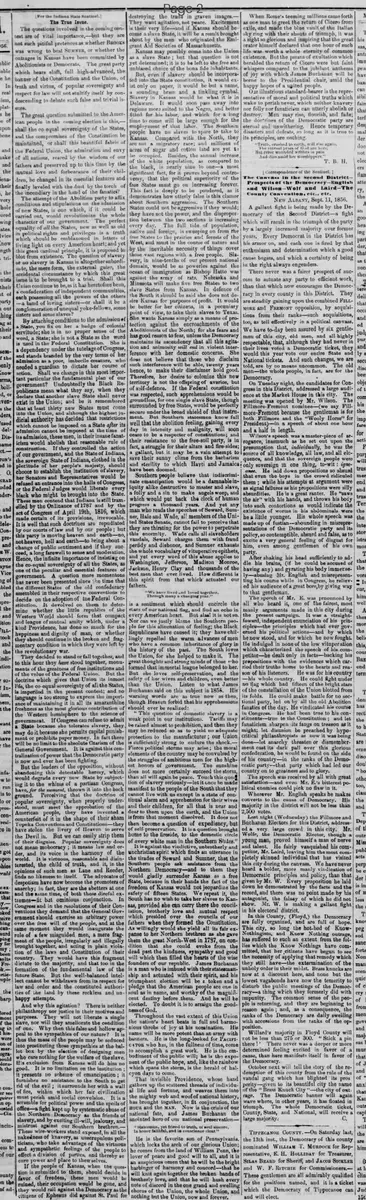
The questions involved in the coming contest are of vital importance,-but they are not such pitiful pretences as whether Brooks was wrong to beat Sumner, or whether the outrages in Kansas have been committed by Abolitionists or Democrats. The great party which bears aloft, full high-advanced, the banner of the Constitution and the Union, of truth and virtue, of popular sovereignty and respect for law will not stultify itself by condescending to debate such false and trivial issues.
The great question submitted to the American people in the coming election is this,—shall the co-equal sovereignty of the States, and the compromises of the Constitution be maintained, or shall this beautiful fabric of the Federal Union, the admiration and envy of all nations, reared by the wisdom of our fathers and preserved up to this time by the mutual love and forbearance of their children, be changed in its essential features and finally leveled with the dust by the torch of the incendiary in the hand of the fanatic?
The attempt of the Abolition party to affix conditions and stipulations on the admission of new States, is one which, if it could be carried out, would revolutionize the whole character of our government. The perfect equality of all the States, new as well as old in political rights and privileges is a truth which should be emblazoned in letters of living light on every American heart; and yet this great cardinal principle, it is proposed to blot from existence. The question of slavery or no slavery in Kansas is altogether subordinate, the mere form, the external guise, the accidental circumstance by which this great issue is to be brought to a trial. Shall this Union continue to be, as it has heretofore been a confederation of independent communities, each possessing all the powers of the others—a band of loving sisters—or shall it be a conglomeration of unequal yoke-fellows, some sisters and some slaves?
By attaching conditions to the admission of a State, you fix on her a badge of colonial servitude; she is in no proper sense of the word, a State; she is not a State as the word is used in the Federal Constitution. She is a dependency under the tutelage of Congress, and stands branded by the very terms of her admission as a poor, imbecile creature, who needed a guardian to dictate her course of action. Shall we change in this most important particular the fundamental plan of our government? Undoubtedly the Black Republicans mean what they say, when they declare that another slave State shall never exist in the Union; and be it remembered that at least thirty new States must come into the Union, and although the highest judicial authority has decided that restrictions which cannot be imposed on a State after its admission cannot be imposed at the time of its admission, these men, in their insane fanaticism would abolish that reasonable rule of construction. If they controlled the action of our government, and the State of Indiana the sovereign State of Indiana, clothed in the plentitude of her people's majesty, should choose to establish the institution of slavery her Senators and Representatives would be refused an entrance into the halls of Congress, or the Federal Judges would liberate every black who might be brought into the State.
These men contend that Indiana is still trammelled by the Ordinance of 1787 and by the act of Congress of April 19th, 1816, which made certain of its provisions, irrevocable. It is well that such doctrines are repudiated by our courts of law and by our people; but this party is moving heaven and earth—no, not heaven, hell and earth—to bring about a change of public sentiment and if they succeed, a long farewell to sense and moderation.
Hence, the infinite importance of insisting on the co-equal sovereignty of all the States, as one of the peculiar and essential features of government. A question more momentous has never been presented since the time that the different States of the old confederacy assembled in their respective conventions to decide on the adoption of the Federal Constitution. It devolved on them to determine whether the little republics of the Western World should form that compact and league of mutual amity which, under a kind Providence, has done so much for the happiness and dignity of man, or whether they should continue in the broken and fragmentary condition in which they were left by the revolutionary war.
They decided to stand or fall together, and to this hour they have stood together, monuments of the greatness of free institutions and of the value of the Federal Union. But the doctrine which gives that Union its inmost life, the co-equal sovereignty of all the States, is imperiled in the present contest; and no language is too strong to express the importance of maintaining it in all its amaranthine freshness as the most glorious contribution of the Western hemisphere to the science of government. If Congress can refuse to admit a State because she tolerates slavery, they may do it because she permits capital punishment or prohibits paper money. In fact there will be no limit to the absolute Czarism of the General Government. It is against this centralization of power that the Democratic party is now and ever has been fighting.
But the leaders of the opposition, without abandoning this detestable heresy, which would degrade every new State by subjecting it to the whims of a partisan Congress, have, for the moment, thrown it into the background. Perceiving that the doctrine of popular sovereignty, when properly understood, must meet the approbation of the American people, they have invented a counterfeit of it in the shape of their sham Topeka Conventions and Constitutions—they have stolen the livery of Heaven to serve the Devil in. But we can easily strip them of their disguise. Popular sovereignty does not mean mobocracy; it means law and order, and its voice is the harmony of the world. It is virtuous, reasonable and disinterested, the child of truth, and it, in the opinions of such men as Lane and Reeder, finds no likeness to itself. The advocates of despotism have now become the promoters of anarchy; in fact, they are the abetters at one and the same time, of both these direful extremes—fit but ominous conjunction. In Congress and in the resolutions of their Conventions they demand that the General Government should exercise an arbitrary power over the free will of the people, and at the same moment they would inaugurate the rule of a few misguided men, a mere fragment of the people, irregularly and illegally brought together, and acting in plain violation of the laws and Constitution of their country. They would have this fragment dictate to the majority, and that too in the formation of the fundamental law of the future State. But the well-balanced intellect cannot be withdrawn from its respect for law and order and the constituted authorities of the land by these reckless and unhappy attempts.
And why this agitation? There is neither philanthropy nor justice in their motives and purposes. They will not liberate a single slave, nor will they ameliorate the condition of one. Why then this false and hollow appeal to the sympathies of our nature? It is thus the mass of the people may be seduced into prostituting those sympathies at the ballot box by the election of designing men who care nothing for the welfare of the slave. His exclusion from Kansas will do him no good. It is no limitation on the institution; it presents no scheme of emancipation; it furnishes no assistance to the South to get rid of the evil; it surrounds her with a wall of fire, within which her fair civilization must perish amid social convulsion. It is a scramble for political power and the spoils of office—a fight kept up by systematic abuse of the Northern Democracy as the friends of slavery, and by exciting ill-will, jealousy, and mistrust against our Southern brethren.
These wire-workers stand exposed, in all the nakedness of knavery, as unscrupulous politicians, who take advantage of the virtuous and sympathetic feelings of the people to effect a division of parties, and thereby secure power and place to themselves.
If the people of Kansas, when the question is submitted to them, should decide in favor of freedom, these men would be ruined, their occupation would be gone, and destroying the trade in graven images.
They want agitation, not peace. Excitement is their very life—and if Kansas should become a slave State, it will be a result brought about by the men who originated the Emigrant Aid Societies of Massachusetts.
Kansas may possibly come into the Union as a slave State; but that question is not yet determined; it is to be left to the free and unbiased choice of the bona fide inhabitants. But, even if slavery should be incorporated into the State constitution, it would exist only on paper, it would be but a name, a sounding brass and a tinkling cymbal. Slavery in Kansas would be what it is in Delaware. It would soon pass away into regions more suited to the Negro, and better fitted for his labor, and which for a long time to come will be large enough for the employment of that labor. The Southern people have no slaves to spare to take to Kansas. Compared with the North, they are not a migratory race; and millions of acres of sugar and cotton land are yet to be occupied. Besides, the annual increase of the white population, as compared to the black, is nearly nine to one—a most significant fact, for it proves beyond controversy, that the political superiority of the free States must go on increasing forever.
This fact is deeply to be pondered, as it demonstrates how utterly false is this clamor about Southern aggression. The Southern States could not be aggressive if they would; they have not the power, and the disproportion between the two sections is increasing every day. The full tide of population, native and foreign, is sweeping on from the free States to the prairies and forests of the West, and must in the course of nature and by the inevitable necessity of things cover those vast regions with a free people. Slavery, in nine-tenths of our present national domain, would be as powerless against the ocean of immigration as Bishop Hatto was against the army of rats. Nebraska and Minnesota will make five free States to two slave States from Kansas. In defence of the South it should be said she does not desire Kansas for purposes of profit. It would be better for her citizens, in a pecuniary point of view, to take their slaves to Texas. She wants Kansas simply as a means of protection against the encroachments of the Abolitionists of the North: for she fears and has good reason to fear, unless the Democracy maintains its ascendency that all this agitation and animosity will end in violent interference with her domestic concerns. She does not believe that those who disclaim such interference will be able, twenty years hence, to make their disclaimer hold good.
Therefore, her desire to colonize this new territory is not the offspring of avarice, but of self-defence. If the Federal constitution was respected, such apprehensions would be groundless, for one single slave State, though surrounded by free States, would be perfectly secure under the broad shield of that instrument. But Southern statesmen know full well that the abolition feeling, gaining every day in intensity and malignity, will soon cease to be a respecter of constitutions; and their resistance to the free-soil party, is in fact, a struggle for their altars and firesides; a gallant, but it may be a vain attempt to save their sunny clime from the barbarism and sterility to which Hayti and Jamaica have been doomed.
Southern people believe that indiscriminate emancipation would be a damnable iniquity alike destructive to master and slave a folly and a sin to make angels weep, and which would put back the clock of human progress a thousand years. And yet any man who reads the speeches of Seward, Sumner, Hale and Wade, all members of the United States Senate, cannot fail to perceive that they are thirsting for the power to perpetrate this enormity. Wade calls all slaveholders vandals, Seward charges them with fraud perfidy and dishonor, and Sumner exhausts the whole vocabulary of vituperative epithets, and yet every word of this abuse applies to Washington, Jefferson, Madison Monroe, Jackson, Henry Clay and thousands of the best men that ever lived. How different is this spirit from that which actuated our fathers.
"We have lived and loved together, Through many a changing year."
is a sentiment which should encircle the stars of our national flag, and find an echo in every American heart. But alas! it is not so. Nor can we justly blame the Southern people for this alienation of feeling; the Black Republicans have caused it; they have chillingly repelled the warm advances of men who have a common inheritance of glory in the history of the past. The South loves the Union, for she helped to make it. The great thoughts and strong minds of those who formed that immortal league belonged to her. But she loves self-preservation, and the safety of her wives and children, even better than the Union. Listen to what James Buchanan said on this subject in 1855. His warning words are as true now as then, though Heaven forbid that his apprehensions should ever be realized:
"This question of domestic slavery is a weak point in our institutions. Tariffs may be raised almost to prohibition, and then they may be reduced so as to yield no adequate protection to the manufacturer; our Union is sufficiently strong to endure the shock.—Fierce political storms may arise; the moral elements of the country may be convulsed by the struggles of ambitious men for the highest honors of government. The sunshine does not more certainly succeed the storm than all will again be peace. Touch this question of slavery seriously—let it once be made manifest to the people of the South that they cannot live with us except in a state of continual alarm and apprehension for their wives and their children, for all that is near and dear to them upon the earth, and the Union is from that moment dissolved. It does not then become a question of expediency, but of self-preservation. It is a question brought home to the fireside, to the domestic circle of every white man in the Southern States."
The True Issue.
The questions involved in the coming contest are of vital importance,-but they are not such pitiful pretences as whether Brooks was wrong to beat Sumner, or whether the outrages in Kansas have been committed by Abolitionists or Democrats. The great party which bears aloft, full high-advanced, the banner of the Constitution and the Union, of truth and virtue, of popular sovereignty and respect for law will not stultify itself by condescending to debate such false and trivial issues.
The great question submitted to the American people in the coming election is this,—shall the co-equal sovereignty of the States, and the compromises of the Constitution be maintained, or shall this beautiful fabric of the Federal Union, the admiration and envy of all nations, reared by the wisdom of our fathers and preserved up to this time by the mutual love and forbearance of their children, be changed in its essential features and finally leveled with the dust by the torch of the incendiary in the hand of the fanatic?
The attempt of the Abolition party to affix conditions and stipulations on the admission of new States, is one which, if it could be carried out, would revolutionize the whole character of our government. The perfect equality of all the States, new as well as old in political rights and privileges is a truth which should be emblazoned in letters of living light on every American heart; and yet this great cardinal principle, it is proposed to blot from existence. The question of slavery or no slavery in Kansas is altogether subordinate, the mere form, the external guise, the accidental circumstance by which this great issue is to be brought to a trial. Shall this Union continue to be, as it has heretofore been a confederation of independent communities, each possessing all the powers of the others—a band of loving sisters—or shall it be a conglomeration of unequal yoke-fellows, some sisters and some slaves?
By attaching conditions to the admission of a State, you fix on her a badge of colonial servitude; she is in no proper sense of the word, a State; she is not a State as the word is used in the Federal Constitution. She is a dependency under the tutelage of Congress, and stands branded by the very terms of her admission as a poor, imbecile creature, who needed a guardian to dictate her course of action. Shall we change in this most important particular the fundamental plan of our government? Undoubtedly the Black Republicans mean what they say, when they declare that another slave State shall never exist in the Union; and be it remembered that at least thirty new States must come into the Union, and although the highest judicial authority has decided that restrictions which cannot be imposed on a State after its admission cannot be imposed at the time of its admission, these men, in their insane fanaticism would abolish that reasonable rule of construction. If they controlled the action of our government, and the State of Indiana the sovereign State of Indiana, clothed in the plentitude of her people's majesty, should choose to establish the institution of slavery her Senators and Representatives would be refused an entrance into the halls of Congress, or the Federal Judges would liberate every black who might be brought into the State.
These men contend that Indiana is still trammelled by the Ordinance of 1787 and by the act of Congress of April 19th, 1816, which made certain of its provisions, irrevocable. It is well that such doctrines are repudiated by our courts of law and by our people; but this party is moving heaven and earth—no, not heaven, hell and earth—to bring about a change of public sentiment and if they succeed, a long farewell to sense and moderation.
Hence, the infinite importance of insisting on the co-equal sovereignty of all the States, as one of the peculiar and essential features of government. A question more momentous has never been presented since the time that the different States of the old confederacy assembled in their respective conventions to decide on the adoption of the Federal Constitution. It devolved on them to determine whether the little republics of the Western World should form that compact and league of mutual amity which, under a kind Providence, has done so much for the happiness and dignity of man, or whether they should continue in the broken and fragmentary condition in which they were left by the revolutionary war.
They decided to stand or fall together, and to this hour they have stood together, monuments of the greatness of free institutions and of the value of the Federal Union. But the doctrine which gives that Union its inmost life, the co-equal sovereignty of all the States, is imperiled in the present contest; and no language is too strong to express the importance of maintaining it in all its amaranthine freshness as the most glorious contribution of the Western hemisphere to the science of government. If Congress can refuse to admit a State because she tolerates slavery, they may do it because she permits capital punishment or prohibits paper money. In fact there will be no limit to the absolute Czarism of the General Government. It is against this centralization of power that the Democratic party is now and ever has been fighting.
But the leaders of the opposition, without abandoning this detestable heresy, which would degrade every new State by subjecting it to the whims of a partisan Congress, have, for the moment, thrown it into the background. Perceiving that the doctrine of popular sovereignty, when properly understood, must meet the approbation of the American people, they have invented a counterfeit of it in the shape of their sham Topeka Conventions and Constitutions—they have stolen the livery of Heaven to serve the Devil in. But we can easily strip them of their disguise. Popular sovereignty does not mean mobocracy; it means law and order, and its voice is the harmony of the world. It is virtuous, reasonable and disinterested, the child of truth, and it, in the opinions of such men as Lane and Reeder, finds no likeness to itself. The advocates of despotism have now become the promoters of anarchy; in fact, they are the abetters at one and the same time, of both these direful extremes—fit but ominous conjunction. In Congress and in the resolutions of their Conventions they demand that the General Government should exercise an arbitrary power over the free will of the people, and at the same moment they would inaugurate the rule of a few misguided men, a mere fragment of the people, irregularly and illegally brought together, and acting in plain violation of the laws and Constitution of their country. They would have this fragment dictate to the majority, and that too in the formation of the fundamental law of the future State. But the well-balanced intellect cannot be withdrawn from its respect for law and order and the constituted authorities of the land by these reckless and unhappy attempts.
And why this agitation? There is neither philanthropy nor justice in their motives and purposes. They will not liberate a single slave, nor will they ameliorate the condition of one. Why then this false and hollow appeal to the sympathies of our nature? It is thus the mass of the people may be seduced into prostituting those sympathies at the ballot box by the election of designing men who care nothing for the welfare of the slave. His exclusion from Kansas will do him no good. It is no limitation on the institution; it presents no scheme of emancipation; it furnishes no assistance to the South to get rid of the evil; it surrounds her with a wall of fire, within which her fair civilization must perish amid social convulsion. It is a scramble for political power and the spoils of office—a fight kept up by systematic abuse of the Northern Democracy as the friends of slavery, and by exciting ill-will, jealousy, and mistrust against our Southern brethren.
These wire-workers stand exposed, in all the nakedness of knavery, as unscrupulous politicians, who take advantage of the virtuous and sympathetic feelings of the people to effect a division of parties, and thereby secure power and place to themselves.
If the people of Kansas, when the question is submitted to them, should decide in favor of freedom, these men would be ruined, their occupation would be gone, and destroying the trade in graven images.
They want agitation, not peace. Excitement is their very life—and if Kansas should become a slave State, it will be a result brought about by the men who originated the Emigrant Aid Societies of Massachusetts.
Kansas may possibly come into the Union as a slave State; but that question is not yet determined; it is to be left to the free and unbiased choice of the bona fide inhabitants. But, even if slavery should be incorporated into the State constitution, it would exist only on paper, it would be but a name, a sounding brass and a tinkling cymbal. Slavery in Kansas would be what it is in Delaware. It would soon pass away into regions more suited to the Negro, and better fitted for his labor, and which for a long time to come will be large enough for the employment of that labor. The Southern people have no slaves to spare to take to Kansas. Compared with the North, they are not a migratory race; and millions of acres of sugar and cotton land are yet to be occupied. Besides, the annual increase of the white population, as compared to the black, is nearly nine to one—a most significant fact, for it proves beyond controversy, that the political superiority of the free States must go on increasing forever.
This fact is deeply to be pondered, as it demonstrates how utterly false is this clamor about Southern aggression. The Southern States could not be aggressive if they would; they have not the power, and the disproportion between the two sections is increasing every day. The full tide of population, native and foreign, is sweeping on from the free States to the prairies and forests of the West, and must in the course of nature and by the inevitable necessity of things cover those vast regions with a free people. Slavery, in nine-tenths of our present national domain, would be as powerless against the ocean of immigration as Bishop Hatto was against the army of rats. Nebraska and Minnesota will make five free States to two slave States from Kansas. In defence of the South it should be said she does not desire Kansas for purposes of profit. It would be better for her citizens, in a pecuniary point of view, to take their slaves to Texas. She wants Kansas simply as a means of protection against the encroachments of the Abolitionists of the North: for she fears and has good reason to fear, unless the Democracy maintains its ascendency that all this agitation and animosity will end in violent interference with her domestic concerns. She does not believe that those who disclaim such interference will be able, twenty years hence, to make their disclaimer hold good.
Therefore, her desire to colonize this new territory is not the offspring of avarice, but of self-defence. If the Federal constitution was respected, such apprehensions would be groundless, for one single slave State, though surrounded by free States, would be perfectly secure under the broad shield of that instrument. But Southern statesmen know full well that the abolition feeling, gaining every day in intensity and malignity, will soon cease to be a respecter of constitutions; and their resistance to the free-soil party, is in fact, a struggle for their altars and firesides; a gallant, but it may be a vain attempt to save their sunny clime from the barbarism and sterility to which Hayti and Jamaica have been doomed.
Southern people believe that indiscriminate emancipation would be a damnable iniquity alike destructive to master and slave a folly and a sin to make angels weep, and which would put back the clock of human progress a thousand years. And yet any man who reads the speeches of Seward, Sumner, Hale and Wade, all members of the United States Senate, cannot fail to perceive that they are thirsting for the power to perpetrate this enormity. Wade calls all slaveholders vandals, Seward charges them with fraud perfidy and dishonor, and Sumner exhausts the whole vocabulary of vituperative epithets, and yet every word of this abuse applies to Washington, Jefferson, Madison Monroe, Jackson, Henry Clay and thousands of the best men that ever lived. How different is this spirit from that which actuated our fathers.
"We have lived and loved together, Through many a changing year."
is a sentiment which should encircle the stars of our national flag, and find an echo in every American heart. But alas! it is not so. Nor can we justly blame the Southern people for this alienation of feeling; the Black Republicans have caused it; they have chillingly repelled the warm advances of men who have a common inheritance of glory in the history of the past. The South loves the Union, for she helped to make it. The great thoughts and strong minds of those who formed that immortal league belonged to her. But she loves self-preservation, and the safety of her wives and children, even better than the Union. Listen to what James Buchanan said on this subject in 1855. His warning words are as true now as then, though Heaven forbid that his apprehensions should ever be realized:
"This question of domestic slavery is a weak point in our institutions. Tariffs may be raised almost to prohibition, and then they may be reduced so as to yield no adequate protection to the manufacturer; our Union is sufficiently strong to endure the shock.—Fierce political storms may arise; the moral elements of the country may be convulsed by the struggles of ambitious men for the highest honors of government. The sunshine does not more certainly succeed the storm than all will again be peace. Touch this question of slavery seriously—let it once be made manifest to the people of the South that they cannot live with us except in a state of continual alarm and apprehension for their wives and their children, for all that is near and dear to them upon the earth, and the Union is from that moment dissolved. It does not then become a question of expediency, but of self-preservation. It is a question brought home to the fireside, to the domestic circle of every white man in the Southern States."
What sub-type of article is it?
Constitutional
Slavery Abolition
Partisan Politics
What keywords are associated?
Co Equal Sovereignty
Popular Sovereignty
Kansas Admission
Abolitionists
Black Republicans
Slavery Issue
Union Preservation
Southern Rights
Democratic Party
Political Agitation
What entities or persons were involved?
Abolition Party
Black Republicans
Democratic Party
Brooks
Sumner
Lane
Reeder
Seward
Hale
Wade
James Buchanan
Southern States
Kansas
Indiana
Editorial Details
Primary Topic
Preservation Of Co Equal State Sovereignty Against Abolitionist Restrictions On New States
Stance / Tone
Strongly Pro Democratic And Pro Southern Rights, Anti Abolitionist, Warning Of Union Dissolution
Key Figures
Abolition Party
Black Republicans
Democratic Party
Brooks
Sumner
Lane
Reeder
Seward
Hale
Wade
James Buchanan
Southern States
Kansas
Indiana
Key Arguments
Co Equal Sovereignty Of States Must Be Maintained To Preserve The Union
Abolitionists Seek To Impose Anti Slavery Conditions On New States, Revolutionizing Government
Slavery Question In Kansas Is Subordinate To Broader Issue Of State Equality
Popular Sovereignty Means Law And Order, Not Mobocracy Or Sham Conventions
Agitation In Kansas Is For Political Power, Not Slave Welfare
Southern Desire For Kansas Is Self Defense Against Northern Encroachments
Indiscriminate Emancipation Would Destroy South And Slaves
Black Republicans' Rhetoric Threatens Constitutional Protections