Thank you for visiting SNEWPapers!
Sign up free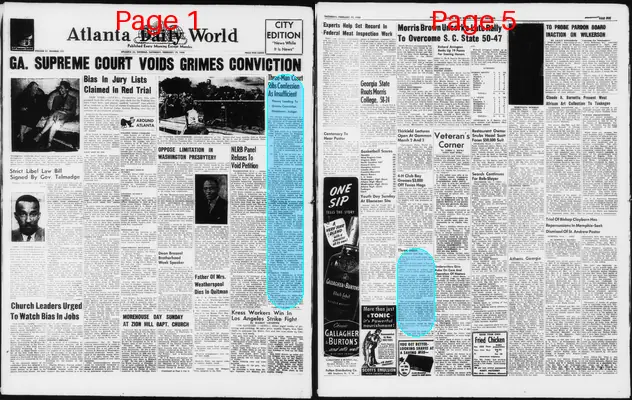
Atlanta Daily World
Atlanta, Fulton County, Georgia
What is this article about?
Georgia Supreme Court unanimously voids WWII vet Isaiah Grimes' murder conviction for stepfather's death, citing lack of corroborating evidence for confession. Also addresses arson convictions amid claims of coercion and racial motives in Loganville fires. (214 chars)
Merged-components note: Continuation of Three-Man Court story from page 1 to page 5.
Clippings

1 of 2
OCR Quality
Full Text
Ribs Confession
As Insufficient
Theory Leading To
Grimes Conviction
Displeases Judges
The Georgia Supreme Court in a unanimous decision Thursday voided the conviction of 27-year-old World War II Veteran Isaiah Grimes of Loganville, Ga., in connection with the death of his step-father, Fluke Catlin.
The High Court in a three-point ruling handed down by Presiding Judge W. T. Atkinson declared:
(1) A confession is insufficient to authorize a conviction in absence of extraneous evidence of the corpus delicti;
(2) A dying man's declaration is not a mere conclusion or opinion, and is admissible as evidence;
(3) and, It is not in error for a trial judge to charge a jury with "This statement is not made under oath and he (the defendant) can not be cross-examined unless he consents to be."
Grimes was convicted last August 23, in Walton Superior Court. He had been earlier arrested in connection with a series of fires which burned down two Negro schools and a church in Loganville, Ga. After his arrest he was indicted on a murder charge, and convicted and sentenced to life imprisonment. He earlier had received a 30-year sentence on three counts of arson.
The defendant was sentenced to a term of 30-years imprisonment on the arson charge, despite his plea that he had been beaten and threatened to be lynched.
Grimes' arrest on an arson charge brought nationwide comment after the Atlanta Daily World published a letter in which he repudiated a "confession" before news of his arrest had been made public.
THEORY DISCOUNTED
At the trial Defense Atty. Frank A. Bowers asked Superior Judge Henry West to dismiss the Arson charge on the grounds of insufficient evidence in citing a Georgia code which ruled that confessions must be substantiated by corroborating evidence.
In the death of Fluke Catlin the state contended that Grimes claimed in his confession that he poured kerosene on his stepfather and set him afire on June 1, 1947. Catlin died on July 1, 1947 from complications growing out of his burns.
The arson charge alleges that Grimes burned two schools in 1946, and the Mt. Zion Baptist Church on August 21, 1947.
Loganville Negro citizens contended the fires were started by whites to gain ownership of property facing a new highway in Loganville.
Judge William Y. Atkinson in handing down the unanimous ruling of the court gave an opinion on two future issues pending a new trial.
EVIDENCE VARIES
It was the declaration of Fluke Catlin as to the cause of the fire: "He might have crossed his legs and knocked the lamp off" and "I don't know how I got burned unless I crossed my legs and knocked the lamp off." The Court said these statements were not merely a conclusion or opinion, but admissible as evidence.
The second point was Judge Henry West's charge to the jury in which he stated "The defendant has made a statement in this case which he has a right to do under law. This
(Continued on Page 5, Col. 3)
Three Man (Continued from Page One)
statement, is not made under oath and the defendant cannot be cross-examined."
The High Court stated it saw no reasons for exceptions to these statements.
Judge Atkinson in writing the opinion cited a ruling which stated: "To prove corpus delicti in a charge of murder it is essential to establish that the person alleged to have been killed is actually dead and that death was caused or accomplished by violence or other direct criminal agency of another human being; that is, it was not accidental, nor due to natural causes, nor to the act of the deceased, and that the accused caused the death in the manner charged."
The sensational case dates back to December 9, 1947 when Sheriff Louis Howard arrested Grimes, along with his mother Mrs. Maggie Catlin and Willie Malcolm on an arson charge. Mrs. Catlin and Malcolm were subsequently released. Before news of Grimes' arrest was made public he smuggled a note to the Atlanta Daily World proclaiming his innocence.
The confession stated he killed his father-in-law for insurance indemnities.
No direct ruling was made on the arson charge and the case will be re-tried in Walton Superior Court.
What sub-type of article is it?
What themes does it cover?
What keywords are associated?
What entities or persons were involved?
Where did it happen?
Story Details
Key Persons
Location
Loganville, Ga., Walton Superior Court, Georgia Supreme Court
Event Date
Convicted Last August 23; Poured Kerosene On June 1, 1947; Died On July 1, 1947; Burned Schools In 1946; Mt. Zion Baptist Church On August 21, 1947; Arrested December 9, 1947
Story Details
Georgia Supreme Court voids Isaiah Grimes' murder conviction due to insufficient evidence corroborating confession; rules on admissibility of dying declarations and jury charges; Grimes also convicted of arson for burning schools and church, claims coercion; case involves racial tensions in Loganville.