Thank you for visiting SNEWPapers!
Sign up free
Editorial
September 10, 1819
Daily National Intelligencer
Washington, District Of Columbia
What is this article about?
An editorial from the Providence Patriot proposes a Peace Society requiring members to abstain from animal food and ardent spirits to foster peace by reducing human aggression, linking diet to national character and war proneness, with satirical references to China and historical examples.
Clipping
OCR Quality
98%
Excellent
Full Text
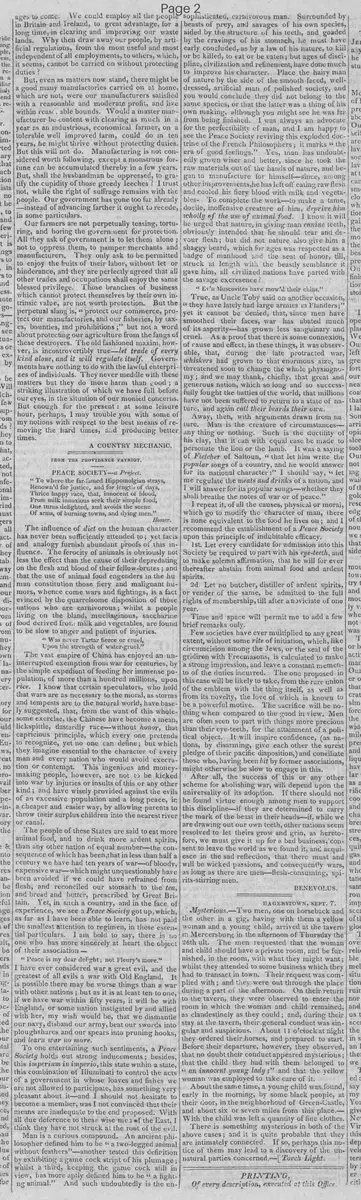
FROM THE PROVIDENCE PATRIOT.
PEACE SOCIETY—a Project.
"To where the far-famed Hippomolgian strays,
Renown'd for justice, and for length of days,
Thrice happy race, that, innocent of blood,
From milk innoxious seek their simple food,
One turns delighted, and avoids the scene
Of arms, of burning towns, and dying men."
Homer.
The influence of diet on the human character has never been sufficiently attended to; yet facts and analogy furnish abundant proofs of this influence. The ferocity of animals is obviously not less the effect than the cause of their depredating on the flesh and blood of their fellow-brutes; and that the use of animal food engenders in the human constitution those fiery and malignant humors, whence come wars and fightings, is a fact evinced by the quarrelsome disposition of those nations who are carnivorous; whilst a people living on the bland, mucilaginous, saccharine food derived from milk and vegetables, are found to be slow to anger and patient of injuries.
"Was never Tartar fierce or cruel,
Upon the strength of water-gruel."
The vast empire of China has enjoyed an uninterrupted exemption from war for centuries, by the simple expedient of feeding her immense population, of more than a hundred millions, upon rice. I know that certain speculators, who hold that wars are as necessary to the moral, as storms and tempests are to the natural world, have basely suggested, that, from the want of this wholesome exercise, the Chinese have become a mean, lickspittle, dastardly race—without honor, that capricious principle, which every one pretends to recognize, yet no one can define; but which they imagine essential to the character of every man and every nation who would avoid execration or contempt. This ingenious and money-making people, however, are not to be kicked into war by injuries or insults of this or any other kind; and have wisely provided against the evils of an excessive population and a long peace, in a cheaper and easier way, by allowing parents to throw their surplus children into the nearest river or canal.
The people of these States are said to eat more animal food, and to drink more ardent spirits, than any other nation of equal number the consequence of which has been, that in less than half a century we have had ten years of war—of bloody, expensive war—which might unquestionably have been avoided if we could have refrained from flesh, and reconciled our stomach to the tea, and bread and butter, prescribed by Great Britain. Yet, in such a country, and in the face of experience, we see a Peace Society got up, which, as far as I have been able to learn, has not paid the smallest attention to regimen, in these essential particulars. I am bold to say, there is no one who has more sincerely at heart the object of their association—
"Peace is my dear delight; not Fleury's more."
I have ever considered war a great evil, and the greatest of all evils a war with Old England. It is possible there may be worse things than a war with other nations; but as it is at least ten to one, if we have war within fifty years, it will be with England, or some nation instigated by and allied with her, my wish would be, that we dismantle our navy, disband our army, beat our swords into ploughshares and our spears into pruning hooks, and learn war no more.
To one entertaining such sentiments, a Peace Society holds out strong inducements; besides, this imperium in imperio, this state within a state, this combination of Illuminati to control the acts of a government in whose loaves and fishes we are not allowed to participate, has something very pleasant about it—and I should not hesitate to become a member, was I not convinced that their means are inadequate to the end proposed. With all due deference to these wise men of the East, I think they have not struck at the root of the evil.
Man is a curious compound. An ancient philosopher defined him to be "a two-legged animal without feathers"—another tested this definition by exhibiting a game cock stripped of his plumage; whilst a third, keeping the game cock still in view, has more aptly defined him to be "a fighting animal." And such undoubtedly is the unsophisticated, carnivorous man. Surrounded by beasts of prey, and savages of his own species, aided by the structure of his teeth, and goaded by the cravings of his stomach, he must have early concluded, as by a law of his nature, to kill or be killed, to eat or be eaten; but ages of discipline, civilization and refinement, have done much to improve his character. Place the hairy man of nature by the side of the smooth-faced, well-dressed, artificial man of polished society, and you would conclude they did not belong to the same species, or that the latter was a thing of his own making, although you might see he was far from being finished. I was always an advocate for the perfectibility of man, and I am happy to see the Peace Society reviving this exploded doctrine of the French Philosophers; it marks "the era of good feelings." Yes, man has undoubtedly grown wiser and better, since he took the raw materials out of the hands of nature, and began to manufacture for himself—since, among other improvements, he has left off eating raw flesh and cooled his fiery blood with milk and vegetables— To complete the work—to make a tame, docile, inoffensive creature of him, deprive him wholly of the use of animal food. I know it will be urged that nature, in giving man canine teeth, obviously intended that he should tear and devour flesh; but did not nature also give him a shaggy beard, which for ages was respected as a badge of manhood and the seat of honor, till, struck at length with the beastly semblance it gave him, all civilized nations have parted with the savage excrescence?
"Ev'n Muscovites have mow'd their chins."
True, as Uncle Toby said on another occasion, "they have lately had large armies in Flanders;" yet it cannot be denied, that, since men have smoothed their faces, war has abated much of its asperity—has grown less sanguinary and cruel. As a proof that there is some connexion, of cause and effect, in these things, it was observable, that, during the late protracted war, whiskers had grown to that enormous size, as threatened soon to change the whole physiognomy; and we may thank, chiefly, that great and generous nation, which so long and so successfully fought the battles of the world, that millions have not been suffered to return to a state of nature, and again call their beards their own.
Away, then, with arguments drawn from nature. Man is the creature of circumstances—any thing or nothing. Such is the ductility of his clay, that it can with equal ease be made to personate the lion or the lamb. It was a saying of Fletcher of Saltoun, "that let him write the popular songs of a country, and he would answer for its national character:" I should say, "let me regulate the meats and drinks of a nation, and I will answer for its popular songs—whether they shall breathe the notes of war or of peace."
I repeat it, of all the causes, physical or moral, which go to modify the character of man, there is none equivalent to the food he lives on; and I recommend the establishment of a Peace Society upon this principle of indubitable efficacy.
1st. Let every candidate for admission into this Society be required to part with his eye-teeth, and to make solemn affirmation, that he will for ever thereafter abstain from animal food and ardent spirits.
2d. Let no butcher, distiller of ardent spirits, or vender of the same, be admitted to the full rights of membership, till after a noviciate of one year.
Time and space will permit me to add a few brief remarks only.
Few societies have ever multiplied to any great extent, without some rite of initiation, which, like circumcision among the Jews, or the seal of the gridiron with Freemasons, is calculated to make a strong impression, and leave a constant memento of the duties incurred. The one proposed in this case will be likely to take, from the rare union of the emblem with the thing itself, as well as from its novelty, the love of which is known to be a powerful motive. The sacrifice will be nothing when compared to the good in view. Men are often seen to part with things more precious than their eye-teeth, for the attainment of a political object. It will inspire confidence, (as nations, by disarming, give each other the surest pledge of their pacific disposition,) and conciliate those who, having been bit by former associations, might otherwise be slow to engage in this.
After all, the success of this or any other scheme for abolishing war, will depend upon the universality of its adoption. If there should not be found virtue enough among men to support this discipline—if they are determined to carry the mark of the beast in their heads—if, while we are drawing out our own teeth, other nations seem resolved to let theirs grow and grin, as heretofore, we must give it up for a bad business, 'consent to leave the world as we found it, and acquiesce in the sad reflection, that there must and will be wicked passions, and consequently wars, as long as there are men—flesh-consuming, spirits-stirring men.
BENEVOLUS.
PEACE SOCIETY—a Project.
"To where the far-famed Hippomolgian strays,
Renown'd for justice, and for length of days,
Thrice happy race, that, innocent of blood,
From milk innoxious seek their simple food,
One turns delighted, and avoids the scene
Of arms, of burning towns, and dying men."
Homer.
The influence of diet on the human character has never been sufficiently attended to; yet facts and analogy furnish abundant proofs of this influence. The ferocity of animals is obviously not less the effect than the cause of their depredating on the flesh and blood of their fellow-brutes; and that the use of animal food engenders in the human constitution those fiery and malignant humors, whence come wars and fightings, is a fact evinced by the quarrelsome disposition of those nations who are carnivorous; whilst a people living on the bland, mucilaginous, saccharine food derived from milk and vegetables, are found to be slow to anger and patient of injuries.
"Was never Tartar fierce or cruel,
Upon the strength of water-gruel."
The vast empire of China has enjoyed an uninterrupted exemption from war for centuries, by the simple expedient of feeding her immense population, of more than a hundred millions, upon rice. I know that certain speculators, who hold that wars are as necessary to the moral, as storms and tempests are to the natural world, have basely suggested, that, from the want of this wholesome exercise, the Chinese have become a mean, lickspittle, dastardly race—without honor, that capricious principle, which every one pretends to recognize, yet no one can define; but which they imagine essential to the character of every man and every nation who would avoid execration or contempt. This ingenious and money-making people, however, are not to be kicked into war by injuries or insults of this or any other kind; and have wisely provided against the evils of an excessive population and a long peace, in a cheaper and easier way, by allowing parents to throw their surplus children into the nearest river or canal.
The people of these States are said to eat more animal food, and to drink more ardent spirits, than any other nation of equal number the consequence of which has been, that in less than half a century we have had ten years of war—of bloody, expensive war—which might unquestionably have been avoided if we could have refrained from flesh, and reconciled our stomach to the tea, and bread and butter, prescribed by Great Britain. Yet, in such a country, and in the face of experience, we see a Peace Society got up, which, as far as I have been able to learn, has not paid the smallest attention to regimen, in these essential particulars. I am bold to say, there is no one who has more sincerely at heart the object of their association—
"Peace is my dear delight; not Fleury's more."
I have ever considered war a great evil, and the greatest of all evils a war with Old England. It is possible there may be worse things than a war with other nations; but as it is at least ten to one, if we have war within fifty years, it will be with England, or some nation instigated by and allied with her, my wish would be, that we dismantle our navy, disband our army, beat our swords into ploughshares and our spears into pruning hooks, and learn war no more.
To one entertaining such sentiments, a Peace Society holds out strong inducements; besides, this imperium in imperio, this state within a state, this combination of Illuminati to control the acts of a government in whose loaves and fishes we are not allowed to participate, has something very pleasant about it—and I should not hesitate to become a member, was I not convinced that their means are inadequate to the end proposed. With all due deference to these wise men of the East, I think they have not struck at the root of the evil.
Man is a curious compound. An ancient philosopher defined him to be "a two-legged animal without feathers"—another tested this definition by exhibiting a game cock stripped of his plumage; whilst a third, keeping the game cock still in view, has more aptly defined him to be "a fighting animal." And such undoubtedly is the unsophisticated, carnivorous man. Surrounded by beasts of prey, and savages of his own species, aided by the structure of his teeth, and goaded by the cravings of his stomach, he must have early concluded, as by a law of his nature, to kill or be killed, to eat or be eaten; but ages of discipline, civilization and refinement, have done much to improve his character. Place the hairy man of nature by the side of the smooth-faced, well-dressed, artificial man of polished society, and you would conclude they did not belong to the same species, or that the latter was a thing of his own making, although you might see he was far from being finished. I was always an advocate for the perfectibility of man, and I am happy to see the Peace Society reviving this exploded doctrine of the French Philosophers; it marks "the era of good feelings." Yes, man has undoubtedly grown wiser and better, since he took the raw materials out of the hands of nature, and began to manufacture for himself—since, among other improvements, he has left off eating raw flesh and cooled his fiery blood with milk and vegetables— To complete the work—to make a tame, docile, inoffensive creature of him, deprive him wholly of the use of animal food. I know it will be urged that nature, in giving man canine teeth, obviously intended that he should tear and devour flesh; but did not nature also give him a shaggy beard, which for ages was respected as a badge of manhood and the seat of honor, till, struck at length with the beastly semblance it gave him, all civilized nations have parted with the savage excrescence?
"Ev'n Muscovites have mow'd their chins."
True, as Uncle Toby said on another occasion, "they have lately had large armies in Flanders;" yet it cannot be denied, that, since men have smoothed their faces, war has abated much of its asperity—has grown less sanguinary and cruel. As a proof that there is some connexion, of cause and effect, in these things, it was observable, that, during the late protracted war, whiskers had grown to that enormous size, as threatened soon to change the whole physiognomy; and we may thank, chiefly, that great and generous nation, which so long and so successfully fought the battles of the world, that millions have not been suffered to return to a state of nature, and again call their beards their own.
Away, then, with arguments drawn from nature. Man is the creature of circumstances—any thing or nothing. Such is the ductility of his clay, that it can with equal ease be made to personate the lion or the lamb. It was a saying of Fletcher of Saltoun, "that let him write the popular songs of a country, and he would answer for its national character:" I should say, "let me regulate the meats and drinks of a nation, and I will answer for its popular songs—whether they shall breathe the notes of war or of peace."
I repeat it, of all the causes, physical or moral, which go to modify the character of man, there is none equivalent to the food he lives on; and I recommend the establishment of a Peace Society upon this principle of indubitable efficacy.
1st. Let every candidate for admission into this Society be required to part with his eye-teeth, and to make solemn affirmation, that he will for ever thereafter abstain from animal food and ardent spirits.
2d. Let no butcher, distiller of ardent spirits, or vender of the same, be admitted to the full rights of membership, till after a noviciate of one year.
Time and space will permit me to add a few brief remarks only.
Few societies have ever multiplied to any great extent, without some rite of initiation, which, like circumcision among the Jews, or the seal of the gridiron with Freemasons, is calculated to make a strong impression, and leave a constant memento of the duties incurred. The one proposed in this case will be likely to take, from the rare union of the emblem with the thing itself, as well as from its novelty, the love of which is known to be a powerful motive. The sacrifice will be nothing when compared to the good in view. Men are often seen to part with things more precious than their eye-teeth, for the attainment of a political object. It will inspire confidence, (as nations, by disarming, give each other the surest pledge of their pacific disposition,) and conciliate those who, having been bit by former associations, might otherwise be slow to engage in this.
After all, the success of this or any other scheme for abolishing war, will depend upon the universality of its adoption. If there should not be found virtue enough among men to support this discipline—if they are determined to carry the mark of the beast in their heads—if, while we are drawing out our own teeth, other nations seem resolved to let theirs grow and grin, as heretofore, we must give it up for a bad business, 'consent to leave the world as we found it, and acquiesce in the sad reflection, that there must and will be wicked passions, and consequently wars, as long as there are men—flesh-consuming, spirits-stirring men.
BENEVOLUS.
What sub-type of article is it?
War Or Peace
Social Reform
Moral Or Religious
What keywords are associated?
Peace Society
Diet And War
Vegetarianism
Temperance
National Character
Anti War
Carnivorous Aggression
What entities or persons were involved?
Peace Society
Chinese People
Americans
Great Britain
Homer
Editorial Details
Primary Topic
Proposal For A Peace Society Based On Dietary Reform
Stance / Tone
Satirical Advocacy For Peace Through Vegetarianism And Temperance
Key Figures
Peace Society
Chinese People
Americans
Great Britain
Homer
Key Arguments
Diet Influences Human Character And Propensity For War
Animal Food Engenders Aggression And Wars
Vegetable And Milk Based Diets Promote Peacefulness
China's Rice Diet Has Prevented Wars For Centuries
American Consumption Of Meat And Spirits Led To Recent Wars
Peace Society Should Require Abstinence From Animal Food And Spirits
Rite Of Removing Eye Teeth As Initiation For Commitment
Civilization Improves Man, Including Abandoning Raw Flesh And Beards