Thank you for visiting SNEWPapers!
Sign up free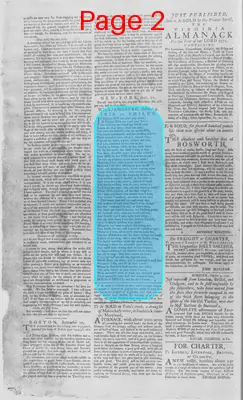
Poem
October 4, 1770
The Virginia Gazette
Williamsburg, Virginia
What is this article about?
A heartbroken Iris writes to her unfaithful lover Philus, lamenting their past tender love, his betrayal with another, and her impending death, using garden imagery and turtle doves as symbols of lost fidelity. Set in Williamsburg on October 4.
Clipping
OCR Quality
98%
Excellent
Full Text
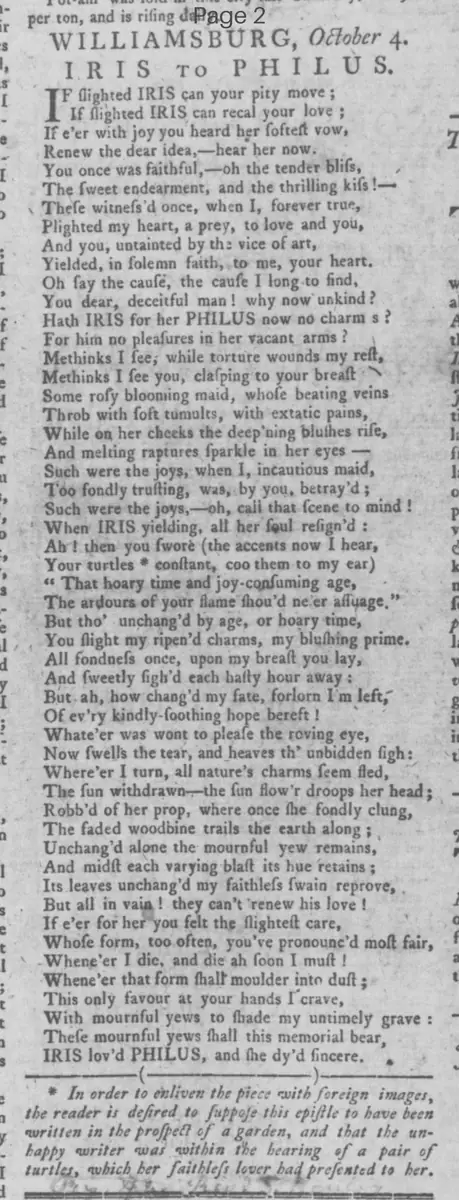
WILLIAMSBURG, October 4.
IRIS TO PHILUS.
If slighted IRIS can your pity move;
If slighted IRIS can recall your love;
If e'er with joy you heard her softest vow,
Renew the dear idea,—hear her now.
You once was faithful,—oh the tender bliss,
The sweet endearment, and the thrilling kiss!
Thee witness'd once, when I, forever true,
Plighted my heart, a prey, to love and you,
And you, untainted by the vice of art,
Yielded, in solemn faith, to me, your heart.
Oh say the cause, the cause I long to find,
You dear, deceitful man! why now unkind?
Hath IRIS for her PHILUS now no charms?
For him no pleasures in her vacant arms?
Methinks I see; while torture wounds my breast,
Methinks I see you, clasping to your breast
Some rosy-blooming maid, whose beating veins
Throb with soft tumults, with ecstatic pains,
While on her cheeks the deepening blushes rise,
And melting raptures sparkle in her eyes—
Such were the joys, when I, incautious maid,
Too fondly trusting, was, by you, betray'd;
Such were the joys,—oh, call that scene to mind!
When IRIS yielding, all her soul resign'd:
Ah! then you swore (the accents now I hear,
Your turtle's constant, coo them to my ear)
"That hoary time and joy-consuming age,
The ardours of your flame shou'd ne'er assuage."
But tho' unchang'd by age, or hoary time,
You slight my ripen'd charms, my blushing prime.
All fondness once, upon my breast you lay,
And sweetly sigh'd each lazy hour away:
But. ah, how chang'd my fate, forlorn I'm left,
Of ev'ry kindly-soothing hope bereft!
Whate'er was wont to please the roving eye,
Now wells the tear, and heaves th' unbidden sigh:
Where'er I turn, all nature's charms seem fled,
The sun withdraws; the sun flow'r droops her head;
Robb'd of her prop, where once she fondly clung,
The faded woodbine trails the earth along;
Unchang'd alone the mournful yew remains,
And midst each varying blast its hue retains:
Its leaves unchang'd my faithless swain reprove,
But all in vain! they can't renew his love!
If e'er for her you felt the slightest care,
Whose form, too often, you've pronounc'd most fair,
Whene'er I die, and die ah soon I must!
Whene'er that form shall moulder into dust;
This only favour at your hands I crave,
With mournful yews to shade my untimely grave:
These mournful yews shall this memorial bear,
IRIS lov'd PHILUS, and she dy'd sincere.
* In order to enliven the piece with foreign images, the reader is desired to suppose this epistle to have been written in the prospect of a garden, and that the unhappy writer was within the hearing of a pair of turtles, which her faithless lover had presented to her.
IRIS TO PHILUS.
If slighted IRIS can your pity move;
If slighted IRIS can recall your love;
If e'er with joy you heard her softest vow,
Renew the dear idea,—hear her now.
You once was faithful,—oh the tender bliss,
The sweet endearment, and the thrilling kiss!
Thee witness'd once, when I, forever true,
Plighted my heart, a prey, to love and you,
And you, untainted by the vice of art,
Yielded, in solemn faith, to me, your heart.
Oh say the cause, the cause I long to find,
You dear, deceitful man! why now unkind?
Hath IRIS for her PHILUS now no charms?
For him no pleasures in her vacant arms?
Methinks I see; while torture wounds my breast,
Methinks I see you, clasping to your breast
Some rosy-blooming maid, whose beating veins
Throb with soft tumults, with ecstatic pains,
While on her cheeks the deepening blushes rise,
And melting raptures sparkle in her eyes—
Such were the joys, when I, incautious maid,
Too fondly trusting, was, by you, betray'd;
Such were the joys,—oh, call that scene to mind!
When IRIS yielding, all her soul resign'd:
Ah! then you swore (the accents now I hear,
Your turtle's constant, coo them to my ear)
"That hoary time and joy-consuming age,
The ardours of your flame shou'd ne'er assuage."
But tho' unchang'd by age, or hoary time,
You slight my ripen'd charms, my blushing prime.
All fondness once, upon my breast you lay,
And sweetly sigh'd each lazy hour away:
But. ah, how chang'd my fate, forlorn I'm left,
Of ev'ry kindly-soothing hope bereft!
Whate'er was wont to please the roving eye,
Now wells the tear, and heaves th' unbidden sigh:
Where'er I turn, all nature's charms seem fled,
The sun withdraws; the sun flow'r droops her head;
Robb'd of her prop, where once she fondly clung,
The faded woodbine trails the earth along;
Unchang'd alone the mournful yew remains,
And midst each varying blast its hue retains:
Its leaves unchang'd my faithless swain reprove,
But all in vain! they can't renew his love!
If e'er for her you felt the slightest care,
Whose form, too often, you've pronounc'd most fair,
Whene'er I die, and die ah soon I must!
Whene'er that form shall moulder into dust;
This only favour at your hands I crave,
With mournful yews to shade my untimely grave:
These mournful yews shall this memorial bear,
IRIS lov'd PHILUS, and she dy'd sincere.
* In order to enliven the piece with foreign images, the reader is desired to suppose this epistle to have been written in the prospect of a garden, and that the unhappy writer was within the hearing of a pair of turtles, which her faithless lover had presented to her.
What sub-type of article is it?
Verse Letter
What themes does it cover?
Love Courtship
Death Mourning
What keywords are associated?
Iris To Philus
Lost Love
Betrayal
Romantic Lament
Turtle Doves
Mourful Yew
Williamsburg Epistle
Poem Details
Title
Iris To Philus.
Subject
Epistle From Iris To Philus On Lost Love And Betrayal
Form / Style
Rhymed Couplets
Key Lines
If Slighted Iris Can Your Pity Move;
If Slighted Iris Can Recall Your Love;
You Once Was Faithful,—Oh The Tender Bliss,
The Sweet Endearment, And The Thrilling Kiss!
Such Were The Joys, When I, Incautious Maid,
Too Fondly Trusting, Was, By You, Betray'd;
Iris Lov'd Philus, And She Dy'd Sincere.