Thank you for visiting SNEWPapers!
Sign up free
Editorial
June 6, 1812
Alexandria Daily Gazette, Commercial & Political
Alexandria, Virginia
What is this article about?
Editorial by Senex warns Americans against impending war with England and conquest of Canada, arguing it threatens the republic's union through standing armies, taxes, executive power growth, North-South differences, and foreign alliances, citing Montesquieu.
Clipping
OCR Quality
95%
Excellent
Full Text
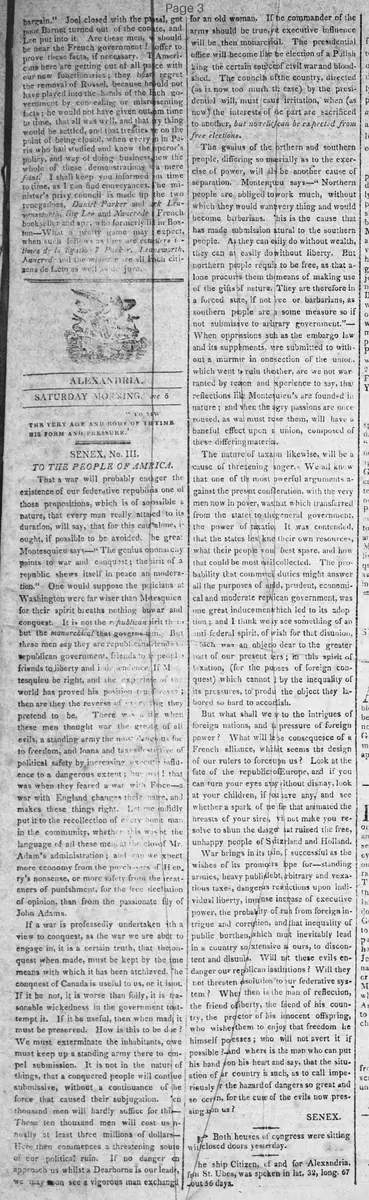
SENEX. No. III.
TO THE PEOPLE OF AMERICA.
That a war will probably endanger the existence of our federative republic is one of those propositions, which is of so serious a nature, that every man really attached to its duration, will say, that for this cause alone, it ought, if possible to be avoided. The great Montesquieu says-- "The genius of monarchy points to war and conquest; the spirit of a republic shews itself in peace and moderation." One would suppose the politicians at Washington were far wiser than Montesquieu or their spirit breathes nothing but war and conquest. It is not the republican spirit that is but the monarchical that governs them. But these men say they are republicans friends to republican government. friends to the people friends to liberty and independence. if Montesquieu be right, and the experience of the world has proved his position true forever ; then are they the reverse of everything they pretend to be. There was a time when these men thought war the greatest of all evils, a standing army the most dangerous foe to freedom, and loans and taxes destructive of political safety by increasing executive influence to a dangerous extent; but hum! that was when they feared a war with France--a war with England changes their nature, and makes these things right. Let me candidly put it to the recollection of every honest man in the community, whether this was not the language of all these men at the close of Mr. Adam's administration; and can we expect more economy from the purchasers of Henry 's nonsense, or more safety from the greateners of punishment, for the free declamation of opinion, than from the passionate fly of John Adams.
If a war is professedly undertaken with a view to conquest, as the war we are about to engage in, it is a certain truth, that the conquest when made, must be kept by the same means with which it has been atchieved. The conquest of Canada is useful to us, or it is not. If it be not, it is worse than folly, it is treasonable wickedness in the government to attempt it. If it be useful, then when made it must be preserved. How is this to be done? We must exterminate the inhabitants, or we must keep up a standing army there to compel submission. It is not in the nature of things, that a conquered people will continue submissive, without a continuance of the force that caused their subjugation. Ten thousand men will hardly suffice for this. These ten thousand men will cost us annually at least three millions of dollars-- Here then commences a threatening source of our political ruin. If no danger can approach us whilst a Dearborne is our leader, we may soon see a vigorous man exchanged or an old woman. If the commander of the army should be truly executive influence will be then monarchical. The presidential office will become like the election of a Polish king the certain source of civil war and bloodshed. The councils of the country, directed (as is now too much the case) by the presidential will, must cause irritation, when (as now) the interests of one part are sacrificed to another, but no relief can be expected from free elections.
The genius of the northern and southern people, differing so materially as to the exercise of power, will also be another cause of separation." Montesquieu says- "Northern people are obliged to work much, without which they would want everything and would become barbarians. This is the cause that has made submission natural to the southern people. As they can easily do without wealth, they can as easily do without liberty. But northern people require to be free, as that alone procures them the means of making use of the gifts of nature. They are therefore in a forced state, if not free or barbarians, as southern people are in some measure so if not submissive to arbitrary government."
When oppressions such as the embargo law and its supplements. were submitted to without a murmur in one section of the union. which went to ruin the other, are we not warranted by reason and experience to say, that reflections like Montesquieu's are founded in nature; and when the angry passions are once roused, as war must rouse them, will have a baneful effect upon a union, composed of these differing materials.
The nature of taxation likewise, will be a cause of threatening anger. We all know that one of the most powerful arguments against the present confederation, with the very men now in power, was that which transferred from the states to the general government, the power of taxation. It was contended. that the states best knew their own resources, what their people could best spare, and how that could be most easily collected. The probability that commerce duties might answer all the purposes of a mild, prudent, economical and moderate republican government, was one great inducement which led to its adoption ; and I think we shall see something of an anti federal spirit, of wish for that disunion, which was an object dear to the greater part of our present leaders; in this spirit of taxation, (for the purposes of foreign conquest) which cannot by the inequality of its pressures, to produce the object they laboured so hard to accomplish.
But what shall we say to the intrigues of foreign nations, and the pressure of foreign power? What will be the consequence of a French alliance, which it seems the design of our rulers to force upon us? Look at the fate of the republics of Europe, and if you can turn your eyes away without dismay, look at your children, if you have any, and see whether a spark of the fire that animated the breasts of your sires, will not make you resolve to shun the danger that ruined the free, unhappy people of Switzerland and Holland.
War brings in its train, if successful as the wishes of its promoters hope for-standing armies, heavy public debt, arbitrary and vexatious taxes, dangerous restrictions upon individual liberty, immense increase of executive power, the probability of ruin from foreign intrigue and corruption, and that inequality of public burthen, which must inevitably lead in a country so extensive as ours, to discontent and disunion. Will not these evils endanger our republican institutions? Will they not threaten dissolution to our federative system ? When then is the man of reflection, the friend of liberty, the friend of his country, the protector of his innocent offspring, who wishes them to enjoy that freedom he himself possesses; who will not avert it if possible ? and where is the man who can put his hand upon his heart and say, that the situation of our country is such, as to call imperiously for the hazard of dangers so great and so certain, for the cure of the evils now pressing upon us ?
SENEX.
TO THE PEOPLE OF AMERICA.
That a war will probably endanger the existence of our federative republic is one of those propositions, which is of so serious a nature, that every man really attached to its duration, will say, that for this cause alone, it ought, if possible to be avoided. The great Montesquieu says-- "The genius of monarchy points to war and conquest; the spirit of a republic shews itself in peace and moderation." One would suppose the politicians at Washington were far wiser than Montesquieu or their spirit breathes nothing but war and conquest. It is not the republican spirit that is but the monarchical that governs them. But these men say they are republicans friends to republican government. friends to the people friends to liberty and independence. if Montesquieu be right, and the experience of the world has proved his position true forever ; then are they the reverse of everything they pretend to be. There was a time when these men thought war the greatest of all evils, a standing army the most dangerous foe to freedom, and loans and taxes destructive of political safety by increasing executive influence to a dangerous extent; but hum! that was when they feared a war with France--a war with England changes their nature, and makes these things right. Let me candidly put it to the recollection of every honest man in the community, whether this was not the language of all these men at the close of Mr. Adam's administration; and can we expect more economy from the purchasers of Henry 's nonsense, or more safety from the greateners of punishment, for the free declamation of opinion, than from the passionate fly of John Adams.
If a war is professedly undertaken with a view to conquest, as the war we are about to engage in, it is a certain truth, that the conquest when made, must be kept by the same means with which it has been atchieved. The conquest of Canada is useful to us, or it is not. If it be not, it is worse than folly, it is treasonable wickedness in the government to attempt it. If it be useful, then when made it must be preserved. How is this to be done? We must exterminate the inhabitants, or we must keep up a standing army there to compel submission. It is not in the nature of things, that a conquered people will continue submissive, without a continuance of the force that caused their subjugation. Ten thousand men will hardly suffice for this. These ten thousand men will cost us annually at least three millions of dollars-- Here then commences a threatening source of our political ruin. If no danger can approach us whilst a Dearborne is our leader, we may soon see a vigorous man exchanged or an old woman. If the commander of the army should be truly executive influence will be then monarchical. The presidential office will become like the election of a Polish king the certain source of civil war and bloodshed. The councils of the country, directed (as is now too much the case) by the presidential will, must cause irritation, when (as now) the interests of one part are sacrificed to another, but no relief can be expected from free elections.
The genius of the northern and southern people, differing so materially as to the exercise of power, will also be another cause of separation." Montesquieu says- "Northern people are obliged to work much, without which they would want everything and would become barbarians. This is the cause that has made submission natural to the southern people. As they can easily do without wealth, they can as easily do without liberty. But northern people require to be free, as that alone procures them the means of making use of the gifts of nature. They are therefore in a forced state, if not free or barbarians, as southern people are in some measure so if not submissive to arbitrary government."
When oppressions such as the embargo law and its supplements. were submitted to without a murmur in one section of the union. which went to ruin the other, are we not warranted by reason and experience to say, that reflections like Montesquieu's are founded in nature; and when the angry passions are once roused, as war must rouse them, will have a baneful effect upon a union, composed of these differing materials.
The nature of taxation likewise, will be a cause of threatening anger. We all know that one of the most powerful arguments against the present confederation, with the very men now in power, was that which transferred from the states to the general government, the power of taxation. It was contended. that the states best knew their own resources, what their people could best spare, and how that could be most easily collected. The probability that commerce duties might answer all the purposes of a mild, prudent, economical and moderate republican government, was one great inducement which led to its adoption ; and I think we shall see something of an anti federal spirit, of wish for that disunion, which was an object dear to the greater part of our present leaders; in this spirit of taxation, (for the purposes of foreign conquest) which cannot by the inequality of its pressures, to produce the object they laboured so hard to accomplish.
But what shall we say to the intrigues of foreign nations, and the pressure of foreign power? What will be the consequence of a French alliance, which it seems the design of our rulers to force upon us? Look at the fate of the republics of Europe, and if you can turn your eyes away without dismay, look at your children, if you have any, and see whether a spark of the fire that animated the breasts of your sires, will not make you resolve to shun the danger that ruined the free, unhappy people of Switzerland and Holland.
War brings in its train, if successful as the wishes of its promoters hope for-standing armies, heavy public debt, arbitrary and vexatious taxes, dangerous restrictions upon individual liberty, immense increase of executive power, the probability of ruin from foreign intrigue and corruption, and that inequality of public burthen, which must inevitably lead in a country so extensive as ours, to discontent and disunion. Will not these evils endanger our republican institutions? Will they not threaten dissolution to our federative system ? When then is the man of reflection, the friend of liberty, the friend of his country, the protector of his innocent offspring, who wishes them to enjoy that freedom he himself possesses; who will not avert it if possible ? and where is the man who can put his hand upon his heart and say, that the situation of our country is such, as to call imperiously for the hazard of dangers so great and so certain, for the cure of the evils now pressing upon us ?
SENEX.
What sub-type of article is it?
War Or Peace
Constitutional
Foreign Affairs
What keywords are associated?
War Dangers
Republican Spirit
Conquest Canada
Standing Army
Disunion
Montesquieu
Taxation
Foreign Alliance
What entities or persons were involved?
Montesquieu
Politicians At Washington
John Adams
Henry
Dearborne
French
English
Editorial Details
Primary Topic
Dangers Of War And Conquest To The American Republic
Stance / Tone
Strongly Anti War And Cautionary Against Disunion
Key Figures
Montesquieu
Politicians At Washington
John Adams
Henry
Dearborne
French
English
Key Arguments
War Endangers The Federative Republic's Existence
Republics Favor Peace, Monarchies War And Conquest
Current Leaders Contradict Republican Principles By Pursuing War
Conquest Of Canada Requires Permanent Standing Army And High Taxes
North South Differences In Character Lead To Potential Separation
War Taxation Revives Anti Federal Sentiments And Disunion Desires
French Alliance Risks Foreign Intrigue And Corruption Like European Republics
War Introduces Standing Armies, Debt, Taxes, Executive Power Growth, And Disunion