Thank you for visiting SNEWPapers!
Sign up free
The Liberator
Boston, Suffolk County, Massachusetts
What is this article about?
Detailed report from the Norfolk Democrat on a chaotic quarterly meeting of the Norfolk County Anti-Slavery Society in Wrentham, Massachusetts, marked by divisions between William Lloyd Garrison supporters and opponents (mostly clergy) over issues like Sabbath observance, women's participation, non-resistance, and political action, culminating in the formation of a rival county society.
Clipping
OCR Quality
Full Text
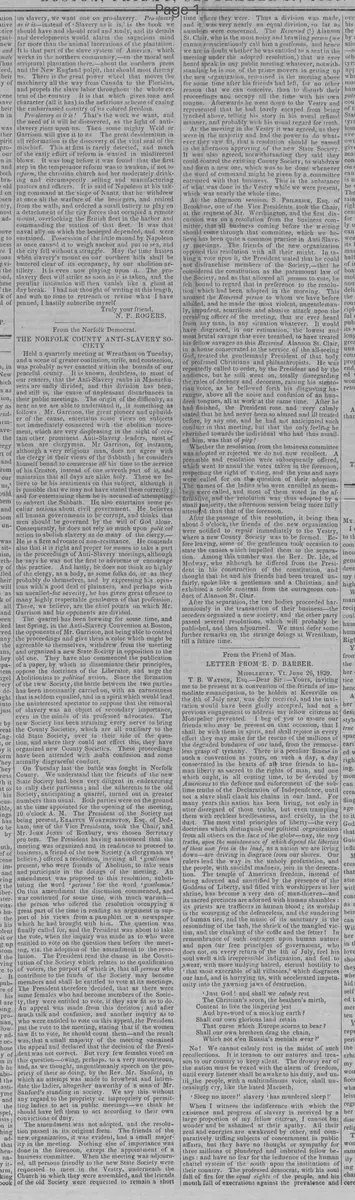
THE NORFOLK COUNTY ANTI-SLAVERY SOCIETY
Held a quarterly meeting at Wrentham on Tuesday, and a scene of greater confusion, strife, and contention, was probably never enacted within the bounds of our peaceful county. It is known, doubtless, to most of our readers, that the Anti-Slavery ranks in Massachusetts are sadly divided, and this division has been, and still is, the cause of unpleasant disturbances in their public meetings. The origin of the difficulty, as near as we are able to understand it, is something as follows. Mr. Garrison, the great pioneer and upbuilder of the cause, entertains some views on subjects not immediately connected with the abolition movement, which are very displeasing in the sight of certain other prominent Anti-Slavery leaders, most of whom are clergymen. Mr Garrison, for instance, although a very religious man, does not agree with the clergy in their views of the Sabbath; he considers himself bound to consecrate all his time to the service of his Creator, instead of one seventh part of it, and maintains that all days are alike holy. These we believe to be his sentiments on this subject, although it is possible that we may not have stated them correctly : and for entertaining them he is accused of attempting to subvert the Sabbath. He also entertains some peculiar notions about civil government. He believes all human governments to be corrupt, and thinks that men should be governed by the will of God alone Consequently, he does not rely so much upon political action to abolish slavery as do many of the clergy.— He is a firm advocate of non-resistance. He contends also that it is right and proper for women to take a part in the proceedings of Anti-Slavery meetings, although he says he was not the first to advocate or encourage this practice. And lastly, he does not think so highly of the clergy, as a body, as some folks do, or as they probably do themselves, and by expressing his opinions with a good deal of plainness, and perhaps with an uncalled-for severity, he has given great offence to many highly respectable gentlemen of that profession. These, we believe, are the chief points on which Mr. Garrison and his opponents are divided.
The quarrel has been brewing for some time, and last Spring, in the Anti-Slavery Convention at Boston, the opponents of Mr. Garrison, not being able to control the proceedings and give them a color which might be agreeable to themselves, withdrew from the meeting and organized a new State Society in opposition to the old one. They have also commenced the publication of a paper, by which to disseminate their principles, oppose the doctrines of the Liberator, and urge the Abolitionists to political action. Since the formation of the new Society, the battle between the two parties has been incessantly carried on, with an earnestness that is seldom equalled, and in a spirit which would lead the uninterested spectator to suppose that the removal of slavery was an object of secondary importance even in the minds of its professed advocates. The new Society has been straining every nerve to bring the County Societies, which are all auxiliary to the old State Society, over to their side of the question, and where they could not effect this, they have organized new County Societies. These proceedings have been attended with much confusion and some actually disgraceful conduct.
On Tuesday last the battle was fought in Norfolk County. We understand that the friends of the new State Society had been very diligent in endeavoring to rally their partisans; and the adherents to the old Society, anticipating a quarrel, turned out in greater numbers than usual. Both parties were on the ground at the time appointed for the opening of the meeting, 10 o'clock A. M. The President of the Society not being present, Erastus Worthington, Esq. of Dedham, one of the Vice Presidents, took the Chair, and Mr. John Jones of Roxbury, was chosen Secretary pro tem. The President having announced that the meeting was organized and in readiness to proceed to business, a friend of the new Society (a clergyman we believe,) offered a resolution, inviting all gentlemen' present, who were friends of Abolition, to take seats and participate in the doings of the meeting. An amendment was proposed to this resolution, substituting the word 'persons' for the word gentlemen. On this amendment the discussion commenced, and was continued for some time, with much warmth— the person who offered the resolution occupying a great part of the time in reading an argument in support of his views from a pamphlet or a newspaper which he had brought with him. The question was finally called for, and the President was about to take the vote, when the inquiry was made as to who were entitled to vote on the question then before the meeting, viz. the adoption of the amendment to the resolution. The President read the clause in the Constitution of the Society which relates to the qualification of voters, the purport of which is, that all persons who contribute to the funds of the Society may become members and shall be entitled to vote at its meetings. The President therefore decided, that as there were some females who had become members of the Society, they were entitled to vote. if they saw fit so to do. An appeal was made from this decision; and after much talk and confusion, and another inquiry as to who were entitled to vote on this appeal, the President put the vote to the meeting, stating that if the women saw fit to vote, he should count them—and the result was, that a small majority of the meeting sustained the appeal and declared that the decision of the President was not correct. But very few females voted on this question—owing, perhaps. to a very uncourteous, and, as we thought, ungentlemanly speech on the propriety of their so doing, by the Rev. Mr. Sanford, in which an attempt was made to browbeat and intimidate the ladies, altogether unworthy of a man of Mr. Sanford's standing in society. We say this without any regard to the propriety or impropriety of permitting ladies to act in public meetings—we think he should have left them to act according to their own convictions of duty.
The amendment was not adopted, and the resolution passed in its original form. The friends of the new organization, it was evident, had a small majority in the meeting. Nothing else of importance was done in the forenoon, except the appointment of a business committee. When the meeting was adjourned, all persons friendly to the new State Society were requested to meet in the Vestry, underneath the Church in which they were assembled, and the friends of the old Society were requested to remain a short time where they were. Thus a division was made and it was very nearly an equal division, so far as numbers were concerned. The Reverend (!) Alanson St. Clair, who is the most noisy and brawling person (we cannot conscientiously call him a gentleman, and hence we are in doubt whether he was entitled to a seat in the meeting under the adopted resolution,) that we ever heard speak in any public meeting whatever, notwithstanding he is one of the prime movers in getting up the new organization, remained in the meeting above for some time after his friends had left, for no other reason that we can conceive, than to disturb their proceedings and occupy all the time with his own tongue. Afterwards he went down to the Vestry and represented that he had barely escaped from being lynched above. telling his story in his usual refined manner, and probably with his usual regard for truth.
At the meeting in the Vestry it was agreed, as they were in the majority and had the power to do whatever they saw fit, that a resolution should be passed in the afternoon approving of the new State Society. It was also agreed, notwithstanding they said they could control the existing County Society, to withdraw and form a new one, which was to be done whenever the word of command might be given by a. committee entrusted with that business. This is the substance of what was done in the Vestry while we were present, which was nearly the whole time.
At the afternoon session, S. Philbrick, Esq. of Brookline, one of the Vice Presidents, took the Chair. at the request of Mr. Worthington, and the first discussion was on a resolution from the business committee, that all business coming before the meeting should come through that committee, which we believe has been quite a common practice in Anti Slavery meetings. The friends of the new organization opposed this resolution with all their might. In taking a vote upon it, the President stated that he could not disfranchise members of the Society,—that he considered the constitution as the paramount law of the Society. and as that allowed all persons to vote, he felt bound to regard that in preference to the resolution which had been, adopted in the morning. This aroused the Reverend person to whom we have before alluded, and he made the most violent, ungentlemanly, impudent, scurrilous and abusive attack upon the presiding officer of the meeting, that we ever heard from any man, in any situation whatever. It would have disgraced, in our estimation, the lowest and most brutal savage that ever breathed, to have treated his fellow savages as this Reverend Alanson St. Clair, in a house consecrated to the service of the all-seeing God, treated the gentlemanly President of that body of professed Christians and philanthropists. He was repeatedly called to order, by the President and by the audience. but he still went on, totally disregarding the rules of decency and decorum, raising his stentorian voice, as he bellowed forth his disgusting harangue, above all the noise and confusion of an hundred tongues, all at work at the same time. After he had finished, the President rose and very calmly stated that he had never been so abused and ill treated before, by any one, and he had not anticipated such conduct in that meeting, but that the only feeling he cherished towards the individual who had thus assailed him, was that of pity!
Whether the resolution from the business committee was adopted or rejected we do not now recollect. A preamble and resolution were subsequently offered, which went to annul the votes taken in the forenoon, respecting the right of voting, and the yeas and nays were called for on the question of their adoption. The names of the ladies who were enrolled as members were called, and most of them voted in the affirmative, and the resolution was thus adopted by a small majority, the afternoon session being more fully attended than that of the forenoon.
After the passage of this resolution, it being then about 5 o'clock, the friends of the new organization were notified to repair immediately to the Vestry, where a new County Society was to be formed. Before leaving, some of the gentlemen took occasion to state the causes which impelled them to the separation. Among this number was the Rev. Dr. Ide, of Medway, who although he differed from the President in his construction of the constitution, and thought that he and his friends had been treated unfairly, spoke like a gentleman and a Christian. and exhibited a noble contrast from the outrageous conduct of Alanson St. Clair.
After the separation, the two bodies proceeded harmoniously in the transaction of their business-the seceders organized a new society, and the other party passed several resolutions, which will probably be published, and then adjourned. We must defer some further remarks on the strange doings at Wrentham, till a future time.
What sub-type of article is it?
What themes does it cover?
What keywords are associated?
What entities or persons were involved?
Where did it happen?
Story Details
Key Persons
Location
Wrentham, Norfolk County, Massachusetts
Event Date
Tuesday Last
Story Details
Chaotic anti-slavery society meeting descends into strife over Garrison's views on Sabbath, government, non-resistance, women's roles, and clergy; debates on voting rights lead to split and formation of new county society.